Arriving in midsummer of 77, Agricola finds …
Years: 77 - 77
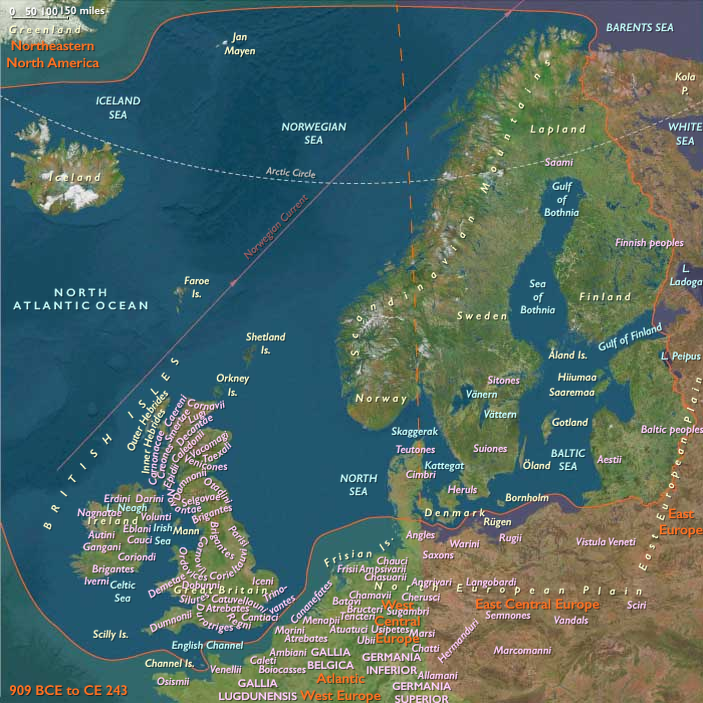
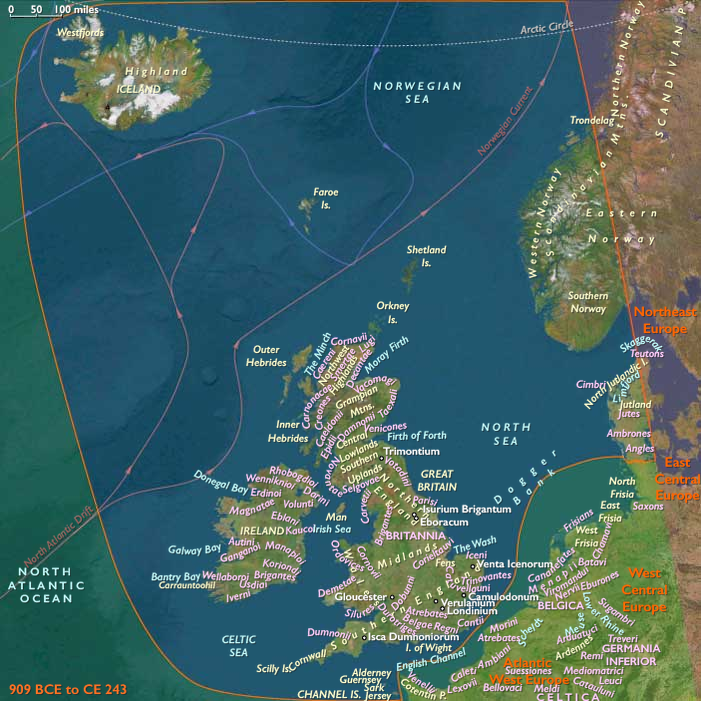
Arriving in midsummer of 77, Agricola finds that the Ordovices of north Wales have virtually destroyed the Roman cavalry stationed in their territory.
He immediately moves against them and defeats them.
He then moves north to the island of Mona (Anglesey), which had previously been reduced by Suetonius Paulinus in 61 but must have been regained by the Britons in the meantime, and forces its inhabitants to sue for peace.
Locations
People
Groups
Topics
- Classical antiquity
- Roman colonization
- Pre-Roman Iron Age of Northern Europe
- Roman Age Optimum
- Pax Romana
- Roman Conquest of Britain
Commodoties
Subjects
Regions
Subregions
Related Events
Filter results
Showing 10 events out of 61526 total
Gaius Plinius Secundus, called Pliny the Elder, writes the monumental Historia naturalis, the earliest truly encyclopedic work, published in 77 as a series of anthologies concerned with such scientific and technical topics as anthropology, botany, cosmography, metallurgy, psychology, pharmacology, and zoology.
Gnaeus Julius Agricola, a general who had begun his career in Roman public life as a military tribune, serving in Britain under Gaius Suetonius Paulinus from 58 to 62, is Frontinus’ replacement as governor of Britannica in 78.
He was probably attached to the Legio II Augusta, but had been chosen to serve on Suetonius's staff and thus almost certainly had participated in the suppression of Boudica's uprising in 61.
Returning from Britain to Rome in 62, he had married Domitia Decidiana, a woman of noble birth.
Their first child was a son.
Agricola was appointed to the quaestorship for 64, which he served in the province of Asia under the corrupt proconsul Salvius Titianus.
While he was there his daughter, Julia Agricola, was born, but his son died shortly afterwards.
He was tribune of the plebs in 66 and praetor in 68, during which time he was ordered by Galba to take an inventory of the temple treasures.
In June 68, when the emperor Nero was deposed and committed suicide, and the period of civil war known as the Year of the Four Emperors began, Galba had succeeded Nero, but was murdered in early 69 by Otho, who took the throne.
Agricola's mother was murdered on her estate in Liguria by Otho's marauding fleet.
Hearing of Vespasian's bid for the empire, Agricola had immediately given him his support.
After Vespasian had established himself as emperor, Agricola had been appointed to the command of the Legio XX Valeria Victrix, stationed in Britain, in place of Marcus Roscius Coelius, who had stirred up a mutiny against the governor, Marcus Vettius Bolanus.
Britain had suffered revolt during the year of civil war, and Bolanus was a mild governor.
Agricola had reimposed discipline on the legion and helped to consolidate Roman rule.
Bolanus had been replaced in 71 by the more aggressive Quintus Petillius Cerialis, and Agricola had been able to display his talents as a commander in campaigns against the Brigantes.
When his command ended in 75, Agricola had been enrolled as a patrician and appointed to govern Gallia Aquitania.
He had been recalled to Rome in 76 or 77 and been appointed suffect consul, and had betrothed his daughter to Tacitus.
The following year Tacitus and Julia marry; Agricola is appointed to the College of Pontiffs, and returns to Britain for a third time, as its governor.
Emperor Zhang had taken a daughter of his cousin, the Princess Piyang, and great-granddaughter of the statesman Dou Rong, as consort in 77.
Having fallen in love with her, he creates Consort Dou empress in 78.
Titus, in addition to sharing tribunician power with his father, has held seven consulships during Vespasian's reign and acted as his secretary, appearing in the Senate on his behalf.
More crucially, he had been appointed commander of the Praetorian Guard, ensuring their loyalty to the Emperor and further solidifying Vespasian's position as a legitimate ruler.
In this capacity, Titus has achieved considerable notoriety in Rome for his violent actions, frequently ordering the execution of suspected traitors on the spot.
Suetonius claims that Vespasian was met with "constant conspiracies" against him, but only one is known specifically.
When in 78 or 79, a plot by Aulus Caecina Alienus and Eprius Marcellus to overthrow Vespasian is uncovered, Titus invites Alienus to dinner and orders him to be stabbed before he has even left the room.
Why these men turned against Vespasian is not known.
Emperor Zhang, being close to his Ma uncles, has wanted to create them marquesses from the beginning of his reign.
This measure had initially been rebuffed by Empress Dowager Ma, who had found it inappropriate.
In 79, however, he creates them marquesses over her objection and over their requests to only be made acting marquesses.
Empress Dowager Ma, who has provided Emperor Zhang with abundant good counsel, dies in this year.
Even after her death, Emperor Zhang does not honor his birth mother Consort Jia as his mother, but merely permits her to take on the style of an imperial prince.
After his adoptive mother's death, Emperor Zhang continues to be a diligent emperor, but within the palace, there is much struggle between Empress Dou and the other imperial consorts, which will eventually lead to political instability.
While Empress Dowager Ma was alive, she had selected two daughters of Song Yang as consorts for Emperor Zhang.
In 78, the elder Consort Song had given birth to a son named Liu Qing, and because Empress Dou is without a male child, Prince Qing is created crown prince in 79.
The Consorts Song had been greatly favored by Empress Dowager Ma.
Later in 79, however, Empress Dou (perhaps remembering Empress Dowager Ma's example) adopts the son of another imperial consort, Consort Liang, Liu Zhao, as her own son, and she plots, along with her mother Princess Piyang and her brothers, to have her adopted son made crown prince.
She has her brothers collect dossiers on the faults of the Song clan while bribing the servants and eunuchs of Consorts Song to gather their own damaging information.
Vespasian, in his ninth consulship, has a slight illness in Campania.
Returning at once to Rome, he leaves for Aquae Cutiliae and the country around Reate, where he spends every summer; however, his illness worsens and he develops severe diarrhea.
Vespasian is on his deathbed on June 23, 79, and, expiring rapidly, he demands that he be helped to stand as he believes "An emperor should die on his feet".
He dies of a fever.
His purported great wit can be glimpsed from his last words; Væ, puto deus fio, "Oh! I think I'm becoming a god!".
Vespasian is immediately succeeded by his son Titus, who is supported by the Praetorian Guard and the Senate.
Because of his many alleged vices, many Romans fear at this point that he would be another Nero.
Against these expectations, however, Titus will prove to be an effective Emperor and will become well-loved by the population, who praise him highly when they find that he possesses the greatest virtues instead of vices.
One of his first acts as Emperor is to publicly order a halt to trials based on treason charges, which have long plagued the principate.
The law of treason, or maiestas law, was originally intended to prosecute those who had corruptly 'impaired the people and majesty of Rome' by any revolutionary action.
Under Augustus, however, this custom had been revived and applied to cover slander or libelous writings as well, eventually leading to a long cycle of trials and executions under such emperors as Tiberius, Caligula and Nero, spawning entire networks of informers that have terrorized Rome's political system for decades.
Titus puts n end to this practice, against himself or anyone else, declaring: "It is impossible for me to be insulted or abused in any way.
For I do naught that deserves censure, and I care not for what is reported falsely.
As for the emperors who are dead and gone, they will avenge themselves in case anyone does them a wrong, if in very truth they are demigods and possess any power."
(Cassius Dio, Roman History LXVI.19) Consequently, no senators will be put to death during his reign; he thus keeps to his promise that he would assume the office of Pontifex Maximus "for the purpose of keeping his hands unstained".
(Suetonius, The Lives of Twelve Caesars, Life of Titus) The informants are publicly punished and banished from the city, and Titus further prevents abuses by introducing legislation that make it unlawful for persons to be tried under different laws for the same offense.
Finally, when Berenice returns to Rome, he sends her away.
As Emperor he will become known for his generosity, and Suetonius states that upon realizing he had brought no benefit to anyone during a whole day he remarked, "Friends, I have lost a day.” Although his administration is marked by a relative absence of major military or political conflicts, Titus faceds a number of major disasters during his brief reign.
On August 24, 79, two months after his accession, Mount Vesuvius erupts, resulting in the almost complete destruction of life and property in the cities and resort communities around the Bay of Naples.

Reconstruction of the Roman resort towns of Pompeii and neighboring Herculaneum is still in progress seventeen years after the great earthquake On the morning of August 24, 79, the sudden, violent eruption of Mount Vesuvius buries Pompeii, Stabiae, and a number of smaller settlements under a thick layer of lava, stone, and ash.
When the eruption ceases on the second day, more than two thousand of Pompeii’s inhabitants have perished in the layer of ash and volcanic debris that covers the city to a depth of about twenty feet (six meters).
The scientific curiosity of Pliny the Elder leads to his death by asphyxiation when he approaches too close to Mount Vesuvius on its eruption.
His nephew, Gaius Plinius Caecilius Secundus, called Pliny the Younger, delivers an eyewitness account of the calamity in two letters written to the historian Tacitus.
Mudflows from Vesuvius cover the town of Herculaneum in a layer of hot mud (not hot ashes, as at nearby Pompeii) to a depth of fifty to sixty-five feet (fifteen to twenty meters) thick.
All but a few of the approximately four thousand inhabitants of Herculaneum apparently escape.
As soon as the ashes cool, survivors attempt to dig out their possessions (but Pompeii will later be all but forgotten).
The Villa of the Mysteries is one of the many structures buried in the eruption.
Titus appoints two ex-consuls to organize and coordinate the relief effort, while personally donating large amounts of money from the imperial treasury to aid the victims of the volcano.
Agricola, who establishes a good reputation as an administrator as well as a commander by reforming the widely corrupt corn levy, introduces romanizing measures, encouraging communities to build towns on the Roman model and educating the sons of the native nobility in the Roman manner.
Years: 77 - 77
Locations
People
Groups
Topics
- Classical antiquity
- Roman colonization
- Pre-Roman Iron Age of Northern Europe
- Roman Age Optimum
- Pax Romana
- Roman Conquest of Britain