
The city of Tarifa, captured in the …
Years: 1292 - 1292
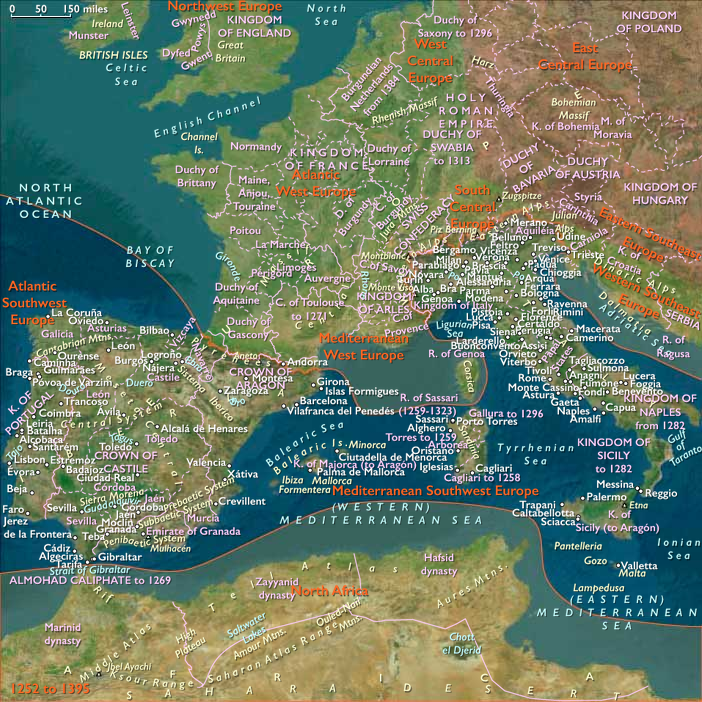
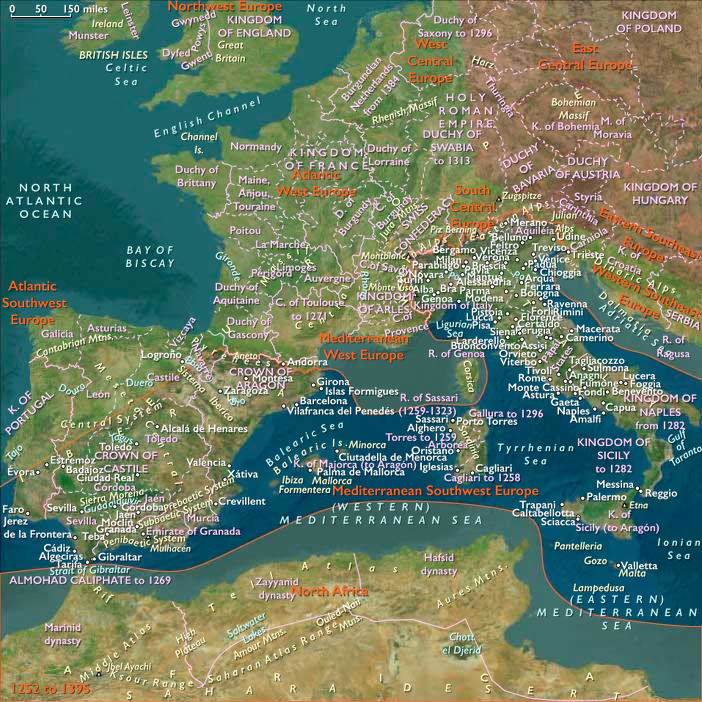
The city of Tarifa, captured in the Islamic conquest of southern Spain, had been fortified starting from the tenth century.
Later Tarifa was held by the taifa of Algeciras (1031) and by that of Seville (1057), and subsequently by the Almoravids.
After the latter's fall, it had lived a short period under another taifa of Algeciras (1231), until becoming part of the Kingdom of Granada.
It is conquered in 1292 by Sancho IV of Castile.
Locations
People
Groups
- Moors
- Muslims, Sunni
- Christians, Roman Catholic
- Castile, Crown of
- Granada, Emirate of, or Nasrid Kingdom of
Topics
Commodoties
Subjects
Regions
Subregions
Related Events
Filter results
Showing 10 events out of 45274 total
Jayakatwang, with the bulk of the Javanese army in campaign overseas and Singhasari's defense weakened, seizes his chance and mounts a coup against Kertanegara.
He launches a diversionary attack to northern Java, where his troops draw the remaining Singhasari troops left on the island.
With Singhasari defenseless, he attacks the capital city.
Kertanegara is killed, along with many courtiers in his palace in Singhasari in May or June 1292, apparently while drunk on palm wine in a religious Tantric Buddhist ceremony.
Jayakatwang then declares himself ruler of Java and king of the restored Kediri.
Among the few surviving relatives of Kertanegara is his son-in-law, Raden Wijaya, who flees to Madura,where he is sheltered by its regent, Arya Wiraraja.
Following pleas from Wiraraja, Jayakatwang forgives Wijaya, who in return submits himself to Jayakatwang.
Jayakatwang gives Wijaya land in the Tarik forest in the Brantas delta, where he builds a village that will later be called Majapahit.
The Venetian trader Marco Polo, who has become a favorite of Kublai Khan, has spent seventeen years roaming through China in the service of the Mongol emperor.
He, and more particularly, his uncles, increasingly desire to return home, but have, for years, been unable to obtain Kublai’s consent until 1292 when he finally—reluctantly—permits them to return to Venice on a diplomatic mission.
Torkel Knutsson, who hails from an old noble family of West Geatish ancestry, is related to the Folkungs, the royal family, and like them, he has a lion in his coat of arms.
He was first mentioned in 1282, and in documents from 1288, he is mentioned as a knight and a member of the privy council (riksråd).
When king Magnus Ladulås died, Torkel had become regent for the underage king Birger, being the highest state official and because Magnus' foreign-born widow, Hedwig of Holstein, was not yet trusted to hold such a powerful position.
The Deccan Yadava dynasty of Daulatabad subjugates the Vaghela dynasty in Gujarat.
Marco Polo uses the term Angaman in 1292 to refer to the group of more than two hundred islands located in the Bay of Bengal and known as the Andaman Islands.
The indigenous Andamanese, ethnically related to the Negrito peoples of Malaysia and the Philippines, have dark brown skin and tightly curled black hair, and speak a language not identified as related to any linguistic family.
The Anadamanese of this age reportedly have no knowledge of agriculture or fire, use tools made of stone, and lack domesticated animals.
As hunter-gatherers, the Andamanese collect wild fruits, roots, and nuts, hunt wild pigs with the bow and arrow, and, in outrigger canoes, obtain turtles, fish, and shellfish with nets and harpoons.
The animistic Andamanese religion includes ceremonies held to honor or placate environmental and ancestral spirits.
The Andamanese apparently trace genealogical descent through both parents.
Jacob van Maerlant: Chivalric Poet and Crusade Advocate
Jacob van Maerlant, a Flemish poet active in the latter half of the 13th century, is best known for his romantic and didactic verse, which played a crucial role in the development of Middle Dutch literature. His works evoke the romance of chivalry, yet also engage in moral and religious commentary.
His Literary Contributions
- Maerlant was deeply influenced by French and Latin sources, adapting romances, encyclopedic texts, and theological works for a Dutch-speaking audience.
- His writings include long didactic poems, designed to educate the nobility and commoners alike on topics ranging from history and natural science to religion and morality.
- His earlier works celebrated chivalric ideals, but later, his tone became more critical of contemporary society and Church corruption.
Van den Lande van Oversee (After 1291): A Call to Crusade
- Van den Lande van Oversee (On the Land Overseas), written after the fall of Acre in 1291, reflects Maerlant’s deep concern over the loss of Christian territories in the Holy Land.
- The poem is a stirring summons to a new crusade, urging European rulers to retake the Holy Land from the "infidels."
- At the same time, it includes bitter complaints about abuses within the Church, criticizing clerical corruption and moral decay as obstacles to the Christian cause.
Legacy
- Jacob van Maerlant is considered one of the most important early Dutch-language poets, shaping the vernacular literary tradition in the Low Countries.
- His blend of chivalric romance, moral instruction, and political commentary foreshadowed later Dutch medieval literature and the religious reformist movements of the following centuries.
- His crusading fervor reflected the waning enthusiasm for crusades in late 13th-century Europe, as practical politics and internal Church conflicts took precedence over the Holy Land.
Through Van den Lande van Oversee, Maerlant left a lasting mark on medieval Dutch literature, capturing both the idealism and disillusionment of his time.
The Templars’ Decline: Rivalries, Banking, and Growing Hostility (Late 13th Century)
By the late 13th century, the Knights Templar, once one of the most formidable military orders of Christendom, found themselves increasingly embroiled in conflicts and political tensions that would ultimately lead to their downfall.
Rivalry with the Hospitallers and Calls for a Merger
- The Templars had long engaged in a bitter rivalry with the Knights Hospitaller, another military order with a similar mission of defending Christian lands in the East.
- By the late 13th century, proposals emerged to merge the two orders into one, a solution intended to end their internal feuding and consolidate resources.
- However, neither order was willing to surrender its independence, and the idea never materialized.
The Fall of Acre and the Loss of the Templars’ Purpose (1291)
- The fall of Acre in 1291, the last major crusader stronghold in the Holy Land, was a catastrophic blow to the military orders.
- With no remaining territories to defend in the East, the Templars lost much of their original purpose as warrior-monks dedicated to the Crusades.
- Forced to withdraw to Cyprus and Europe, they struggled to redefine their role, shifting from military activities to financial services.
The Rise of the Templars as Bankers and Growing Hostility
- In the absence of active military campaigns, the Templars focused increasingly on banking, managing deposits, transferring funds, and lending money to rulers, including kings.
- Their enormous landholdings and financial strength made them one of the wealthiest and most powerful institutions in Europe.
- This economic dominance aroused suspicion and hostility among rulers and clergy, who saw them as:
- A threat to royal authority due to their independent wealth and influence.
- A financial rival to secular and ecclesiastical banking institutions.
- A privileged organization exempt from local laws, protected only by the Pope.
The Growing Danger to the Templars
- With their military purpose diminished and their financial empire expanding, the Templars became an easy target for rulers burdened by debt.
- This resentment would culminate in the early 14th century, when King Philip IV of France, heavily indebted to the order, would orchestrate their downfall in 1307.
By the end of the 13th century, the Templars had shifted from a formidable crusading force to a financial power, but their wealth and independence made them vulnerable to political and ecclesiastical persecution, foreshadowing their dramatic suppression in the following century.
The Treatment of Jews in France Following Their Expulsion from England (1290–14th Century)
Following their expulsion from England in 1290 by King Edward I, many Jews sought refuge in France, where their presence was still permitted. However, despite being allowed to reside there, they faced a series of bans and increasing restrictions, reflecting the broader pattern of medieval European anti-Jewish policies.
Legal and Economic Restrictions
- Jewish communities in France were subject to periodic expulsions, taxation, and limitations on their professions.
- They continued to be legally considered the personal property of the Crown, meaning they could be heavily taxed and expelled at the king’s discretion.
- The practice of usury (moneylending with interest) had long been a primary economic role for Jews, as Christians were forbidden from engaging in it. However, successive kings restricted or banned usury, depriving Jewish communities of their primary means of livelihood.
Escalating Persecution
- While the Jews expelled from England initially found relative security in France, they increasingly became targets of royal financial policies.
- In 1306, King Philip IV (Philip the Fair) expelled the Jews from France, seizing their property and financial assets.
- Some were allowed to return under later monarchs, but the policy of exploiting, taxing, and periodically expelling Jewish communities continued throughout the 14th century, culminating in the final expulsion of Jews from France in 1394 under King Charles VI.
Legacy
The experience of the Jews in France mirrored their treatment in other medieval European kingdoms—permitted to settle when economically useful, but subject to legal restrictions, heavy taxation, and eventual expulsion when rulers sought financial or political gains.
While some English Jews found temporary refuge in France, their presence remained precarious, reflecting the broader instability and vulnerability of Jewish communities in medieval Christian Europe.
The Taxatio Ecclesiastica, often referred to as the Taxatio Nicholai or just the Taxatio, compiled in 1291–92 under the order of Pope Nicholas IV, is a detailed database valuation for ecclesiastical taxation of English and Welsh parish churches and prebends.
The Pope promises Edward I one tenth of the annual profits of every ecclesiastical benefice for the endeavor.
John Balliol, of whose early life little is known, was born between 1248 and 1250 at an unknown location; possibilities include Galloway, Picardy and Barnard Castle, County Durham.
He was the son of John, Fifth Baron Balliol, Lord of Barnard Castle, and his wife Dervorguilla of Galloway, daughter of Alan, Lord of Galloway and granddaughter of David, Earl of Huntingdon.
From his mother hehas inherited significant lands in Galloway and claim to Lordship over the Gallovidians, as well as various English and Scottish estates of the Huntingdon inheritance; from his father he has inherited large estates in England and France, such as Hitchin, in Hertfordshire.
Balliol had attended a parliament at Scone in 1284, which had recognized Margaret, Maid of Norway, as heir presumptive to her grandfather, King Alexander III.
Following the death of Margaret in 1290, John Balliol has been a competitor for the Scottish crown in the Great Cause, as he is a great-great-great-grandson of King David I through his mother (and therefore one generation further than his main rival Robert Bruce, Fifth Lord of Annandale, grandfather of Robert the Bruce, who will later become king), being senior in genealogical primogeniture but not in proximity of blood.
He had submitted his claim to the Scottish auditors with King Edward I of England as the arbitrator, at Berwick-upon-Tweed on June 6, 1291.
The Scottish auditors' decision in favor of Balliol is pronounced in the Great Hall of Berwick on November 30, 1292, St. Andrew's Day.
Years: 1292 - 1292
Locations
People
Groups
- Moors
- Muslims, Sunni
- Christians, Roman Catholic
- Castile, Crown of
- Granada, Emirate of, or Nasrid Kingdom of
