
Baghdad, as the 'Abbasid capital, had became …
Years: 830 - 830
Baghdad, as the 'Abbasid capital, had became the center of scientific studies and trade after the Islamic conquest of Persia, and many merchants and scientists from as far as China and India travel to this city, as had Muslim mathematician Al-Khwārizmī.
Caliph al-Ma'mun, who encourages the translation of Greek philosophical and scientific work, founds an academy in Baghdad in 829 called the Bayt al-Hikmah, or House of Wisdom, to which the translators, most often Christians, are attached.
He also imports manuscripts of particularly important works that do not exist in the Islamic countries from Constantinople.
The contributions of Al-Khwārizmī', who works in the House of Wisdom, to mathematics, geography, astronomy, and cartography establish the basis for innovation in algebra and trigonometry.
His systematic approach to solving linear and quadratic equations leads to algebra, a word derived from the title of his 830 book on the subject, "The Compendious Book on Calculation by Completion and Balancing".
On the Calculation with Hindu Numerals, written about 825, is principally responsible for spreading the Indian system of numeration throughout the Middle East and Europe.
It will be translated into Latin as Algoritmi de numero Indorum.
Al-Khwārizmī, rendered as (Latin) Algoritmi, will lead to the term "algorithm".
Some of his work is based on Persian and Babylonian astronomy, Indian numbers, and Greek mathematics.
Al-Ma'mun, developing an interest in the sciences as well, establishes observatories at the Bayt al-Hikmah, and at …
Locations
People
Groups
Topics
Subjects
- Commerce
- Symbols
- Writing
- Theory
- Government
- Scholarship
- Technology
- Cartography
- Mathematics
- Astronomy
- Geography
Regions
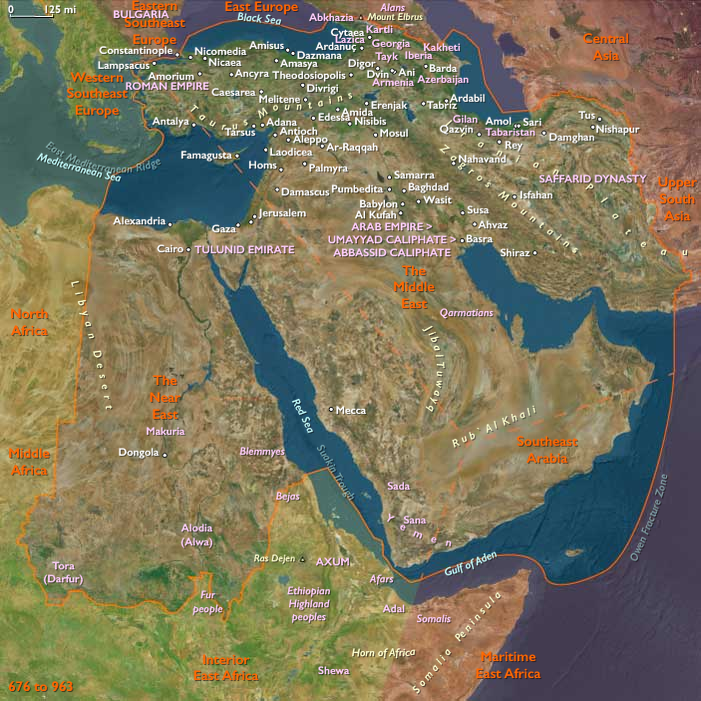
Subregions
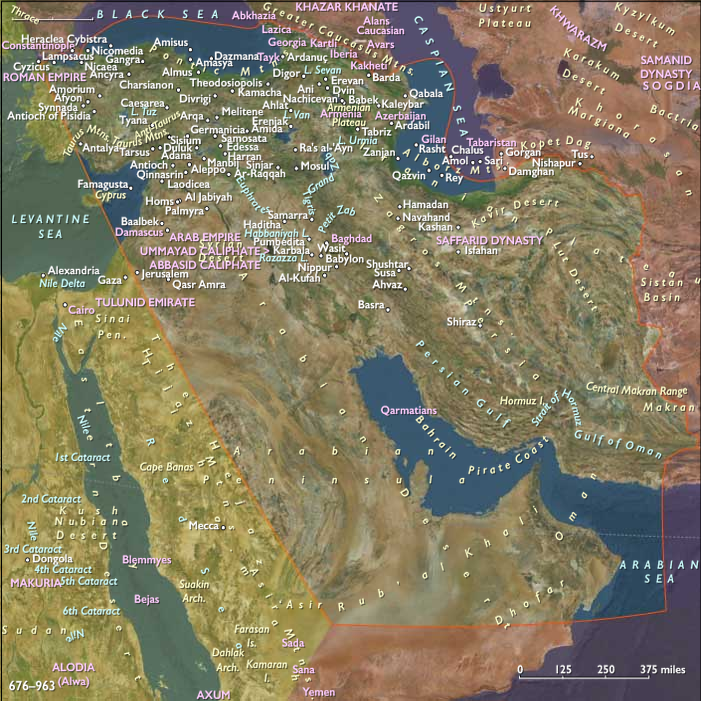
Related Events
Showing 10 events out of 54369 total
Years: 830 - 830
Locations
People
Groups
Topics
Subjects
- Commerce
- Symbols
- Writing
- Theory
- Government
- Scholarship
- Technology
- Cartography
- Mathematics
- Astronomy
- Geography
Regions
Subregions