Sicyon's institutions survive after the fall of …
Years: 513BCE - 502BCE
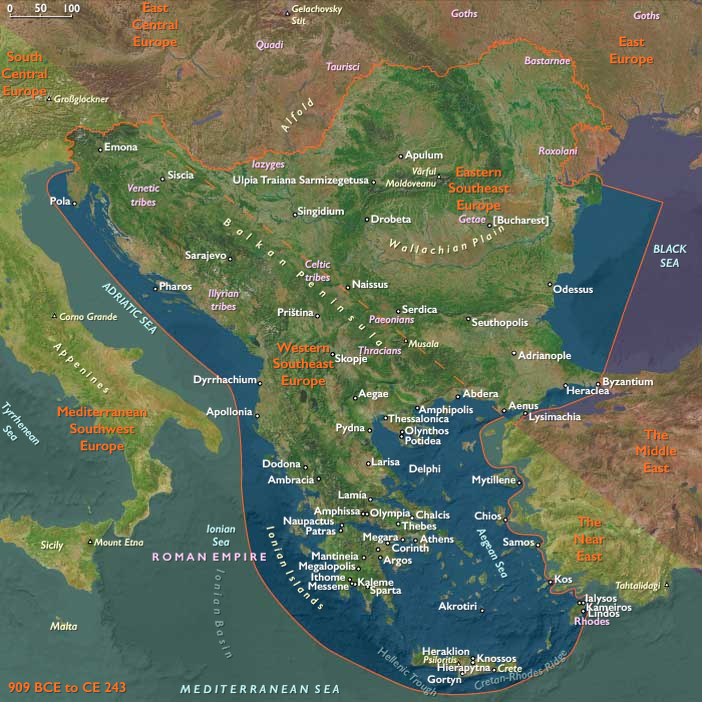
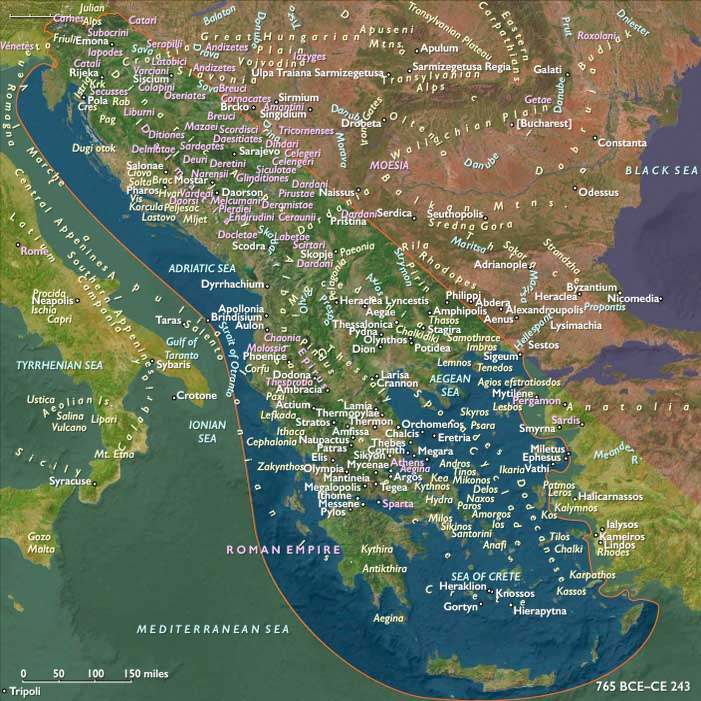
Sicyon's institutions survive after the fall of the city’s tyrants until the end of the sixth century BCE, when Cleisthenes, grandson of Cleisthenes of Sicyon, is again exiled from Athens and Dorian supremacy is reestablished in Sicyon, perhaps by the agency of Sparta under the ephor Chilon, and the city is enrolled in the Peloponnesian League.
Its policy henceforth will usually be determined either by Sparta or Corinth.
Locations
People
Groups
- Athens, City-State of
- Dorians
- Greece, classical
- Sicyon, Greek city-state of
- Sparta, Kingdom of
- Corinth, City-State of
- Peloponnesian League (Spartan Alliance)
Topics
Subjects
Regions
Subregions
Related Events
Filter results
Showing 10 events out of 65725 total
The Getae, a people of Thracian origin first appearing in the late sixth century BCE, inhabit the banks of the lower Danube region and nearby plains.
Subjected to Scythian influence, the Getae are known as expert mounted archers and devotees of the deity Zalmoxis, a healing thunder god who is master of the cloudy sky; however, they do not depict Zalmoxis in any plastic form.
Originally polytheistic nature-worshipers, the Thraco-Getae develop a sun cult and decorate their artwork with sun symbols.
The people offer agricultural products and animals as sacrifices and also cremate their dead, seal the ashes in urns, and bury them.
Darius, turning westward in 513, crosses the Bosporus over a bridge of boats to subdue the Scythians in eastern Thrace and the eastern Getae territory, marking the first Persian offensive in European territory.
He crosses the Danube River into European Scythia, but the Scythian nomads devastate the country as they retreat from him, using feints and retreating technique eastward while wasting the countryside, by blocking wells, intercepting convoys, destroying pastures and continuous skirmishes against Darius' army.
Seeking to fight with the Scythians, Darius' army chases the Scythian army deep into Scythian lands, where there are no cities to conquer and no supplies to forage.
In frustration, Darius sends a letter to the Scythian ruler Idanthyrsus to fight or surrender.
The ruler replies that he will not stand and fight with Darius until the Persians find the graves of their fathers and try to destroy them—until then, they will continue their current technique as they have no cities or cultivated lands to lose.
Darius orders a halt at the banks of Oarus, where he builds eight frontier fortresses spaced at intervals of eight miles.
After chasing the Scythians for a month, Darius' army is suffering losses due to fatigue, privation and sickness.
In fear of losing more troops, he halts the march at the banks of the Volga River and heads towards Thrace.
He has conquered enough territory of Scythia to force the Scythians to respect the Persian forces.
After abandoning his campaign against the Scythians, Darius orders his satraps to force the submission (but not the surrender) of Macedonia, and to capture Lesbos and Imbroz, in preparation for a campaign against the merchant cities of mainland Greece.

The Middle East: 513–502 BCE
Imperial Expansion and Stabilization Under Darius
From 513 to 502 BCE, Darius I continues to fortify and expand the Achaemenid Persian Empire, consolidating the significant administrative and infrastructural reforms he previously implemented. In 513 BCE, Darius embarks on an ambitious military expedition across the Bosporus into Europe, aiming to extend Persian control into the Balkans and potentially as far as the Greek mainland. His armies successfully subjugate Thrace and Macedon, integrating these territories into the Persian imperial framework and thereby securing strategic control of vital trade routes between Europe and Asia.
Darius’s incursions into Europe mark the westernmost extension of Persian influence, creating new satrapies and demanding tribute from Greek city-states, significantly altering the geopolitical balance of the region. Concurrently, he strengthens Persia’s internal coherence through infrastructural advancements, notably enhancing the Royal Road, facilitating efficient communication and administration across vast distances from the Aegean coast to Susa and Persepolis.
Diplomatic endeavors during this period bolster Persian dominance. Darius maintains amicable relations with many Ionian cities, securing their allegiance and integrating them economically and culturally into the empire. However, tensions persist beneath this surface stability, setting the stage for future conflicts.
In terms of culture and administration, Darius’s reign sees further encouragement of Zoroastrianism as a unifying ideological force. Monumental architecture flourishes at Persepolis, where extensive construction continues, reflecting both the power and sophistication of Achaemenid art and governance. These endeavors not only symbolize Persian imperial power but also serve practical functions in managing the empire’s vast territories and diverse populations.
By the end of this era, Darius has effectively stabilized the Persian Empire’s expansive territories, creating a period of relative peace and prosperity internally, though the seeds of future conflict, particularly with the Greek world, are firmly planted.
Near East (513–502 BCE): Samaritan Identity and Ionian Intrigue
Samaritan Origins and Religious Identity
In the wake of the Assyrian conquest centuries earlier, the post-exilic population of Samaria is described by Jewish tradition as colonists introduced from Mesopotamia who adopted a form of Judaism regarded by mainstream Jews as distorted. Known as Shomronim (Samaritans) among Hebrew-speakers, they are referred to pejoratively in the Talmud—the rabbinical compilation of Jewish law and commentary—as Kutim, implying descent from settlers originally from the Mesopotamian city of Cuthah.
The Samaritans themselves, however, firmly maintain a distinct narrative: they identify as the direct descendants of those Israelites of the ancient northern kingdom who escaped deportation following the Assyrian conquest of 722 BCE. Asserting their lineage from the tribes of Ephraim and Manasseh, they refer to themselves as Bene-Yisrael ("Children of Israel") or Shamerim ("Observant Ones"), emphasizing their adherence exclusively to the Pentateuch—the first five books of the Hebrew Bible—as their canonical scripture. Rejecting all other prophets, the Samaritans uniquely revere Moses alone as a prophet.
Modern scholarship suggests that the Samaritan community likely emerged from a blend of indigenous northern Israelites who remained after the Assyrian deportations, intermarried and integrated with Assyrian-introduced colonists, resulting in their distinctive religious and ethnic identity.
Miletus, Histiaeus, and Persian Politics
Meanwhile, political tensions rise in Anatolia. Histiaeus, the tyrant of Miletus, comes to prominence by offering crucial support to Persian King Darius I during his military campaign against the Scythians around 513 BCE. Herodotus records that Histiaeus convinces fellow Ionian tyrants not to destroy the strategic bridge over the Danube River, facilitating the safe return of the Persian army from Scythian territory. In gratitude, Darius grants Histiaeus control over territory in Thrace.
However, this close relationship soon sours. Darius, increasingly wary of Histiaeus’s growing influence and suspicious of his intentions, summons him to the Persian capital of Susa, effectively placing him under polite but strict confinement to limit his political power. With Histiaeus sidelined, governance of Miletus passes to his ambitious son-in-law, Aristagoras—a decision that sets the stage for forthcoming unrest in the Ionian region, ultimately leading toward the pivotal Ionian Revolt against Persian domination.
Legacy of the Era
The period between 513 and 502 BCE thus marks an important intersection of religious identity formation in the Levant and escalating geopolitical tensions in the Greek-inhabited territories of Anatolia. The crystallization of Samaritan identity, with its enduring religious and cultural distinctiveness, coincides with political maneuvers and tensions in the western reaches of the Persian Empire—developments that foreshadow greater conflict and transformation in the region.
The post-exilic inhabitants of Samaria are, according to Jewish tradition, allegedly colonists introduced after the Assyrian conquest who have adopted a distorted form of Judaism.
Other Hebrew-speakers call them simply Shomronim (Samaritans); in the Talmud (rabbinical compendium of law, lore, and commentary), they are called Kutim, suggesting that they are rather descendants of Mesopotamian Cuthaeans, who settled in Samaria after the Assyrian conquest.
The Samaritans themselves claim to be related by blood to those Israelites of ancient Samaria who were not deported by the Assyrian conquerors of the kingdom of Israel in 722.
Claiming descent from the tribes of Ephraim and Manasseh and maintaining that they have preserved the way and will of Yahweh, they call themselves Bene-Yisrael (”Children of Israel”), or Shamerim (”Observant Ones”), for their sole norm of religious observance is the Pentateuch (the first five books of the Old Testament).
The Samarians honor Moses as the only prophet.
It is likely that the Samaritans are a Judaized mixture of native north Israelites and Gentile deportees settled by the Assyrians in the erstwhile northern kingdom.
The tyrant Histiaeus rules Miletus at the end of the sixth century BCE.
Histiaeus, according to Herodotus, renders great service to Darius during the king's Scythian campaign of about 513 by persuading the tyrants of other cities not to destroy the Danubian bridge over which the Persians are to return.
Histiaeus receives Thracian territory as a reward.
Darius, however, becomes distrustful of Histiaeus and recalls him to Susa, where he holds him a virtual prisoner.
Histiaeus' son-in-law Aristagoras replaces him as ruler of Miletus.
The tyrant Miltiades the Younger marries Hegesipyle, the daughter of a Thracian prince.
Soon after, however, his authority is severely limited when Darius of Persia expands his power into Europe and reduces Miltiades to the rank of a Persian vassal.
He leads a contingent in the Scythian expedition of Darius in about 513, and, according to Herodotus, advises the destruction of the Danube bridge, which would have cut off Darius' retreat. (Since the Persians did not at once expel Miltiades, the story is doubtful.)
The Macedonian region is populated during the first millennium BCE by a mixture of peoples—Dacians, Thracians, Illyrians, Celts, and Greeks.
The ancient Macedonians probably have some Illyrian roots, but their ruling class has adopted Greek cultural characteristics.
Macedonian power by the reign of Amyntas I (late sixth century BCE) extends eastward beyond the Axius (Axiós) River to dominate the neighboring Thracian tribes.
The satraps of Asia Minor in about 516-510 BCE secure the submission of Macedonia, and, under Otanes, a general of Darius, …
…capture the Aegean islands of Lemnos and Imbros.
The approaches to Greece are thus in Persian hands, as is control of the Black Sea grain trade through the straits, the latter being of major importance to the Greek economy.
The conquest of Greece is a logical step to protect Persian rule over the Greeks of Asia Minor from interference by their European kinsmen.
Hippias, frightened by the murder of his brother in 514 BCE, has become increasingly repressive, and the Alcmaeonids try unsuccessfully with other Athenian nobles to fight their way back to power two years later.
They are more successful when they enlist the help of Delphi.
The Spartans are repeatedly urged by Delphi to set Athens free, and it is finally a Spartan army under Cleomenes I invades Attica, besieges the tyrant's party on the acropolis, and forces their surrender and evacuation.
Hippias takes refuge with the Persian governor at Sardis.
The Spartans have no wish to see a democratic Athens, but they misjudge the mood of the people.
In the struggle for power that follows the fall of the tyranny, Cleisthenes, the head of the prominent Alcmaeonidae family, fails to impose his leadership, and Isagoras, the leader of the more reactionary nobles, is elected chief archon in 508 BCE.
It is at this point, according to later tradition, that Cleisthenes takes the people into partnership and transforms the situation.
Now in his early sixties, reorganizes the Athenian tribes into demes—political divisions based on locality—and extends citizenship to include nearly all resident aliens, apparently to pack the assembly with new voters who will support him.
In this first introduction of democracy to Athens, the liberal Cleisthenes fulfills the tendencies begun by Solon and enforced by Peisistratus.
Before the year 508-507 is over, the main principles of a complete reform of the system of government have been approved by the popular Assembly, a relative of the Alcmaeonids has been elected chief archon for the following year, Isagoras has left Athens to invoke Spartan intervention, and Sparta has declared for Isagoras.
The Spartan king demands the expulsion of “those under the curse,” and Cleisthenes and his relatives are again exiles.
The prosperity of Euboea, the large, mostly mountainous island adjacent to the east coast of the Greek mainland, has been checked by several decades of war, beginning about 700 BCE, between Chalcis and Eretria.
Though it lost influence in the West, Eretria may have emerged from the war the stronger power, but by the classical period, Chalcis has become the leading city of Euboea.
The Euboeans, having lost their former trade advantages on the mainland, are forced into an alliance with Boeotia and Sparta against Athens.
Athenians in 506 capture Chalcis and settle the Lelantine Plain with their own citizens.
Years: 513BCE - 502BCE
Locations
People
Groups
- Athens, City-State of
- Dorians
- Greece, classical
- Sicyon, Greek city-state of
- Sparta, Kingdom of
- Corinth, City-State of
- Peloponnesian League (Spartan Alliance)