
Wang, after the defeat of Zhai and …
Years: 9 - 9
Wang, after the defeat of Zhai and Liu Xin becoming even more convinced that the empire is entirely under his control, decides to finally seize the throne and start a new dynasty.
After receiving a false prophecy written by the hoodlum Ai Zhang that purports to be a divine decree from Emperor Gaozu (Liu Bang) stating that the throne should be given to Wang, and that Grand Empress Dowager Wang should follow this divine will, Wang in the winter of 8-9 issues a decree accepting the position of emperor, establishing the Xin Dynasty.
The self-confident Wang Mang believes that he now has the power to implement his ideals of restoring the legendary golden age of the early Zhou Dynasty.
To this end, he modifies the governmental structure in many ways to conform with Zhou standards.
He also continues the regime of modifying geographical names to fit with ancient names (or more euphemistic names, as he sees fit)—so much so that even imperial edicts discussing the locations by their new names are forced to include notes on the old names so that the recipients of the edicts can tell what locations he is referring to.
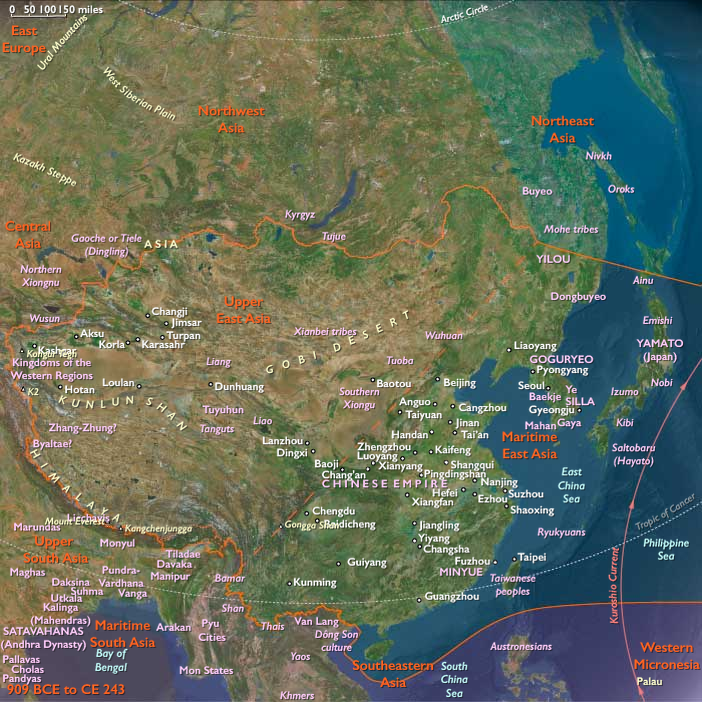
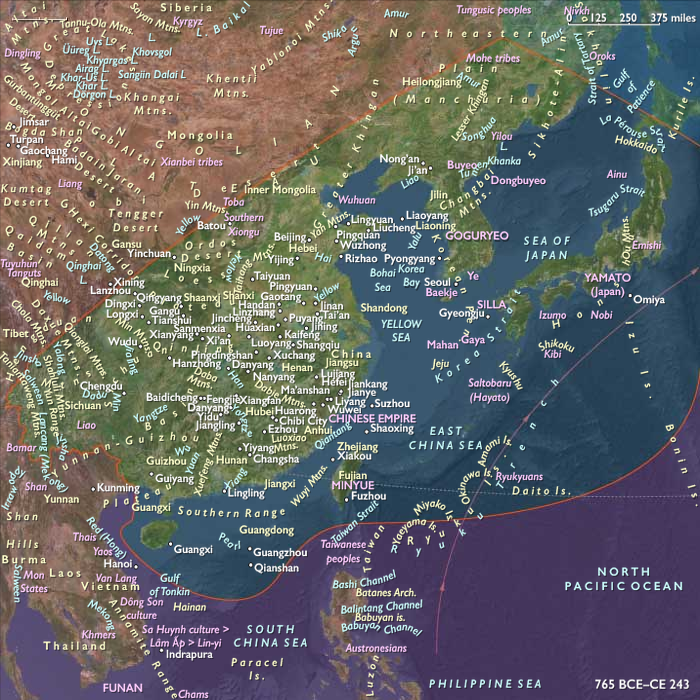
As part of this regime, the capital Chang'an's name is changed as well, involving the change of a homophonous character: literally, long peace, to, literally, enduring peace.
Wang Mang creates his wife, Lady Wang, empress.
By this point, only two of her four sons are still alive.
The older, Wang An, is described as lacking in talent; Wang makes him the Lord of Xinjia.
Wang makes the younger, Wang Lin, crown prince, and appoints several Confucian scholars to advisors him.
Grateful to his aunt Grand Empress Dowager Wang (who, however, resents him for deceiving her and usurping the throne), continues to honor her as empress dowager, but also gives her an additional title of Wangmu, the same title carried by the mother of King Wen of Zhou, implying that she is also his mother and had helped establish a new dynasty.
In 9 also, Wang Mang institutes a revolutionary land redistribution system, ordering that all land in the empire become legally the property of the empire, to be known as wangtian, in a system similar to the Zhou well-field system.
All further land transactions are banned, although property owners are allowed to continue to possess the property.
However, if a family has less than eight members but has one "well" or larger property (about 0.6 km²), it is required to distribute the excess to fellow clan members, neighbors, or other members of the same village.
Criticism of the wangtian system is punishable by exile.
Wang also abolishes slavery.
In 9, after Wang Mang has usurped the throne, Liu Kuai, the Marquess of Xuxiang, attacks the Dukedom of Fuchong, held by his brother Liu Ying, the former Prince of Jiaodong.
He is defeated and dies while fleeing from the battle.
Locations
People
Groups
Topics
Commodoties
Subjects
Regions
Subregions
Related Events
Showing 10 events out of 62028 total
Years: 9 - 9
Locations
People
Groups
Topics
Commodoties
Subjects
Regions
Subregions