
The northern parts of China after the …
Years: 465 - 465
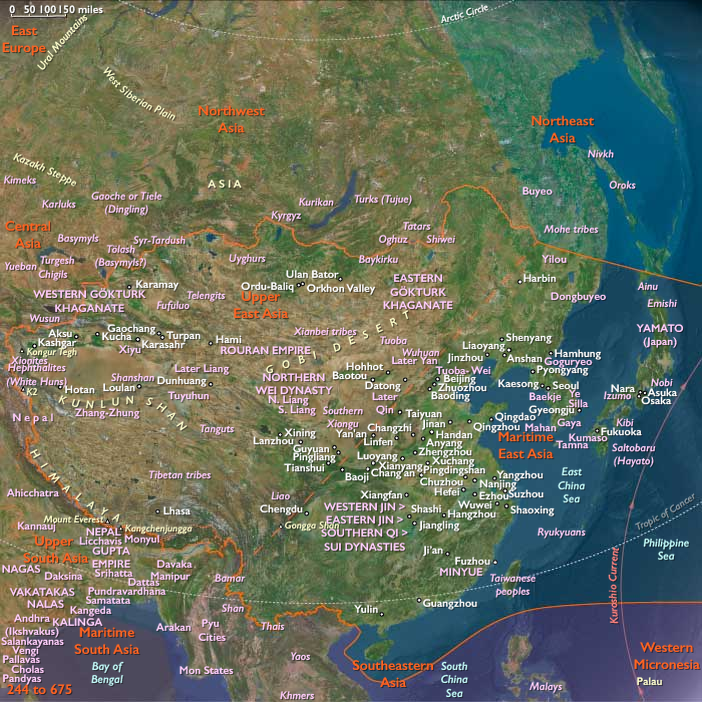
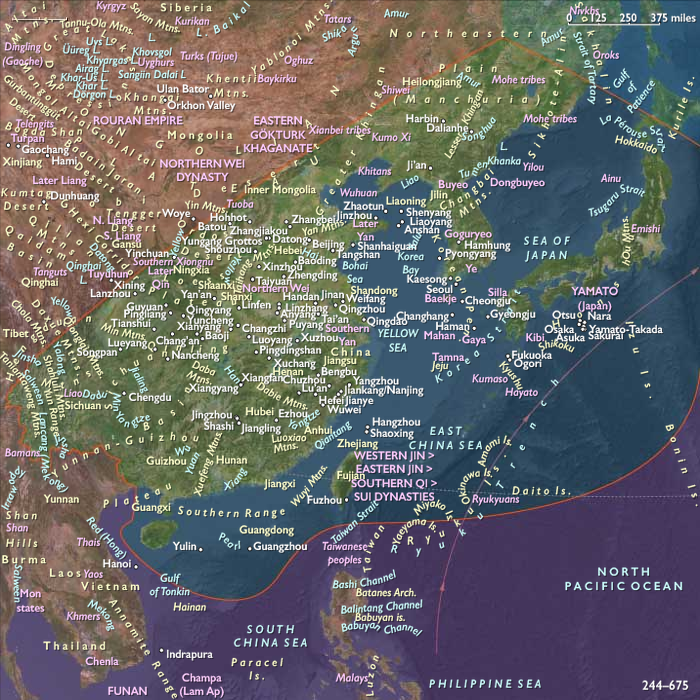
The northern parts of China after the decline of the Jin Dynasty had come under the control of the Northern Wei, who made the city of Pingcheng, now known as Datong, their capital.
Due to its promotion, Pingcheng saw an increase in construction work.
The Northern Wei had early adopted Buddhism as their state religion.
Buddhism had arrived in this location via travel on the ancient North Silk Road, the northernmost route of about twenty-six hundred kilometers in length, which connects the ancient Chinese capital of Xi'an to the west over the Wushao Ling Pass to Wuwei and emerging in Kashgar before linking to ancient Parthia.
A sectarian movement within the Buddhist religion called Chan (or Ch'an, a Chinese attempt to render the Sanskrit word for meditation, “dhyana”), emphasizing the practice of meditation as the means to enlightenment, becomes distinct in East Asia, flourishing here.
Bodhidharma, a master of this text known as the Lankavatara Sutra, reportedly arrives there from India in about 470 and becomes the first Chan patriarch in China.
He stresses the practice of contemplative sitting (and, according to legend, spends nine years in meditation facing a wall).
Bodhidharma is primarily active in the lands of the Northern Wèi Dynasty (386–534).
Modern scholarship dates him to about the early fifth century.
The Yungang Grottoes, Chinese Buddhist temple grottoes near the city of Datong in the province of Shanxi,are excellent examples of rock-cut architecture and one of the three most famous ancient Buddhist sculptural sites of China.
The others are Longmen and Mogao.
The work on this first period of carving lasts until the year 465, and the caves are now known as caves 16–20.
Chinese monumental stone sculpture becomes a tradition.
In the caves of Yungang (“Cloud Hill”), artisans begin the series of rock-cut shrines that contain a 45-foot sculpture of the Buddha.
The earliest caves reflect Central Asian and Gandharan influences, notably that of Afghanistan’s fourth-century Bamian cave-temples.
Locations
Groups
Topics
Commodoties
Subjects
Regions
Subregions
Related Events
Showing 10 events out of 58598 total
Years: 465 - 465
Locations
Groups
Topics
Commodoties
Subjects
Regions
Subregions