Caliph al-Mahdi, in retaliation for the Romans' …
Years: 780 - 780
November
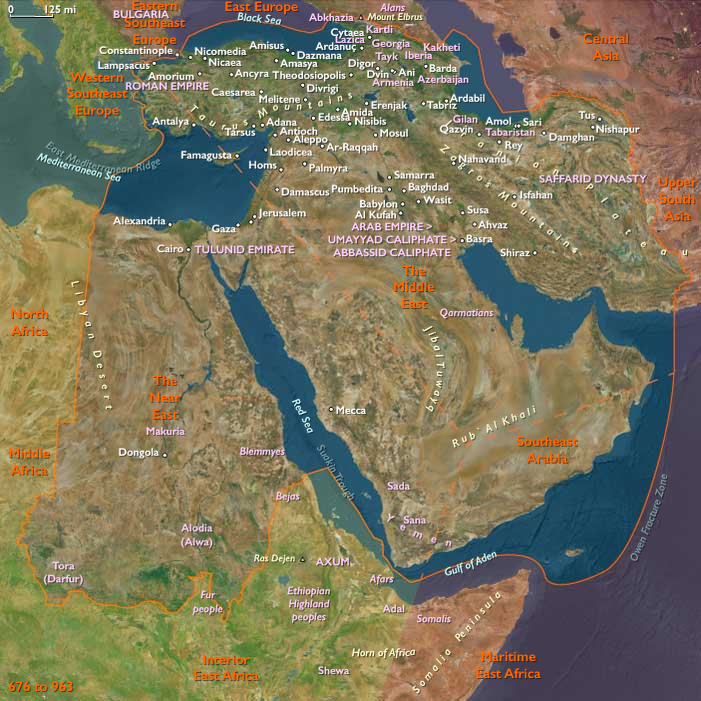
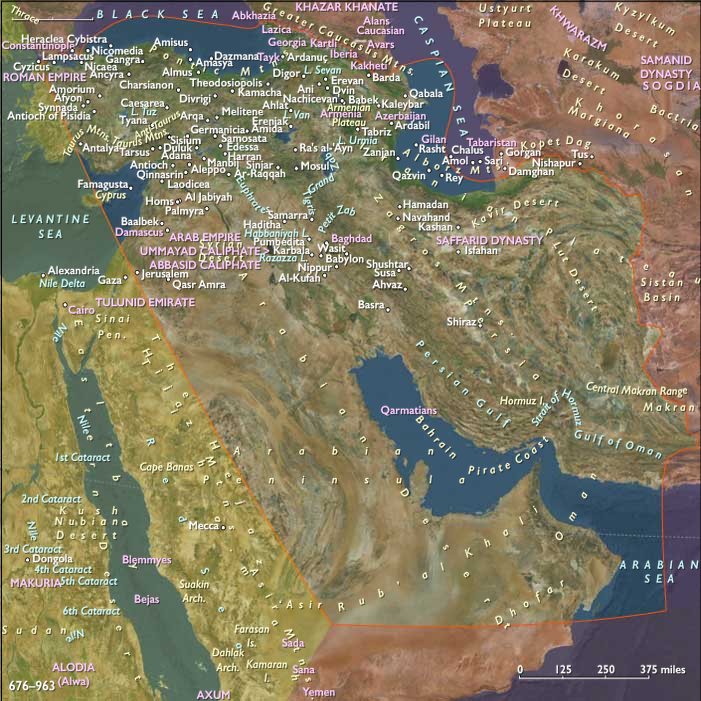
Caliph al-Mahdi, in retaliation for the Romans' post-battle slaughter of his army in 778, has assembled a large force of Mesopotamians, Syrians, and Khorasanians, which he leads northwards in late 780 Aafter the death of Emperor Leo IV, who had campaigned against the Arabs in Anatolia and Syria since 777.
Empress Irene, acting regent for her young son Constantine VI, orders the imperial forces to annihilate the invading Muslims.
Locations
People
Groups
- Iranian peoples
- Arab people
- Persian people
- Khorasan, Greater
- Christianity, Chalcedonian
- Greeks, Medieval (Byzantines)
- Muslims, Sunni
- Syrian people
- Roman Empire, Eastern: Isaurian dynasty
- Abbasid Caliphate (Baghdad)
Topics
Commodoties
Subjects
Regions
Subregions
Related Events
Filter results
Showing 10 events out of 55040 total
Lu Yu was born in 733 in Tianmen, Hubei.
According to Tea Lore, Lu Yu was an orphan of Jinling county (now Tianmen county in Hubei province) who was adopted by a Buddhist monk of the Dragon Cloud Monastery.
He refused to take up the monastic robes and was assigned menial jobs by his stepfather.
Lu Yu ran away and joined the circus as a clown.
At age fourteen, Lu Yu was discovered by the local governor Li Qiwu who offered Lu Yu the use of his library and the opportunity to study with a teacher.
For six years, Lu Yu stayed in Houmen mountain studying under the guidance of master Zou Fuzi.
During this period Lu Yu often brewed tea for his teacher.
He also took care of fellow students' health with his remarkable knowledge in tea and herbs that he learned while at the Longgai Monastery.
Whenever time permitted between his studies Lu Yu often went to the countryside to gather tea leaves and herbs.
In one of those trips Lu Yu stumbled upon a spring underneath a six-foot round rock and the water from the spring was extremely clear and clean.
When Lu Yu brewed tea with this spring water he found the tea tasted unexpectedly better than usual: Lu Yu now realized the importance of quality water in brewing tea.
Zou Fuzi, moved by Lu Yu's obsession with tea and his skill in brewing good tea, cleared the rock together with some of his students and dug a well around the fountainhead of that spring.
(In 1768, just over a thousand years later during the Qing Dynasty (1616–1911), Jingling was hit by drought and the whole city was badly in need of water.
City folks found water still flowing from this well uncovered by Lu Yu and dug by Zou Fuzi.
A Qing official ordered three wells to be dug around the spring, and a structure constructed near the wells named "Lu Yu Hut" and the "Literary Spring".)
Concluding his studies in 752, Lu Yu bade farewell to his guru Zou Fuzi and returned to Jingling to meet his benefactor Li Qiwu.
However, Li Qiwu had been reinstated the previous year and had returned to the Tang capital Chang'an; the new Chief Official of Jingling now was Cui Goufu.
Cui, a senior official who had held a position approximating an Education Minister, had been demoted and transferred to Jingling as a Chief Official for offending a member of the royalty.
Cui Goufu is a scholar and poet well known for his magnificent five-characters-per-verse short poems.
After his demotion to Jingling, Cui Goufu took life at his leisure.
Even though Cui was many years older than Lu Yu, both men share the same interest in tea, literature and poetry.
As such, they had become good friends soon after they met.
During this period, Lu Yu had stayed with Cui Goufu and assisted him in his administrative tasks.
The pair had spent much time traveling, drinking tea and writing poems, co-authoring several books on poetry.
This period with Cui Goufu had been the growing phase for Lu Yu as a man of letters; an incubation period for him to practice and sharpen what he had learned from Zou Fuzi.
Cui Goufu, with his vast experience and skill in literary work, became a coach who provided the necessary guidance to enhance and mature Lu Yu's writing and literary skills.
During this time he writes Cha Jing (The Classic of Tea), publishing it between 760 and 780 as three books covering ten chapters.
According to Cha Jing, tea drinking is widespread.
The book describes how tea plants are grown, the leaves processed, and tea prepared as a beverage.
It also describes how tea is evaluated, and discusses where the best tea leaves are produced.

Charles, having suppressed a revolt in Lombardy in 776, reinvades again in 780 to strengthen the papacy and install his son as king.
Leo at the beginning of his reign had not attempted to continue the fierce iconoclastic policy pursued by his father and grandfather, forbidding the use of icons.
Instead, he has shown considerable moderation toward the proponents of icons, even appointing them to bishoprics.
This action may have resulted from the influence of the strongly orthodox Irene.
In 780, however, he reverses his policy and initiates a persecution of those favoring the use of icons.
He dies prematurely, at thirty-one, on September 8, 780, leaving to succeed him his nine-year-old son, Constantine VI, under the regency of the empress Irene.
Later in this year, Irene crushes what seems to have been a plot by the Iconoclasts to put Leo's half brother, Nikephoros, on the throne.
Leo's widow Irene becomes guardian of their ten-year-old son, Constantine VI, and co-emperor with him.
Irene decries the practice of forced conversion, and, with clerical support, calls for conversion only of those who voluntarily confess and rejects Judaism and its “customs and pursuits.”
The Creation of the Kingdom of Aquitaine and the Crowning of Louis (781)
In 781, Louis, the three-year-old son of Charlemagne, is crowned King of Aquitaine and sent to rule from the region, accompanied by regents and a court. This move is part of Charlemagne’s broader territorial strategy, aimed at securing the southwestern border of the Frankish kingdom after decades of conflict with the Aquitanians and Basques.
Strategic Importance of the Kingdom of Aquitaine
The decision to establish a subkingdom in Aquitaine follows the destructive war against Duke Waifer (768) and the subsequent rebellion of Hunald II, culminating in the disastrous Battle of Roncevaux Pass (778), where Charlemagne’s rear guard was ambushed and annihilated by Basque forces. By placing his son in Aquitaine, Charlemagne ensures that Louis grows up in the land he is to govern, fostering stronger regional ties and loyalty while maintaining Frankish control over the volatile region.
Territorial Composition and Governance
The new Kingdom of Aquitaine, while formally subordinate to Francia, is larger than Aquitaine proper and includes:
- Aquitaine itself,
- Gothia (Septimania),
- Frankish possessions in Spain, forming the early Spanish March, a key frontier against Muslim Al-Andalus.
While Louis resides in the northern palaces of the kingdom, the actual administration is centered in Toulouse, governed by Count Guilhèm de Gellona (William of Gellone), one of Charlemagne’s most trusted vassals and military commanders.
Palaces of the Young King
To ensure proper governance and regional integration, Louis’s court moves among various Carolingian palaces in the northern part of the kingdom, including:
- Limoges / Le Palais-sur-Vienne,
- Poitiers / Chasseneuil,
- Ebreuil,
- Bourges,
- Angeac-sur-Charente / Angoulême,
- Doué-La-Fontaine.
Long-Term Impact
By establishing Louis as King of Aquitaine, Charlemagne creates a more stable administration in the region while ensuring a direct Carolingian presence in a previously rebellious area. This move also lays the foundation for future Frankish expansion into Muslim-held Spain, as the Spanish March develops into a key military frontier. Ultimately, Louis will grow into his role, later ascending as Louis the Pious, the sole heir to the Carolingian Empire after Charlemagne’s death.
The young Alcuin had come to the cathedral church of York during the golden age of Archbishop Egbert and Northumbrian King Eadberht.
Egbert had been a disciple of the Venerable Bede, who had urged him to raise York to an archbishopric.
King Eadbert and his brother Egbert had overseen the reenergizing and reorganization of the English church, with an emphasis on reforming the clergy and on the tradition of learning that Bede had begun.
Egbert had been devoted to Alcuin, who thrived under his tutelage.
The York school is renowned as a center of learning in the liberal arts, literature, and science, as well as in religious matters.
Alcuin had graduated during the 750s to become a teacher.
His ascendancy to the headship of the York school, the ancestor of St Peter's School, began in 767 after Aelbert became Archbishop of York.
Alcuin around the same time became a deacon in the church.
He was never ordained as a priest and there is no real evidence that he became an actual monk, but he lived his life as one.
King Elfwaldhad had sent Alcuin to Rome in 781 to petition the Pope for official confirmation of York's status as an archbishopric and to confirm the election of the new archbishop, Eanbald I.
At some point he either met or was summoned by Charles I, who seeks to inspire the revival of education in the hope of forming one great Christian empire of all the Germanic peoples.
Alcuin's love of the church and his intellectual curiosity allows him to be reluctantly persuaded to join Charles's court.
He joins an illustrious group of scholars that Charles has gathered around him, the mainsprings of the Carolingian Renaissance: Peter of Pisa, Paulinus of Aquileia, Rado, and Abbot Fulrad.
Alcuin will later write that "the Lord was calling me to the service of King Charles."
Charles is determined to have his children educated, including his daughters, as he himself is not.
His children are taught all the arts, and his daughters are learned in the way of being a woman.
His sons take archery, horsemanship, and other outdoor activities.
Alcuin is welcomed by Charles to the Palace School in Aachen (Urbs Regale) in 782, founded by the king's ancestors as a place for the education of the royal children (mostly in manners and the ways of the court).
However, Charles wants to include the liberal arts and, most importantly, the study of the religion that he holds sacred.
Drawing inspiration from the York school, he revives the Palace School with the trivium and quadrivium disciplines, writing a codex on the trivium, while his student Hraban will write one on the quadrivium.
Charles begins construction on his palace chapel at Aachen (Aix-la-Chapelle) in 782, designed and supervised by the architect Odo of Metz.
The new chapel, modeled after a centralized Byzantine model, Justinian's octagonal Church of San Vitale in Ravenna, rejects the simple Merovingian church plan in favor of imperial echoes.
Returning to Saxony in 782, Charles institutes a code of law and appointed counts, both Saxon and Frank.
The laws are severe on religious issues, namely the native paganism of the Saxons.
This stirs a renewal of the old conflict.
In autumn, Widukind returns and leads a revolt that results in many assaults on the church.
The Saxons invade the area of the Chatti, a Germanic tribe already converted by Boniface and firmly in Charles's empire.
Widukind annihilates a Frankish army at the Süntel while Charles is campaigning against the Sorbs.
It is in response to this setback that Charles, in the Massacre of Verden, orders the beheading of forty-five hundred Saxons who had been caught practicing paganism after converting to Christianity, while Widukind escapes to Denmark again.
Charles’ severe and uncompromising position, which earns him the title "butcher of Saxons", causes his close adviser Alcuin of York to urge leniency, as he believes God's word should be spread not by the sword but by persuasion; but the wars continue.
Charles’s action leads to what will be two straight years of constant warfare; he winters in central Saxony, at Minden.
Al-Muqanna, espousing a mixture of Shiite, Zoroastrian and Manichaean belief systems, has commanded his rebel troops in battles with Abbasid forces or about three years in the field until forced to withdraw to his fortress of Sanam, near Kesh, whence he carries on warfare for another two years before he is eventually defeated.
He poisons himself in 738 rather than surrender to the Abbasids, who had set fire to his house when he was on the verge of being captured.
Years: 780 - 780
November
Locations
People
Groups
- Iranian peoples
- Arab people
- Persian people
- Khorasan, Greater
- Christianity, Chalcedonian
- Greeks, Medieval (Byzantines)
- Muslims, Sunni
- Syrian people
- Roman Empire, Eastern: Isaurian dynasty
- Abbasid Caliphate (Baghdad)