
The Senate had appointed Germanicus commander of …
Years: 14 - 14
The Senate had appointed Germanicus commander of the forces in Germania after the death of Augustus in 14.
The legions a short time after had rioted on the news that their recruitment terms would not be marked back down to sixteen years from the then standard twenty.
Refusing to accept this, the rebel soldiers had cried for Germanicus as emperor.
Germanicus, preferring to continue only as a general, puts down this rebellion himself.
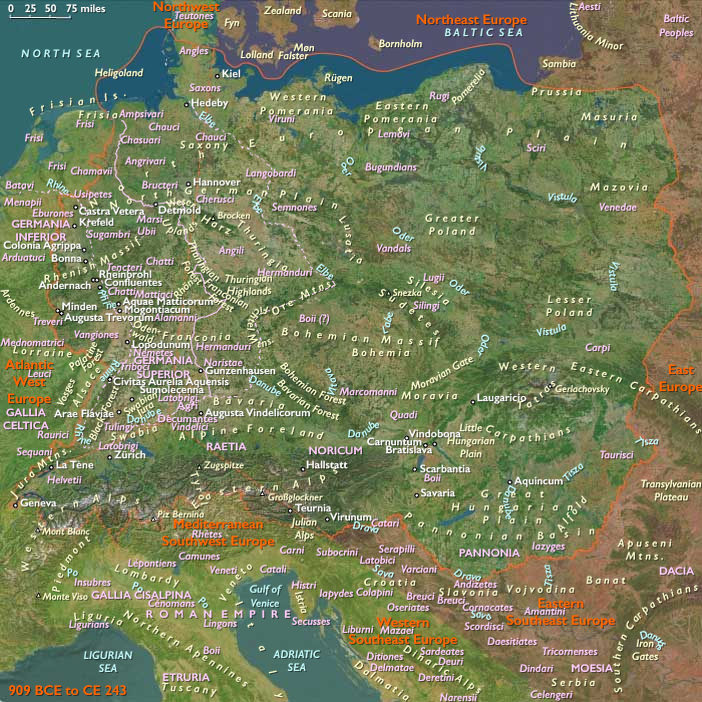
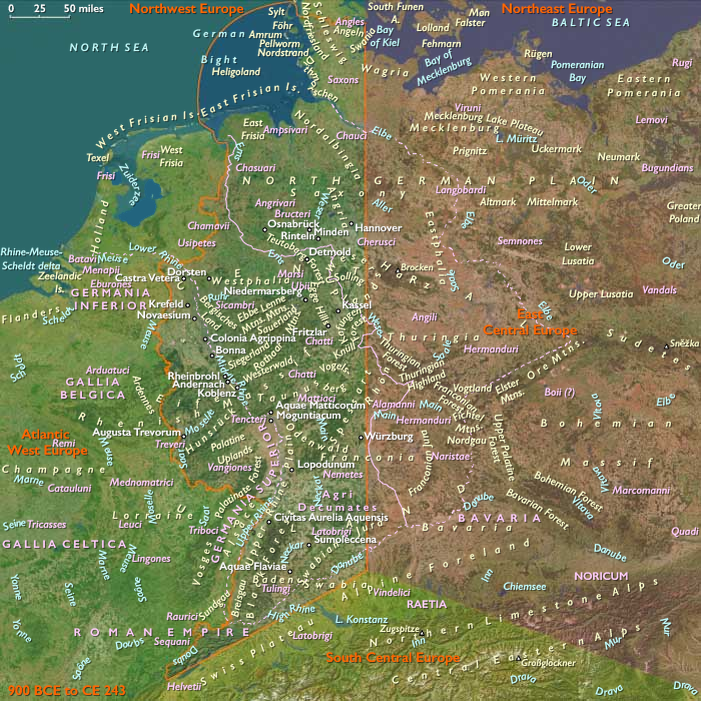
In a bid to secure the loyalty of his troops and his own popularity with them and with the Roman people, he leads them on a spectacular but brutal raid against the Marsi, a German tribe on the upper Ruhr river, in which he massacres much of the tribe.
Tacitus mentions the Marsi repeatedly, in particular in the context of the wars of Germanicus.
They had been part of the tribal coalition of the Cheruscian war leader Arminius that in 9 CE had annihilated the three Roman legions under Varus in the Battle of Teutoburg Forest.
Germanicus, seeking revenge for this defeat, invades the lands of the Marsi in 14 CE with twelve thousand legionnaires, twenty-six cohorts of auxiliaries and eight cavalry squadrons.
The Marsi, celebrating the feast of their goddess Tanfana, are too drunk to respond effectively to the Roman surprise attack and are massacred.
According to Tacitus (Annals 1, 51), an area of fifty Roman miles is laid to waste with fire and sword: "No sex, no age found pity."
A Legion eagle from Varus’s Defeat, either from the XVII or XVIII, is recovered.
Several town names today remain as reminders of the ancient Marsi—e.g., Marsberg and Obermarsberg in eastern North Rhine-Westphalia and Volkmarsen in northern Hesse.
Locations
People
Groups
Topics
- Classical antiquity
- Pre-Roman Iron Age of Northern Europe
- Roman Age Optimum
- Pax Romana
- Roman Northern Frontier Wars of 24 BCE-CE 16
Commodoties
Subjects
Regions
Subregions
Years: 14 - 14
Locations
People
Groups
Topics
- Classical antiquity
- Pre-Roman Iron Age of Northern Europe
- Roman Age Optimum
- Pax Romana
- Roman Northern Frontier Wars of 24 BCE-CE 16
Commodoties
Subjects
Regions
Subregions