
Ghazan, the son of Arghun, had been …
Years: 1295 - 1295
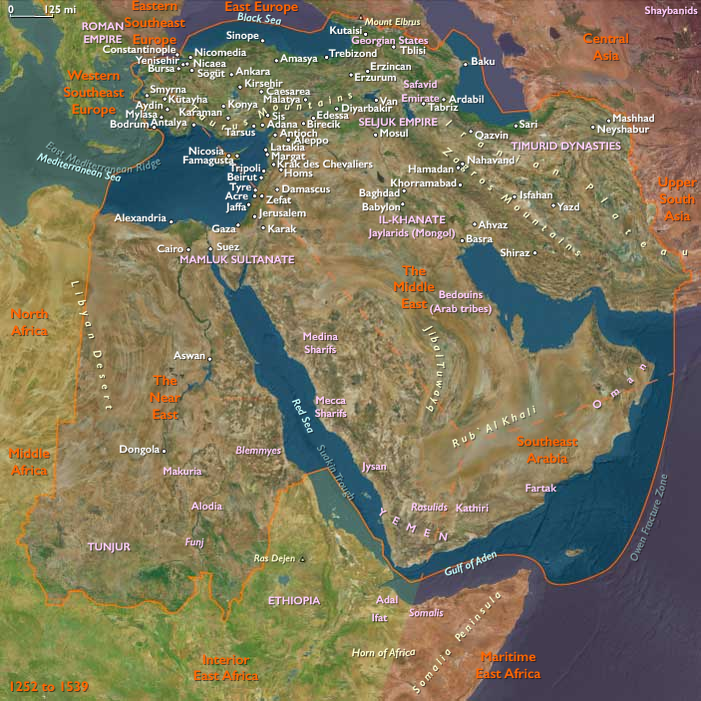
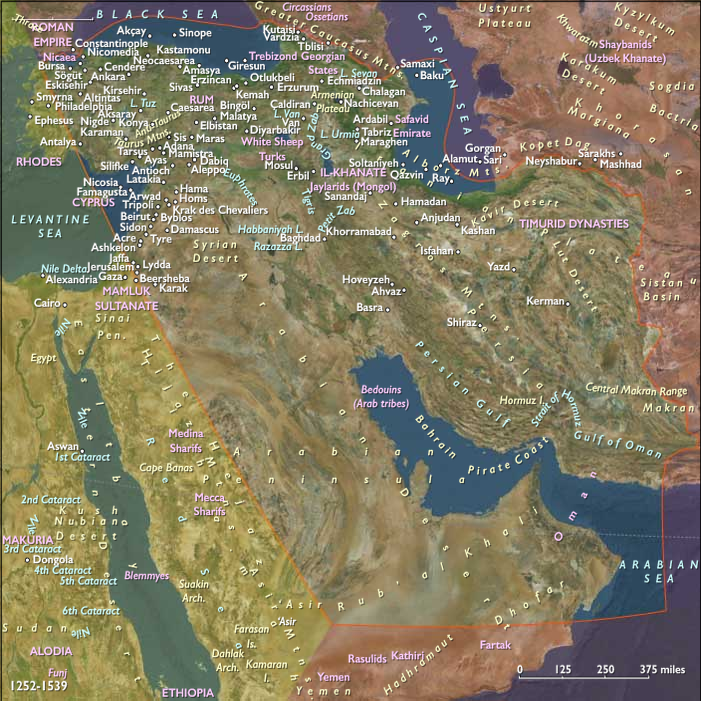
Ghazan, the son of Arghun, had been prevented from pursuing his claim of leadership in the capital after his father's death in 1291 because he was engaged both with Nawruz's raids, and dealing with rebellion and famine in Khorasan and Nishapur.
Taghachar, an army commander who had served the previous three generations of Ilkhan, was probably behind the death of Arghun, and supports Ghazan's uncle Gaykhatu as the new Ilkhan.
Ghazan is loyal to his uncle, though he refuses to follow Gaykhatu's lead in introducing paper currency to his province, explaining that the weather of Khorasan is too humid to handle paper.
In 1294/1295, Ghazan forces Nawruz to surrender at Nishapur, and Nawruz now becomes one of Ghazan's lieutenants.
During Gaykhatu's reign, Kökechin, who had been brought from the Yuan Dynasty from the east by Marco Polo,had originally been betrothed to Ghazan's father, the Ilkhan Arghun, but since he had died during her months-long journey from the capital, she had instead married Ghazan, his son.
She will be Ghazan’s principal wife during his lifetime.
Taghachar and his conspirators, who had been behind the death of Arghun, have his successor Gaykhatu killed as well in 1295.
They now place the controllable Baydu, a cousin of Ghazan, on the throne.
Baydu is primarily a figurehead, allowing the conspirators to divide the Ilkhanate among themselves.
Within a few months, Ghazan challengeds Baydu for the throne, ending by having him executed on October 5, 1295.
Ghazan is assisted in this by his earlier enemy, the prominent Muslim Mongol emir Nawruz.
Ghazan had converted to Islam, on June 16, 1295,at the hands of Ibrahim ibn Muhammad ibn al Mu’ayyid ibn Hamweyh al-Khurasani al-Jawini as a condition for Nawruz's military support.
Another who has assisted Ghazan was Taghachar, but Ghazan deems him unreliable, exiles him to Anatolia, and later has him discreetly murdered.
Locations
People
Groups
- Buddhism
- Khorasan, Greater
- Christians, Eastern (Diophysite, or “Nestorian”) (Church of the East)
- Islam
- Mongols
- Mongol Empire
- Chagatai Khanate
- Il-khanate
Topics
Commodoties
Subjects
Regions
Subregions
Related Events
Showing 10 events out of 45232 total
Years: 1295 - 1295
Locations
People
Groups
- Buddhism
- Khorasan, Greater
- Christians, Eastern (Diophysite, or “Nestorian”) (Church of the East)
- Islam
- Mongols
- Mongol Empire
- Chagatai Khanate
- Il-khanate
Topics
Commodoties
Subjects
Regions
Subregions