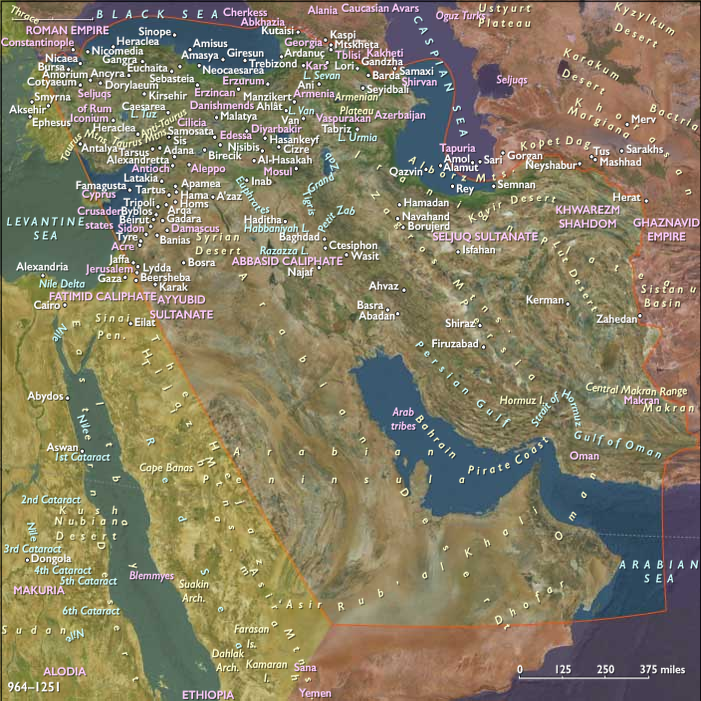
The Anatolian Seljuqs of Rüm finally become …
Years: 1194 - 1194
The Anatolian Seljuqs of Rüm finally become the sole representatives of the dynasty after the death in Iran of the last Great Seljuq sultan in 1194.
Locations
People
Groups
Commodoties
Subjects
Regions
Subregions
Related Events
Filter results
Showing 10 events out of 47790 total
The Huai River originates in Tongbai Mountain in Henan province.
It flows through southern Henan, northern Anhui, and northern Jiangsu, entering the Yangtze River at Jiangdu, Yangzhou.
Historically, the Huai River had entered the Yellow Sea at Yuntiguan ("Escalade Pass") through a broad and level lower course.
It was long used to irrigate the surrounding farmlands, and was the center of an extensive network of canals and tributaries.
Beginning in 1194, however, the Yellow River to the north repeatedly changes its course southwards to run into the Huai River, and will continue in this way until 1897.
The Turkmens of Central Asia have been under the rule of the Seljuq dynasty of Oghuz tribes from 1038 to 1194.
Leopold's share of the immense ransom, supposedly six thousand buckets—about twenty-three tons—of silver, becomes the foundation for the mint in Vienna, and is used to build new city walls for Vienna, as well as to found the towns of Wiener Neustadt and Friedberg in Styria.
However, the duke has been excommunicated by Pope Celestine III for having taken a fellow crusader prisoner.
Leopold's foot is crushed in 1194 when his horse falls on him at a tournament in Graz.
While advised by his surgeons to have the foot amputated, none declare competence to do so.
He orders his servants to chop it off with an ax, after three swings succeeding.
Nonetheless he succumbs to gangrene, still an excommunicate, and is buried at Heiligenkreuz Abbey.
The newly independent Bulgarian state, ruled by the new Asenid dynasty from its capital at Veliko Türnovo, comes to be known as the “empire of Vlachs and Bulgars,” or the Second Bulgarian Empire.
After the major Bulgarian success in the battle of Tryavna in 1190, their troops have launched frequent attacks on Thrace and Macedonia to liberate all Bulgarian lands.
The imperial troops cannot confront the fast Bulgarian cavalry, which attacks from different directions on a vast area.
Towards 1194, Ivan Asen takes the important city of Sofia and the surrounding areas as well as the upper valley of the Struma River, whence his armies advance deep into Macedonia.
To distract his attention the imperial forces decides to strike in an eastern direction.
They assembled the Eastern army under its commander Alexios Gidos and the Western army under its Domestic Basil Vatatzes to stop the rise of Bulgarian power.
Basil Vatatzes, a Greek nobleman and general, is married to a niece of Emperor Isaac II Angelos and had been appointed by him as Domestic of the East and doux of the Thracesians.
In this capacity, he had suppressed the revolt of Theodore Mankaphas in Philadelphia in 1189.
By 1193, he was Domestic of the West (as with his contemporary and co-commander, Alexios Gidos, it is unclear if he was Grand Domestic or not), at Adrianople.
He is probably the father of John III Doukas Vatatzes, the future Emperor of Nicaea, and of the sebastokrator Isaac Doukas Vatatzes.
Near Arcadiopolis in Eastern Thrace, the imperial armies meet the Bulgarian army and, after a fierce battle, are annihilated.
Most of Gidos's troops perish and he has to flee for his life, escaping only with great difficulty, while the Western army is slaughtered completely and Basil Vatatzes is killed on the battlefield.
The power of the Great Seljuqs has been sapped in the century since the death of Malik Shah by a decline in the quality of dynastic leadership and division of Seljuq rule among military commanders and provincial regents (“atabegs”).
As the Seljuq state has fallen into chaos, the Khwarezm-Shahs, rulers of the region in present Uzbekistan located along the Amu Darya (Oxus River) south of the Aral Sea, have expanded their territories southward.
The last Sultan of the Great Seljuq Empire, Toghrul III, is defeated and killed in 1194 by the Khwarezm ruler Ala ad-Din Tekish, who conquers parts of Khorasan and western Iran.
Toghrul's head is sent to the Caliph Al-Nasir, who displays it in front of his palace in Baghdad.
The Great Seljuq Empire disappears with Toghrul's death.
Varanasi, noted for its many temples, was connected in ancient times by a road starting from Taxila and ending at Pataliputra during the Mauryan Empire.
The city succumbs in 1194 to Ghurid Muslim rule under Qutb-ud-din Aibak, who orders the destruction of some one thousand Hindu temples in the city.
Guy's brother Amalric has been constable of Palestine before he is summoned by the Franks in Cyprus in 1194 to become king here after the death of his brother.
Amalric plans a close alliance with Henry of Champagne, the uncrowned ruler of Palestine, betrothing his three sons to Henry's three daughters.
Tancred dies on February 20, 1194.
His younger son assumes the throne as William III of Sicily under the regency of their mother Sibylla of Acerra, but the Emperor Henry VI claims the throne of Sicily in right of his wife Constance, who was William's great-aunt.
Even before Tancred's death, he had been laying plans to invade, and his resources have been further augmented by the ransom paid by Richard I of England.
Sibylla is unable to organize much effective resistance.
By the end of October 1194, Henry has conquered all the mainland parts of the kingdom and crossed over into Sicily.
Henry VI enters Palermo on November 20, 1194.
He offers Sibylla generous terms: William is to retain the county of Lecce, which had been his father's before he had become king, and is also to receive the Principality of Taranto.
With that agreement reached, William, his mother and his sisters watch while Henry is crowned King of Sicily on December 25 (Constance is not crowned due to being in labor).
Four days later, a conspiracy against the new king is uncovered, and many of the leading Sicilian political figures are arrested and sent to prison in Germany, including William and his family.
While his mother and sisters will eventually be released and live in obscurity in France, nothing is known for certain of William's subsequent fate.
He is said to have been blinded, castrated, or both.
Some say he died in captivity a few years later, others that he was released and became a monk.
Another theory is that he later returned to Sicily under the alias Tancredi Palamara, and that Henry's son, Emperor Frederick II (who was also king of Sicily) discovered Tancredi Palamara in Messina and had him executed in 1232.
The date generally accepted for his death is 1198.

King Alfonso VIII of Castile has from 1172 engaged in resistance to the Almohads.
The Almohad caliph Abu Yusuf Ya'qub had in 1190 forced an armistice on the Christian kings of Castile and Leon, after repulsing their attacks on Muslim possessions in Spain.
At the expiration of the truce in 1194, Alfonso invades the province of Sevilla (Seville) with the largest army of this age, over three hundred thousand men, to defeat Abu Yusuf, prompting him to leave his North African capital, Marrakech, with an expedition against the Christians.
The Rebuilding of Chartres Cathedral After the Fire of 1194
In 1194, a catastrophic fire destroyed the fifth church built on the site of Chartres Cathedral, leaving only parts of the previous structure intact. Immediately after the disaster, construction began on a new cathedral, one that would become one of the greatest masterpieces of Gothic architecture.
Community Effort in Rebuilding Chartres
- People of all social classes contributed to the reconstruction, with some donating labor and others providing financial support.
- The new cathedral was to incorporate surviving elements of the older structure, preserving:
- The transitional Gothic west façade.
- The south tower.
- The triple Royal Portal with its magnificent sculpted bays.
- The three stained-glass lancet windows above the portal, featuring the famous Chartres blue, produced from Bohemian cobalt ores.
Innovations in Gothic Architecture
The new Chartres Cathedral introduced a grand Latin-cross plan, stretching 428 feet (124 meters) in length. Inspired by Abbot Suger’s royal abbey church of Saint-Denis, its design reflected key structural and stylistic advancements in Gothic architecture:
-
Structural Framework
- The builders conceived walls, piers, and flying buttresses as a skeletal framework, allowing for soaring vaults and enormous stained-glass windows.
- The flying buttresses provided greater structural stability, enabling the clerestory to reach unprecedented heights.
-
A Return to the Three-Story Elevation
- Unlike the four-story elevations seen in the experimental Gothic cathedrals of Laon and Paris, Chartres followed a simpler three-story design, consisting of:
- A tall arcade at ground level.
- A narrow triforium above it.
- A massive clerestory filled with large stained-glass windows.
- This design enhanced spatial clarity and vertical emphasis, reinforcing the cathedral’s lofty grandeur.
- Unlike the four-story elevations seen in the experimental Gothic cathedrals of Laon and Paris, Chartres followed a simpler three-story design, consisting of:
-
Revolutionary Clerestory and Window Design
- The clerestory was made as tall as the ground-floor arcade, maximizing the amount of natural light streaming into the nave.
- Each bay incorporated two large lancet windows surmounted by a rose window, an arrangement that became a defining feature of High Gothic architecture.
Legacy of the Rebuilt Chartres Cathedral
- Chartres Cathedral set the standard for future Gothic cathedrals, influencing later masterpieces such as Reims and Amiens.
- It perfected the integration of sculpture, stained glass, and structural innovations, creating a harmonious vision of Gothic grandeur.
- The cathedral remains a symbol of medieval faith and artistic achievement, attracting pilgrims and scholars alike to this day.
The post-1194 reconstruction of Chartres Cathedral was not just an act of rebuilding—it was a triumph of Gothic engineering and artistic vision, securing its place as one of the greatest achievements in medieval architecture.