The members of the coalition against Antigonus …
Years: 297BCE - 286BCE
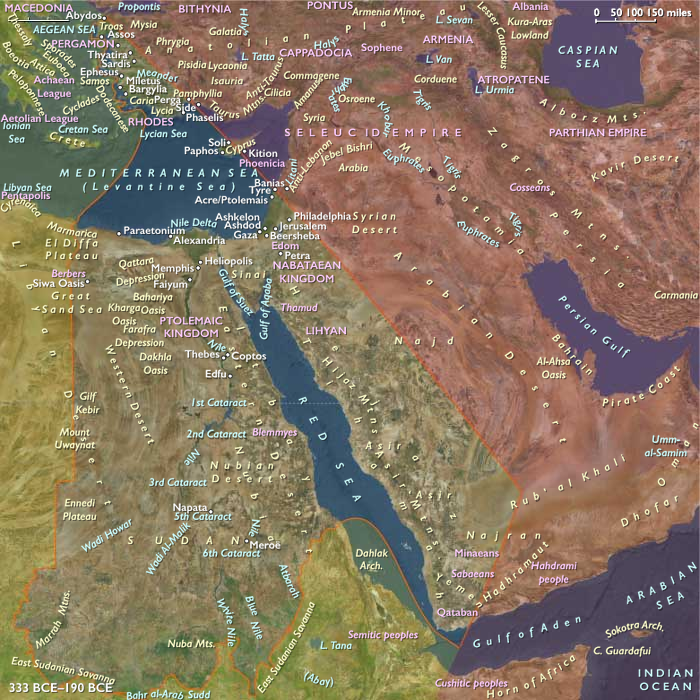
The members of the coalition against Antigonus Monopthalmus after his battle death in 301 had assigned all Syria to Seleucus, after what they regarded as Ptolemy's desertion, and for the next hundred years, the question of the ownership of southern Syria (i.e., Palestine) will produce recurring warfare between the Seleucid and Ptolemaic dynasties.
One of the cities over which they fight is Ashqelon, which becomes known during this period by its Hellenized name of Ascalon, a name it will retain throughout the era of the Crusades.
Similarly, …
Locations
People
Groups
Topics
Commodoties
Subjects
Regions
Subregions
Related Events
Filter results
Showing 10 events out of 64111 total
The Middle East: 297–286 BCE
Consolidation of Seleucid Power and Regional Stability
Seleucus I Nicator and the Expansion of the Seleucid Empire
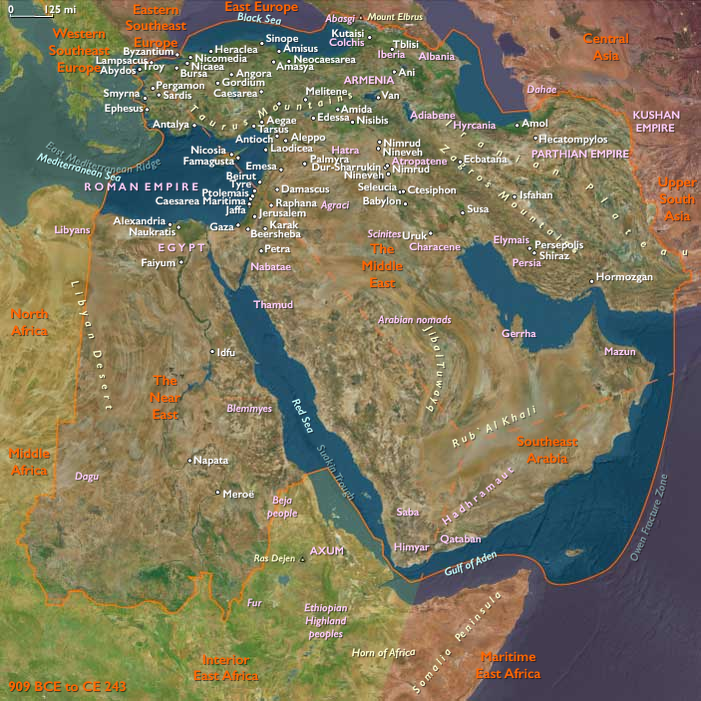
From 297 to 286 BCE, the Seleucid Empire, under the rule of Seleucus I Nicator (312–281 BCE), solidifies its control and expands significantly across the Near East. Seleucus, having secured a decisive victory in the earlier Babylonian War, further establishes his dominance by reinforcing his authority over Mesopotamia, Syria, and territories stretching eastward to Bactria and the borders of India. He skillfully manages the delicate balance of power among the diverse cultures and satrapies, laying robust administrative foundations.
Establishment and Growth of Antioch
In 300 BCE, Seleucus founds the strategically positioned city of Antioch on the Orontes River in Syria. Antioch rapidly emerges as a major urban, commercial, and cultural center, rivaling Alexandria and becoming a cornerstone of Hellenistic civilization. It serves as a vital administrative capital, ensuring effective governance across Seleucid territories in the Levant and western Mesopotamia.
Diplomatic and Military Consolidation
Seleucus skillfully negotiates treaties and diplomatic marriages, securing alliances and internal stability across his domains. His careful diplomacy is coupled with decisive military campaigns aimed at quelling rebellions and securing frontiers. Military reforms further enhance the Seleucid forces, blending Macedonian military traditions with local levies and employing war elephants, a notable innovation adopted from his earlier campaigns in India.
Cultural Integration and Patronage
Under Seleucus’s rule, the empire actively promotes Hellenistic culture alongside local traditions, fostering a cosmopolitan environment that attracts scholars, artists, and merchants. Seleucid patronage supports temples, gymnasiums, libraries, and cultural institutions, significantly enriching the intellectual and artistic landscape. Cities like Antioch and Seleucia-on-the-Tigris flourish, becoming vibrant hubs of Hellenistic cultural synthesis.
Stability and Economic Prosperity
This era is marked by relative peace and economic growth within the Seleucid realm. Infrastructure projects, including extensive road networks, marketplaces, and irrigation systems, greatly stimulate trade and agricultural productivity. The flow of goods between the Mediterranean and Central Asia intensifies, consolidating Seleucid control and prosperity across a vast region.
Thus, the years 297–286 BCE see the Seleucid Empire mature into a powerful and stable Hellenistic state, profoundly influencing the political, cultural, and economic landscape of the Middle East for generations.
Ashoka dispatches missionaries abroad, particularly to Tamraparni, the kingdom ruling the island now known as Sri Lanka.
Ashoka is said to have sent his own son, Mahinda, as a missionary there.
Near East (297–286 BCE): Seleucid-Ptolemaic Rivalry and the Hellenization of Palestine
Following the demise of Antigonus Monophthalmus at Ipsus in 301 BCE, the former members of the victorious coalition allocate all of Syria, including the strategically significant region of southern Syria (Palestine), to Seleucus I Nicator. This arrangement ignites enduring tensions and recurring conflicts between the Seleucid and Ptolemaic dynasties, each striving for dominance over the vital territory.
Among the contested cities is Ashqelon, increasingly known by its Hellenized name, Ascalon, a title it retains throughout subsequent eras, notably during the period of the Crusades. Other cities similarly adopt Hellenized names, such as Ashdod, which becomes known as Azotus, and Ekron, now referred to as Akkaron or Accaron.
The cultural transformation across these cities underscores the broader process of Hellenization that characterizes the period, as Greek culture, language, and administrative practices increasingly permeate the local populations. This era thus witnesses Palestine becoming a central theater of geopolitical rivalry, with each Hellenistic power aiming to secure strategic dominance through both military and cultural means.
…the city of Ashdod becomes known in Hellenistic times as Azotus; and …
…Ekron becomes known as Akkaron, or Accaron.
A tradition of prose satire dates back to the (lost) works of Menippus, who flourishes after 300 in Thebes.
Little is known about his life.
He was a native of Gadara in Coele-Syria.
The ancient sources agree that he was at one time enslaved.
He was in the service of a citizen of Pontus, but in some way obtained his freedom and lived at Thebes.
Diogenes Laërtius relates a dubious story that he amassed a fortune as a money-lender, lost it, and committed suicide through grief.
Lucian ranks Menippus with Antisthenes, Diogenes, and Crates as the most notable of the Cynics.
His works (written in a mixture of prose and verse) are all lost.
He discussed serious subjects in a spirit of ridicule, and especially delighted in attacking the Epicureans and Stoics.
Strabo and Stephanus call him the "earnest-jester".
His writings exercised considerable influence upon later literature, and the Menippean satire genre is named after him.
Although the writings of Menippus no longer survive, there are some fragments of Varro's Saturae Menippeae, which were written in imitation of Menippus.
One of the dialogues attributed to Lucian, his avowed imitator, who frequently mentions him, is called Menippus, but since the sub-title (The Oracle of the Dead) resembles that of a work ascribed to Menippus by Diogenes Laërtius, it has been suggested that it is imitated from his Necromancy.
Mediterranean Southwest Europe (297–286 BCE): Rome's Final Victory in the Samnite Wars
The era 297–286 BCE sees Rome solidifying its dominance over the Italian Peninsula through the conclusion of the Third Samnite War, a decisive struggle that unites multiple Italic peoples against Roman expansion but ultimately confirms Rome's ascendancy.
Roman Colonization and Military Preparations
Between 334–295 BCE, Rome establishes thirteen colonies strategically placed against the Samnites, creating six new rustic tribes to integrate annexed territories. Military colonies reinforce Roman presence in Campania and the eastern borders of Samnium, reflecting Rome’s deliberate territorial consolidation efforts. The Campanian cities, both Italic and Greek—including influential centers such as Capua—maintain varying degrees of independence as Rome's allies, critical to maintaining regional stability and loyalty.
Alliance of Rome’s Adversaries
Alarm spreads in Rome around 298 BCE as the Etruscans and Gauls from northern Italy ally themselves with the Samnites. For the first time, Rome confronts a united opposition rather than isolated foes. Initially, Roman forces suffer setbacks due to the strength and coordination of this alliance.
Decisive Victory at Sentinum
The pivotal moment arrives at the Battle of Sentinum (295 BCE) in Umbria, where the largest Italian armies yet assembled clash. Roman forces initially falter against a fierce assault by Gauls utilizing chariots. However, Roman military discipline, superior organization, and leadership turn the tide dramatically. This battle decisively crushes the allied forces of Gauls and Samnites, shifting momentum permanently in Rome’s favor.
Final Subjugation of the Samnites
Despite their defeat at Sentinum, the Samnites persist stubbornly in resistance until a further decisive defeat in 291 BCE renders continued struggle futile. Peace terms established in 290 BCE are harsh but notably more generous than typically afforded to defeated foes, recognizing the extraordinary tenacity and resilience of the Samnites.
Regional Implications and Roman Ascendancy
The conclusion of the Third Samnite War and the subsequent Roman victories firmly establish Rome as the preeminent power in central and southern Italy. This era's events not only underscore Rome's expanding territorial and political influence but also set a clear precedent for future integration strategies, utilizing colonization and alliances to manage conquered territories effectively.
Legacy of the Era
The period from 297–286 BCE decisively shapes the geopolitical landscape of Mediterranean Southwest Europe, marking Rome’s transition from regional power to dominant force, poised for broader Mediterranean ambitions. The events of this era lay critical foundations for Roman expansion, significantly influencing the historical trajectory of the Italian Peninsula and beyond.
Rome has founded thirteen colonies against the Samnites during the period 334–295 BCE, and created six new rustic tribes in annexed territory.
The Campanian cities, Italian or Greek, through which Rome has been involved in the Samnite wars, Capua and others, are now allies of Rome, with varying degrees of independence.
Roman military colonies are settled in Campania as well as on the eastern outskirts of Samnium.
The Romans are alarmed when they see the Etruscans and Gauls in northern Italy joining the Samnites.
The Romans have benefited from a lack of coordination among its enemies, but now Rome faces them all at once.
Some relief comes with a victory over the Samnites in the South, but the crucial battle for Italy takes place in 295 at Sentinum in Umbria, in Central Italy, where more troops are engaged than any previous battle in Italy.
The Romans at first give way before an attack by Gauls in chariots.
The Romans, benefiting from their self-discipline, the quality of their military legions, and their military leadership, then rally and crush the Samnites and Gauls.
The stubborn Samnites fight on nevertheless until a final defeat in 291 BCE makes further resistance hopeless, and in the following year, peace is made on more favorable terms for the Samnites than Rome would have granted any less dogged foe.
North Africa (297–286 BCE)
Carthaginian Strength, Cyrenaic Stability, and Berber Prosperity
Carthaginian Maritime Power and Economic Expansion
From 297 to 286 BCE, Carthage further solidifies its maritime dominance, actively reinforcing naval defenses and ensuring secure Mediterranean trade routes. This period sees continued territorial consolidation in northern Tunisia and vital colonies such as Leptis and Oea (modern Tripoli), enhancing Carthaginian economic growth and regional authority.
Economic partnerships with Berber tribes of the interior remain robust, fostering sustained trade and resource exchanges. Prosperous coastal trading hubs, particularly Tangier, continue flourishing, reinforcing the economic integration between coastal settlements and inland Berber communities.
Diplomatic Prudence and Regional Stability
Diplomatic engagements during this period reflect Carthage's consistent prudence and careful maneuvering amid the complexities of Mediterranean geopolitics. Relations with Greek city-states, notably Syracuse, and emerging Hellenistic powers remain strategically balanced to avoid conflict and maintain commercial prosperity. Carthage successfully safeguards territorial integrity and economic interests through skilled diplomatic management.
Cyrenaica’s Economic Vitality and Autonomous Governance
The Greek Pentapolis—Cyrene, Barce (Al Marj), Euhesperides (Benghazi), Teuchira (Tukrah), and Apollonia (Susah)—continues its robust economic performance, anchored by significant exports of grain, fruit, horses, and especially the valuable medicinal plant Silphium. Continued investment in civic infrastructure and religious institutions underscores Cyrene’s ongoing economic strength and political autonomy.
Cyrenaica adeptly navigates external pressures, maintaining its autonomy and preserving Greek cultural heritage through effective diplomatic negotiations with neighboring regional powers and the broader Hellenistic world.
Berber Integration and Economic Prosperity
Berber communities persistently deepen their economic integration within Carthaginian trade networks, embracing advanced agricultural practices, maritime techniques, and artisanal innovations. Essential coastal economic centers, notably Oea (Tripoli), sustain their regional importance, significantly contributing to North Africa’s prosperity and stability.
Inland Berber tribes continue maintaining their autonomy, preserving traditional governance systems and cultural identities while indirectly benefiting from vibrant coastal economies. This relationship further enhances economic stability and regional cohesion.
Rich Cultural Exchange and Religious Syncretism
Interactions among Berber, Carthaginian, and Greek populations intensify, leading to further cultural and artistic developments in pottery, textiles, and metalwork. Religious syncretism advances further, harmonizing indigenous Berber traditions with Phoenician and Greek religious practices, enriching the region’s cultural diversity and complexity.
Stable Foundations for Ongoing Influence
By 286 BCE, North Africa maintains strong political stability, vibrant economic prosperity, and rich cultural interactions. Carthage’s maritime supremacy, Cyrenaica’s diplomatic resilience, and effective Berber integration collectively underpin the region’s enduring prominence and sustained influence within the broader Mediterranean sphere.

The Macedonian princess Arsinoe, daughter of Ptolemy Soter of Egypt and the new wife of of Lysimachus, Macedonian king of Thrace and the greater part of Asia Minor, persuades him to have the son of his former wife Amastris, the widowed niece of the last Persian king Darius III, who had divorced herself from Lysimachus, put to death so that her own sons by him would one day inherit the crown.