A period of tension, punctuated by civil …
Years: 1666 - 1666
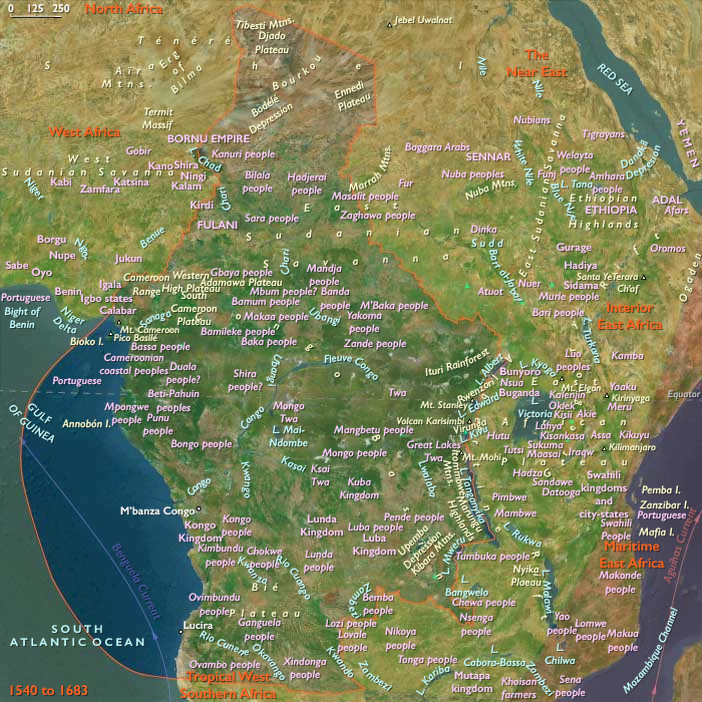
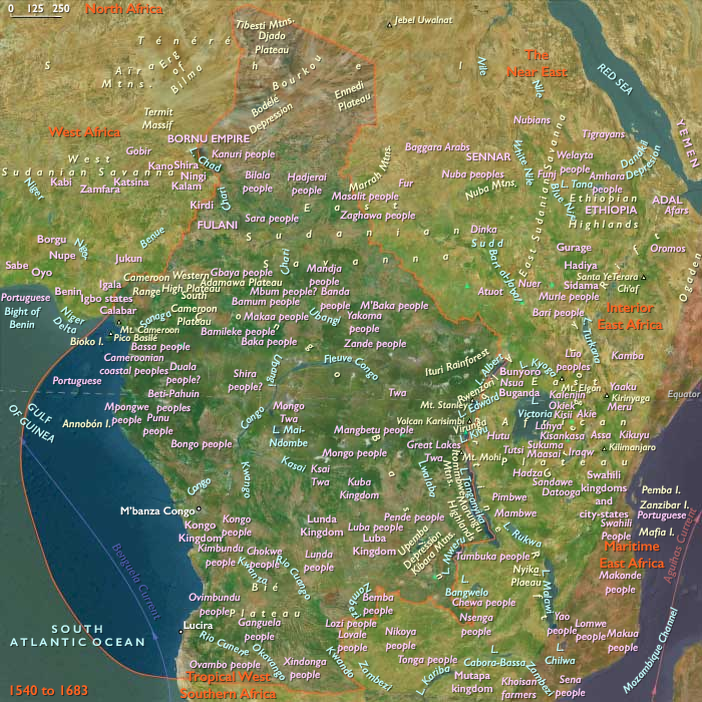
A period of tension, punctuated by civil war, had broken out after Queen Nzinga's death.
Her sister Barbara had succeeded her, but is killed by forces loyal to Nzinga Mona in 1666.
Locations
Groups
Topics
- Interaction with Subsaharan Africa, Early European
- Servitude, slavery, and abolitionism
- Kongo Civil War
Commodoties
Subjects
Regions
Subregions
Related Events
Filter results
Showing 10 events out of 30995 total
Xin'an has ceased to be a separate administrative county by the fifth year of Kangxi.
When the new boundaries had been fixed, the inhabitants living outside them had been given notice to move inland, the orders enforced by troops.
As a result, whole communities have been uprooted from their native place, deprived of their means of livelihood and compelled to settle where they can.
The rural people risk their lives if they ignore the government edict to move, or venture back into the prohibited area.
It is recorded that about sixteen thousand persons from Xin'an were driven inland.
What is now the territory of Hong Kong becomes largely wasteland during the ban.
Alexis has the deposed Nikon condemned by a sobor (council of the Russian Orthodox Church) in 1666; Nikon goes into exile, but his reform of the liturgy remains intact.
Dissenters from his reforms, known as Old Believers, continue to this day.
The city of Lund, which has a long history as a center for learning, had been the ecclesiastical center and seat of the archbishop of Denmark. (A cathedral school for the training of clergy, established in 1085, is today Scandinavia's oldest school.)
A studium generale (a medieval university education) was founded in 1425, but had to close in 1536 in connection with the Danish reformation.
After the Treaty of Roskilde in 1658, the Scanian lands had come under the possession of the Swedish Crown, which quickly founds the Lund University in 1666 as the means of Swedification.
It is the today the second-oldest university on Swedish ground.
Jan Sobieski, after graduating from the Nowodworski College in Kraków, had then graduated from the philosophical faculty of the Jagiellonian University.
After finishing his studies, together with his brother Marek, John had left for western Europe, where he had spent more than two years traveling.
During that time he had met such major political figures as Louis II de Bourbon, Charles II of England and William II, Prince of Orange, and learned French, German and Italian, in addition to Latin.
This will prove to be vital during his later military career.
Both brothers returned to Poland in 1648 and volunteered for the army during the Khmelnytsky Uprising.
Jan had founded his own banner of cavalry and commanded it in the rank of Rotamaster.
The brothers had been separated after the Battle of Zboriv, and Marek had died in Tatar captivity the following year.
Jan, promoted to the rank of pułkownik, had fought with distinction in the Battle of Berestechko.
A promising commander, Jan had been sent by King John II Casimir to Istanbul in the Ottoman Empire as an envoy, where Sobieski had learnt the Tatar language and studied Turkish military traditions and tactics.
After the start of the Swedish invasion of Poland known as "The Deluge", Sobieski had been among the Greater Polish regiments led by Krzysztof Opaliński, Palatine of Poznań which capitulated at Ujście, and sworn allegiance to King Charles X Gustav of Sweden.
However, in less than a year he had returned with his unit to the Polish side, and after April 1656, he again fought for the Polish king.
During the three-day long battle of Warsaw of 1656, Sobieski's command of a two thousand man-strong regiment of Tatar cavalry earned him promotion to the title of Lord Standard-Bearer of the Crown.
He had married Marie Casimire Louise de la Grange d'Arquien in 1665 and had been promoted to the rank of Grand Marshal of the Crown, and the following year, to the rank of Field Hetman of the Crown.
A strong supporter of the French faction, Sobieski remains loyal to the King during the infamous Lubomirski Rebellion, which further helps his military career, though Lubomirski’s rebels defeat royal forces led by Sobieski at Mątwy in 1666.
Moulay Ali Cherif, allegedly a descendant of l-Hesn d-Dakhl, a decendant of the prophet Muhammad who had been taken to Morocco from the town of Yanbu in the Hejaz at the end of the thirteenth century by the inhabitants of Tafilalt to be their Imām, is considered to have been the founder of the Alaouite Dynasty of Morocco, which still reigns today.
He had begun to increase his power in the Tafilalt during the anarchy following the death of the Saadi ruler Ahmad al-Mansur (1578–1603) and ruled that region from (1631–1640).
In 1635 his son Moulay Mohammed had succeeded his still living father.
After the death of Moulay Ali Cherif, Moulay Mohammed brought Tafilalt, the Draa River valley and the Sahara region under Alouite power.
However due to internal feuding war had broken out between Mohammed and his brother, Moulay al-Rashid, and troops of al-Rashid had killed Mohammed in 1664.
Ruling the east of Morocco with a small army, al-Rashid has been able to expand his power and seize Taza.
In 1666,
al-Rashid marches into Fes and ends the rule of the Saadi dynasty.
Vermeer's The Art of Painting, also known as The Allegory of Painting, and or Painter in his Studio, is the largest and most complex of all of Vermeer's works.
Many art historians believe that it is an allegory of painting, hence the alternative title of the painting.
The painting is famous for being one of Vermeer's favorites, and is also a fine example of the optical style of painting, offering a realistic visual depiction of the scene and especially the effects of light streaming through the windows on various elements of the painting.
It depicts a painter painting a female subject in his studio, by a window, with a large map of the Netherlands on the wall behind.
The painting has only two figures, the painter and his subject.
The painter is thought to be a self-portrait of the artist, though the face is not visible.
A number of the items shown in the artist's studio are thought to be somewhat out of place.
The marble tiled floor and the golden chandelier are two examples of items which would normally then be reserved for the houses of the well-to-do.
Experts attribute symbolism to various aspects of the painting.
The subject is the Muse of History, Clio.
This is evidenced by her wearing a laurel wreath, holding a trumpet (depicting fame), possibly carrying a book by Thucydides, which matches the description in Cesare Ripa's sixteenth century book on emblems and personifications titled Iconologia.
The double headed eagle, symbol of the Austrian Habsburg dynasty, former rulers of Holland, which adorns the central golden chandelier, may have represented the Catholic faith.
Vermeer is unusual in being a Catholic in a predominantly Protestant Netherlands.
The absence of candles in the chandelier might represent the suppression of the Catholic faith.
The map on the back wall has a rip that divides the Netherlands between the north and south.
(West is at the top of the map, as was the custom.)
The rip symbolizes the division between the Dutch Republic to the north and the Habsburg controlled Flemish provinces to the south.
The map by Claes Jansz Visscher (Nicolaum Piscatorem) shows the earlier political division between the Union of Utrecht to the north, and the colonies to the south.

Jean Talon, the first intendant to arrive in New France, seeks to boost the growth and prosperity of the remote colony by making it self-sufficient.
On his arrival in 1665, he initiated attempts to diversify the colony's economy by encouraging agriculture, fishing, lumbering, and industry as well as the traditional fur trade.
He conducts the first census in North America in 1666, counting three thousand two hundred and fifteen of its residents.
There is a severe imbalance between single men and women because most female immigrants have had to pay their own passage, and there are few single women who voluntarily come to settle in the harsh climate and conditions of New France.
The majority of the women in the colony are indentured servants or nuns.
France has also, for a long time, considered New France as an outpost rather than a colony, and has not concerned itself with increasing the population.
The most innovative idea instituted by Talon is bringing around seven hundred and nine hundred Frenchwomen (accounts vary as to the exact numbers) to New France.
Agents are hired to find ideal young women, who would marry quickly and bear children, and to whom a sum of thirty livres is given for a wardrobe of two sets of clothes and 60 livres for their transport.
These filles du roi (King's Daughters), who will emigrate to New France between 1663 and 1673, would serve to triple the population of New France within fifteen years.
The title "King's Daughters" is meant to imply state patronage, not royal or even noble parentage.
Most of these women are commoners of humble birth.
Many Daughters are poor, especially those from Île-de-France and Normandy.
They are considered "orphans" by virtue of having lost at least one parent, though not necessarily both; some have both parents living.
The Meskwaki, or Foxes, had lived east of Michigan along the Saint Lawrence River.
The tribe may have numbered as many as ten thousand, but years of war with the French-supplied Hurons and exposure to infectious disease had reduced their numbers and forced them west, initially to the area between Saginaw Bay and Detroit in Michigan.
The Meskwaki move their main village in the winter of 1665-1666 to ...
...a point on the Wolf River, a tributary of the Fox River, in Wisconsin.
Years: 1666 - 1666
Locations
Groups
Topics
- Interaction with Subsaharan Africa, Early European
- Servitude, slavery, and abolitionism
- Kongo Civil War