Moldavia and its prince, Stephen the Great …
Years: 1468 - 1479
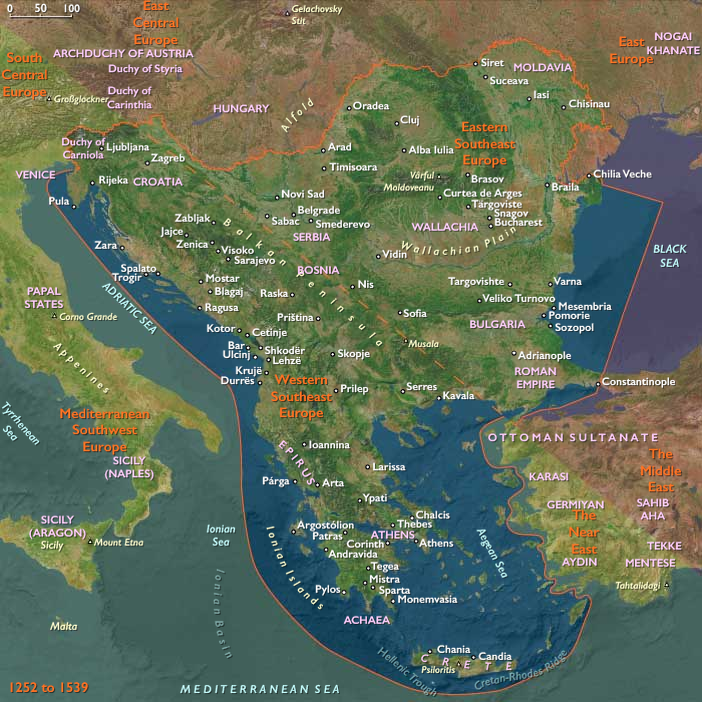
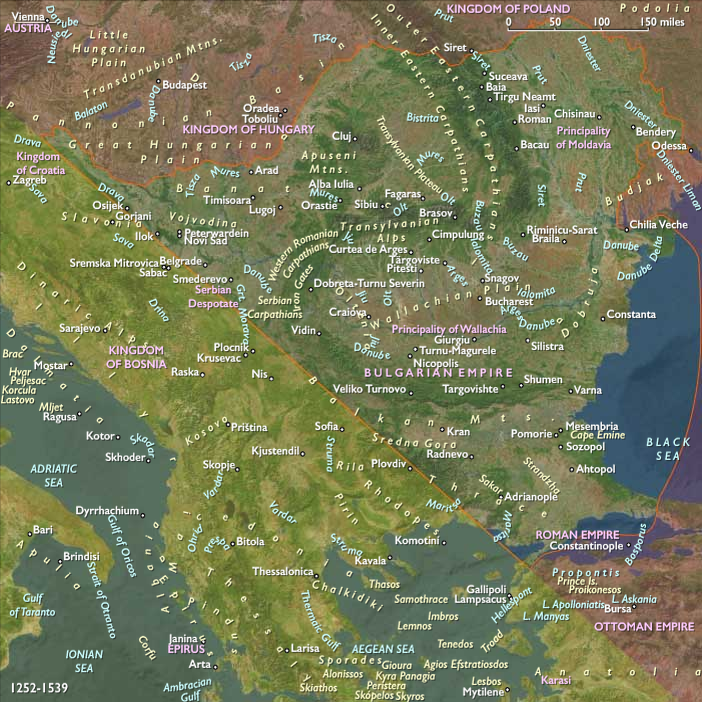
Moldavia and its prince, Stephen the Great (1457-1504), are the principalities' last hope of repelling the Ottoman threat.
Stephen draws on Moldavia's peasantry to raise a fifty-five thousand-man army and repels the invading forces of Hungary's King Matyas Corvinus in a daring night attack.
Stephen's army invades Walachia in 1471 and defeats the Turks when they retaliate in 1473 and 1474.
After these victories, Stephen implores Pope Sixtus IV to forge a Christian alliance against the Turks.
The pope replies with a letter naming Stephen an "Athlete of Christ", but he does not heed Stephen's calls for Christian unity.
Locations
People
Groups
- Romanians
- Christians, Roman Catholic
- Christians, Eastern Orthodox
- Hungary, Kingdom of
- Roman Empire, Eastern: Palaiologan dynasty
- Ottoman Empire
- Moldavia, Principality of
- Wallachia (Ottoman vassal), Principality of
- Turkish people
Topics
- Ottoman-Hungarian War of 1441-44
- Varna, Crusade of
- Ottoman-Hungarian War of 1444-56
- Varna, Battle of
Subjects
Regions
Subregions
Related Events
Filter results
Showing 10 events out of 41031 total
The rival Thai kingdoms of Chiang Mai and Ayutthaya have attempted diplomacy to settle their differences during the four years of peace between them, but these encounters result in bloodshed in 1468.
Border hostilities continue until the Ayutthayans invade in 1474 and seize Chiang Mai territory.
Chiang Mai’s long ruling monarch, Sri Sutham Tilok, after suffering military reversals, sues for peace in 1475.
No formal peace is concluded, but hostilities cease.
Zhu Jianshen, a son of the Zhengtong Emperor, was only two years old when his father was captured by the Oirat Mongols and held captive in 1449.
After that, his uncle, the Jingtai Emperor, had taken over while his father was put under house arrest for almost seven years.
During this time, Zhu Jianshen lived under his uncle's shadow and even had his title of crown prince removed while the Jingtai Emperor installed his own son as heir.
Zhu Jianshen was only reinstated as crown prince on the eve of the death of the Jingtai Emperor in 1457.
Known as the Chenghua Emperor, he had ascended the throne at the age of sixteen.
During the early part of his administration, he has carried out new government policies to reduce tax and strengthen the Ming dynasty.
However these do not last and by the closing years of his reign, governmental affairs will once again fall into the hands of eunuchs, notably Wang Zhi.
Peasant uprisings occur throughout the country and are violently suppressed.
The Chenghua Emperor's reign is also more autocratic than his predecessors' and freedom is sharply curtailed when the emperor establishes institutes such as the Western Depot (to complement the existing Eastern Depot), monitoring all civilians' actions and words.
This institute, not unlike a spy agency, administers punishment to those whom they suspected of treason.
The Western Depot will eventually be shut down but it is the start of a dangerous trend, and the Chenghua Emperor's descendants will again revive the Western Depot during the sixteenth century.
The Chenghua Emperor is also under the influence of Lady Wan, who is an imperial concubine more than twice his age.
Lady Wan had been a mother figure to the young emperor but after he ascended the throne she had quickly become the emperor's favorite consort after giving birth to a child in 1464.
The child had soon died; however, Lady Wan holds sway over the imperial harem and prevents the young emperor from bearing any offspring.
Lady Wan and her eunuchs either induce abortion to those who are about to bear the emperor's child or administer poison to mother and child if birth occurs.
It is not until 1475 that the Chenghua Emperor discovers that he has a son (later the Hongzhi Emperor) who survives and is raised in secrecy.
East Europe (1468–1479 CE): Muscovite Expansion, Khanate Emergence, and Internal Consolidation
Political and Military Developments
Territorial Growth and Authority Strengthening
Between 1468 and 1479 CE, Muscovy expanded its territorial boundaries, further solidifying its political and military dominance in East Europe. Enhanced administrative efficiency contributed significantly to the consolidation of power.
Diplomatic Successes and Regional Stability
Muscovy successfully navigated diplomatic relationships with neighboring states, employing strategic marriages, treaties, and alliances to mitigate conflicts and strengthen its regional position.
Emergence of the Khanates
The collapse of the Golden Horde subsequent to Timur’s conquest led to the emergence of separate khanates such as Astrakhan, Crimea, and Kazan. These entities became significant regional powers, influencing political dynamics and interactions with Muscovy.
Continued Integration of Ethnic Communities
Ethnic communities including the Mari, Mordvins, Udmurts, Komi, and Vepsians experienced increased integration within Muscovite society, bolstering administrative unity and social cohesion.
Economic and Technological Developments
Robust Economic Growth
The Muscovite economy thrived, driven by flourishing internal markets and sustained international trade relationships. Key urban centers such as Moscow, Novgorod, and Tver experienced significant economic development.
Military and Defensive Innovations
Muscovy continued advancing military technology, particularly in fortification design, siege capabilities, and cavalry tactics. These advancements were crucial for territorial defense and regional stability.
Cultural and Artistic Developments
Ongoing Cultural Fusion and Artistic Achievement
Cultural development flourished through the continued integration of Rus', Mongol, and ethnic artistic traditions. Architectural innovation, religious art, and secular artistic expressions notably advanced during this period.
Intellectual and Literary Productivity
Scholarly and literary activities thrived, with extensive documentation of historical, religious, and cultural narratives. Intellectual productivity significantly reinforced regional identity and historical continuity.
Settlement Patterns and Urban Development
Urban Development and Infrastructure Enhancement
Urban centers, especially Moscow, continued their demographic and economic growth, supported by improved infrastructure and sophisticated governance systems, facilitating greater administrative effectiveness.
Enhanced Urban Fortifications
Cities further upgraded their defensive infrastructure, strengthening strategic fortifications and protecting regional urban centers from external threats.
Social and Religious Developments
Social Integration and Cohesiveness
Societal frameworks evolved to effectively accommodate diverse ethnic groups, creating enhanced social harmony and political stability under Muscovite centralized rule.
Orthodox Church’s Central Influence
The Orthodox Church continued playing a pivotal role, influencing education, morality, and community cohesion, thus significantly contributing to societal stability and cultural continuity.
Ethnic and Cultural Shifts
Historical Background of the Tatars and Turkic Peoples
Numerous Turkic tribes inhabited the region from the eleventh to sixteenth centuries, including territories now part of Russia and Kazakhstan. The area known today as Tatarstan was originally inhabited by the Volga Bulgars, who had settled along the Volga River since the eighth century and converted to Islam in 922, influenced by the missionary work of Ahmad ibn Fadlan.
Following the Mongol invasion of Europe from 1241, Volga Bulgaria was defeated and incorporated into the Golden Horde, significantly disrupting the region's demographic structure. Various theories exist regarding the subsequent mixing between the Volga Bulgars and the Cuman-Kipchaks of the Horde. While one theory suggests considerable intermingling, another (known as Bulgarism) argues that such mixing was minimal. Nonetheless, the population eventually adopted the Kipchak language and the ethnonym "Tatars," while Islam became widely embraced.
Long-Term Consequences and Historical Significance
The period from 1468 to 1479 CE marked a crucial phase in Muscovite territorial expansion, political centralization, and cultural enrichment. The emergence of independent khanates and the integration of diverse ethnicities shaped regional dynamics profoundly, laying foundational structures for a unified and culturally diverse Russian state.

The Golden Horde had broken up subsequent to Timur’s conquest into the separate khanates of Astrakhan, ...
…Crimea, and …
...Kazan.
Numerous Turkic tribes during the eleventh to sixteenth centuries live in what is now Russia and Kazakhstan.
The present territory of Tatarstan had been inhabited by the Volga Bulgars, who had settled on the Volga River in the eighth century and converted to Islam in 922 during the missionary work of Ahmad ibn Fadlan.
After the Mongol invasion of Europe from 1241, Volga Bulgaria had been defeated, ruined, and incorporated into the Golden Horde.
Few of the population survived, nearly all of them moved to northern territories.
According to one theory, there was some degree of mixing between it and the Cuman-Kipchaks of the Horde during the ensuing period, yet according to another theory called Bulgarism, the Bulgars did not mix with the Cuman-Kipchaks.
The group as a whole accepted the language of the Kipchaks and the ethnonym "Tatars" (although the name Bulgars persisted in some places), while the bulk of invaders eventually converted to Islam.
Moscow has for centuries vied for supremacy in Russia with Novgorod, long a great trading center with extensive holdings in northern Russia.
Novgorod’s alliance to Roman Catholic Lithuania creates great friction with the Orthodox Christians of Moscow, and the northern city’s formation of a strong alliance with Poland in 1471 prompts Moscow’s Grand Duke Ivan II to declare war.
Ivan, advancing his forces against the Novgorodans, defeats them on the Shelon River and the Shilenga River in 1475.
Novgorod, promised military aid from Poland not forthcoming, elects to surrender, granting Ivan an indemnity of over fifteen thousand rubles and the right to nominate his own archbishop for the city.
Further, Novgorod is compelled to pledge against any alliance with Lithuania.
Rebels, protesting Ivan’s title of “lord” of the Novgorod, disrupt the city in 1477.
Ivan, aided, as before, by the cities of Pskov and Tver (present Tallin), advances toward Novgorod.
After refusing to negotiate, he forces the city’s surrender when its rebellious leader resigns in January 1478, then abducts some boyars and confiscates Novgorod’s monastic estates.
In 1479, Novgorod stages another independence effort, but Ivan’s forces crush the revolt and take many of its citizens captive.
Northeast Europe (1468–1479 CE): Internal Union Struggles, Persistent Rivalries, and Shifting Alliances
Between 1468 and 1479 CE, Northeast Europe continued experiencing internal tensions within the Kalmar Union, persistent rivalries involving the Teutonic Knights, and sustained dominance by the Polish–Lithuanian Union. Strategic realignments and diplomatic maneuvers significantly shaped the region’s political and economic landscapes, driven by key figures such as Margaret I, Christian I, and Casimir IV Jagiellon.
Teutonic Knights’ Continued Decline
The Teutonic Knights persisted in facing severe internal divisions, economic hardships, and territorial vulnerability within Prussia. Their declining military and political capabilities further limited their regional influence, making them susceptible to diplomatic pressures and territorial encroachments, particularly from Poland and Lithuania.
Escalation of Kalmar Union Conflicts
Conflicts intensified within the Kalmar Union under Danish King Christian I, who struggled to maintain unity following the precedent of centralization set by Margaret I. The Swedish nobility increasingly resisted Danish dominance, and internal autonomy movements gained significant strength, contributing to greater regional instability. This internal discord weakened the Union’s authority, setting the stage for heightened confrontations and eventual disintegration.
Polish–Lithuanian Union’s Continued Dominance
Under King Casimir IV Jagiellon, the Polish–Lithuanian Union continued solidifying its political and territorial authority. Effective diplomacy, military strength, and internal governance strategies maintained regional stability, enabling the union to extend its influence, resist external threats, and reinforce its dominant geopolitical position.
Strategic Adjustments in the Livonian Confederation
The Livonian Confederation, administered from Riga, navigated the complex geopolitical environment strategically. Strengthening fortifications, reinforcing diplomatic ties, and reforming internal governance allowed the Confederation to preserve autonomy, economic stability, and regional relevance amid external pressures.
Strengthened Swedish-Finnish Integration
Despite ongoing Union conflicts, Sweden maintained robust integration and administration of southern Finland. Reinforced defenses, administrative networks, and ecclesiastical institutions facilitated strong political, economic, and cultural alignment between Sweden and Finland, mitigating the broader tensions stemming from the Kalmar Union's instability.
Economic Growth and Urban Prosperity
Urban centers such as Reval (Tallinn), Riga, Königsberg, and Visby on Gotland continued to prosper, benefiting from robust maritime trade and expanded commercial connections. These economic hubs provided vital stability, significantly contributing to regional resilience despite the era’s political complexities.
Ecclesiastical Influence and Cultural Continuity
Ecclesiastical institutions, notably the Teutonic Order and prominent regional bishoprics, continued their essential roles in education, governance, and social stability. Their influence significantly strengthened Latin Christian traditions, contributing to cultural cohesion and regional stability amid geopolitical uncertainties.
Persistent Geopolitical Complexities
The era remained characterized by shifting geopolitical alliances, persistent regional rivalries, and diplomatic complexities. The weakening of the Teutonic Knights, the internal divisions of the Kalmar Union, and the sustained ascendancy of the Polish–Lithuanian Union necessitated ongoing diplomatic negotiations and strategic realignments.
Legacy of the Era
The period from 1468 to 1479 CE was marked by intensifying internal conflicts, continued power struggles, and strategic political realignments shaped by significant historical figures. These dynamics significantly influenced future territorial boundaries, regional political structures, and cultural identities, leaving an enduring legacy across Northeast Europe.
East Central Europe (1468–1479 CE): Bohemian–Hungarian War, Matthias Corvinus's Regional Dominance, Jagiellonian Dynastic Expansion, and Peace of Olomouc
Between 1468 and 1479 CE, East Central Europe experienced intense geopolitical rivalries and significant territorial realignments dominated by the military and diplomatic conflicts between King Matthias Corvinus of Hungary and King George of Poděbrady of Bohemia, the expanding influence of the Jagiellonian dynasty, and evolving power dynamics within the Holy Roman Empire. These developments culminated in the critical Peace of Olomouc (1479), reshaping regional political boundaries and significantly influencing subsequent Central European history.
Political and Military Developments
Bohemian–Hungarian War (1468–1478)
-
The prolonged conflict between Matthias Corvinus of Hungary (r. 1458–1490) and George of Poděbrady of Bohemia (r. 1458–1471) erupted primarily due to religious tensions and competing dynastic ambitions. Matthias, backed by Papal support opposing George's moderate Hussite sympathies, invaded Bohemia in 1468, initiating over a decade of destructive warfare.
-
The war significantly destabilized Bohemia, undermined Poděbrady’s rule, and severely impacted economic prosperity, despite George's persistent efforts to consolidate internal unity and defense.
Jagiellonian Dynasty and Bohemian Succession
-
Following George of Poděbrady’s death in 1471, Vladislaus II Jagiellon (r. 1471–1516), son of Polish King Kazimierz IV, was elected King of Bohemia, significantly extending the Jagiellonian dynasty's influence beyond Poland-Lithuania.
-
Vladislaus’s accession established a dynastic rivalry with Matthias Corvinus, exacerbating regional tensions and leading to protracted struggles over control of Moravia, Silesia, and Lusatia.
Matthias Corvinus’s Territorial Expansion and Control
-
Despite prolonged conflicts, Matthias Corvinus successfully asserted Hungarian dominance over substantial Bohemian territories, notably Moravia, Silesia, and Lusatia, controlling them through effective administration and military occupation.
-
Matthias’s expanded control reinforced Hungarian regional hegemony, bolstered his international prestige, and significantly reshaped East Central Europe’s geopolitical landscape.
Peace of Olomouc (1479)
-
After intense negotiations, Matthias Corvinus and Vladislaus II Jagiellon concluded the Peace of Olomouc (1479), partitioning Bohemian lands. Matthias retained control over Moravia, Silesia, and Lusatia, while Vladislaus maintained sovereignty over Bohemia proper.
-
The treaty significantly stabilized regional politics, ending direct Hungarian-Bohemian warfare and solidifying Hungarian dominance over key strategic territories.
Teutonic Order’s Subordination (Second Treaty of Thorn, 1466)
-
The Second Peace of Thorn (1466), concluding the Thirteen Years' War (1454–1466), officially subordinated the Teutonic Order to Polish-Lithuanian authority, with western Prussia (Royal Prussia) becoming a Polish dependency and significantly reshaping Baltic geopolitical dynamics.
Economic and Technological Developments
Post-War Economic Recovery and Growth
-
Despite severe disruptions from military conflicts, Bohemia and Hungary gradually recovered economically, driven by improved agricultural productivity, renewed mining activities (silver, gold, copper), and revitalized trade routes linking the Baltic, Mediterranean, and Western Europe.
-
Moravian and Silesian towns, notably Olomouc and Breslau (Wrocław), recovered economically under Matthias Corvinus’s administration, benefiting from enhanced infrastructure, stable governance, and increased trade.
Cultural and Artistic Developments
Hungarian Renaissance under Matthias Corvinus
-
Matthias Corvinus continued promoting significant cultural patronage, transforming Hungary into a flourishing Renaissance center. His capital, Buda, attracted prominent scholars, artists, and architects, significantly enhancing Hungary’s cultural and intellectual prominence in Europe.
Cultural Stability and Recovery in Bohemia
-
Despite war-induced disruptions, Bohemian cultural and artistic life gradually recovered under Vladislaus Jagiellon’s rule, sustaining Gothic artistic traditions, literary production, and ecclesiastical patronage, especially centered around Prague.
Settlement and Urban Development
Fortifications and Defensive Infrastructure
-
Prolonged conflicts necessitated substantial improvements in defensive fortifications throughout East Central Europe, particularly in Bohemian territories, Moravia, and Silesia. Key cities, including Olomouc, Brno, Breslau, and Prague, strengthened their defensive infrastructure, significantly enhancing regional security.
Urban Revitalization Post-War
-
With regional stabilization following the Peace of Olomouc, towns and cities across Bohemia, Moravia, Silesia, and Hungary experienced significant revitalization and renewed urban development, reflecting improved economic conditions and governance stability.
Social and Religious Developments
Religious Tensions and Moderate Hussitism
-
Religious tensions persisted notably in Bohemia, balancing moderate Hussitism against Catholic orthodoxy. Vladislaus II navigated complex religious dynamics, maintaining relative religious tolerance while reinforcing the Catholic presence, reshaping Bohemian religious life.
Strengthened Aristocratic Privileges
-
Aristocratic classes in Bohemia, Hungary, and Poland-Lithuania significantly increased their political and economic influence, leveraging royal dependencies and wartime instabilities to secure expanded privileges, local autonomy, and strengthened governance roles.
Long-Term Consequences and Historical Significance
The era 1468–1479 CE critically reshaped East Central Europe's medieval political landscape. Matthias Corvinus’s successful expansion, culminating in the Peace of Olomouc, reinforced Hungary's regional hegemony, permanently altering Bohemian territorial dynamics. The accession of Vladislaus II Jagiellon in Bohemia significantly expanded Jagiellonian dynastic influence, deeply affecting future regional alignments and diplomatic interactions. Economic recovery, cultural flourishing under Hungarian Renaissance patronage, and increased aristocratic power solidified societal transformations, influencing East Central Europe's subsequent medieval trajectory. These events profoundly shaped the region’s political, cultural, and social identities, laying foundational structures for future early modern transformations.
The once-powerful Kingdom of Bohemia has been reduced by the 1470s to the territory of Bohemia proper.
The Bohemian War begins when the Kingdom of Bohemia, ruled by the Hussite king, George of Poděbrad, is invaded by the king of Hungary, Matthias Corvinus, under the pretext of returning Bohemia to Catholicism.
Matthias' invasion is largely successful, leading to his acquisition of the southern and eastern parts of the country.
Its core lands, however, centered on Prague, are never taken.
Ultimately both Matthias and Poděbrad proclaim themselves king, though neither ever acquire all the necessary subordinate titles.
When Poděbrad dies in 1471, his successor Vladislaus II continues the fight against Matthias.
In 1478, the war ends following the treaties of Brno and Olomouc.
Years: 1468 - 1479
Locations
People
Groups
- Romanians
- Christians, Roman Catholic
- Christians, Eastern Orthodox
- Hungary, Kingdom of
- Roman Empire, Eastern: Palaiologan dynasty
- Ottoman Empire
- Moldavia, Principality of
- Wallachia (Ottoman vassal), Principality of
- Turkish people
Topics
- Ottoman-Hungarian War of 1441-44
- Varna, Crusade of
- Ottoman-Hungarian War of 1444-56
- Varna, Battle of