Hamilcar Barca enjoys such influence among the …
Years: 237BCE - 237BCE
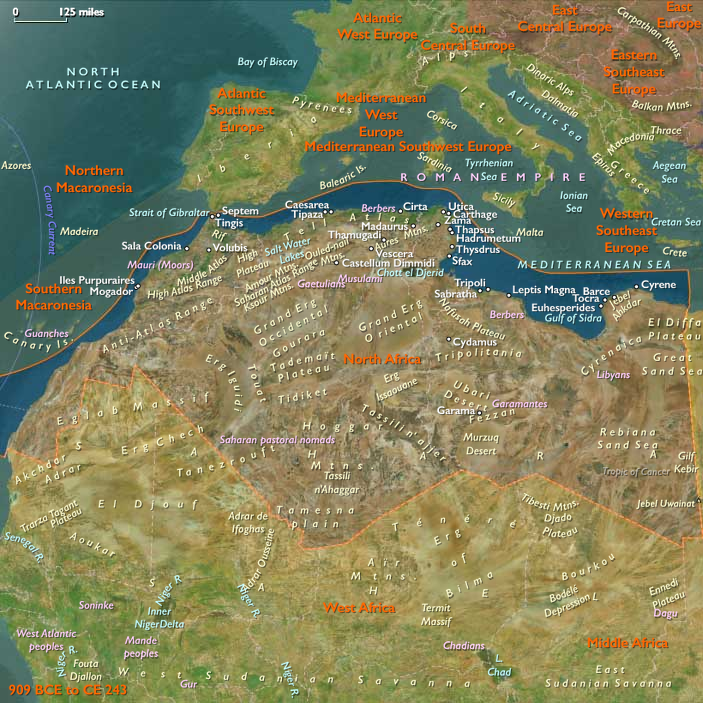
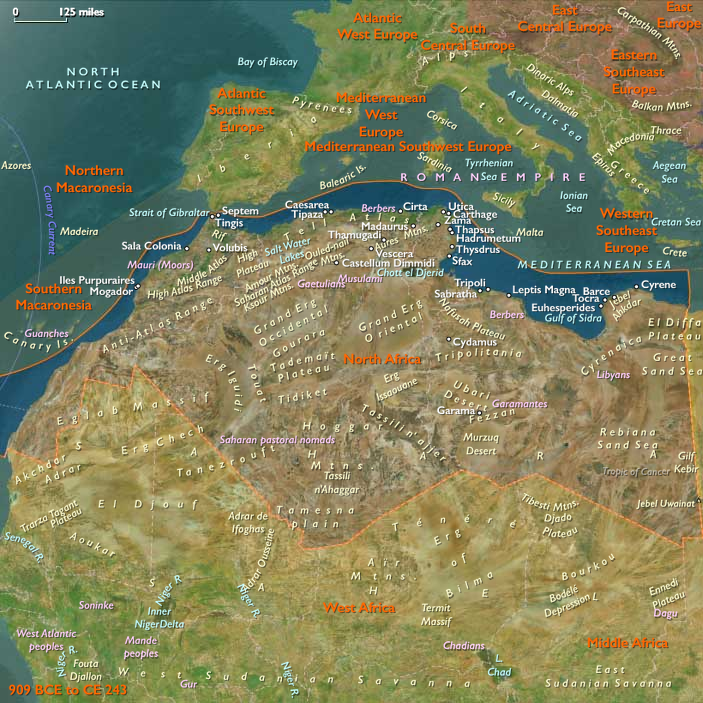
Hamilcar Barca enjoys such influence among the popular and patriotic party after his success in the Mercenary War that his opponents cannot prevent him being raised to a virtual dictatorship.
Allying with Hasdrubal the Fair, his future son in law, to restrict the power of the aristocracy led by Hanno the Great, Hamilcar obtains permission from the Carthaginian Senate for recruiting and training a new army, with the immediate goal of securing the African domain of Carthage.
Hamilcar obtains training for the army in some Numidian forays, then marches the army west to the straits of Gibraltar.
Hasdrubal the Fair commands the fleet carrying supplies and elephants along the coast, keeping pace with the army.
Locations
People
Groups
Topics
Commodoties
Subjects
Regions
Subregions
Related Events
Filter results
Showing 10 events out of 63786 total
The Qin state launches a series of military campaigns in the late third century BCE against the other six major states—Han, Zhao, Yan, Wei, Chu and Qi—within the territories that form modern China.
Zhao attacks Yan in 236 BCE, and Qin uses the opportunity to send two separate forces to invade Zhao.
One Qin army conquers the Zhao territories of Eyu (present-day Heshun County, Jinzhong, Shanxi) and Liaoyang (present-day Zuoquan County, Jinzhong, Shanxi), while the other Qin army captures Ye (present-day Ci County, Handan, Hebei) and Anyang (present-day Anyang County, Anyang, Henan).
Zhao loses nine cities and its military prowess is weakened.
Two years later, Qin plans to attack Han, but fears that Zhao might render support to Han, so it sends an army to attack Zhao's Pingyang (southeast of present-day Ci County, Handan, Hebei) and Wucheng (southwest of present-day Ci County, Handan, Hebei).
More than one hundred thousand soldiers are killed in the battle.
The Zhao army is defeated and its commander is killed in action.
Huan Yi's army crosses Mount Taihang in 233 BCE and conquers the Zhao territories of Chili and Yi'an, both located southeast of present-day Shijiazhuang, Hebei.
The Qin forces split into two groups in 232 BCE to attack Fanwu (present-day Lingshou County, Handan, Hebei) and Langmeng (present-day Yangqu County, Taiyuan, Shanxi), but are defeated by the Zhao army.
Huan Yi flees to Yan to escape punishment for his defeat.
However, the Zhao forces also sustain heavy losses and can only retreat to defend their capital, Handan.
In the following two years, Zhao is struck by two natural disasters — an earthquake and a severe famine.
Han, the weakest of the seven states, had previously been subject to numerous attacks by Qin, which have caused it to be drastically and further weakened.
In 230 BCE, the Qin army moves south, crosses the Yellow River and conquers Zheng (present-day Xinzheng, Zhengzhou, Henan), the capital of Han, within one year.
King An of Han surrenders and Han comes under Qin's control.
Qin takes advantage of the situation in Zhao in 229 BCE to launch a pincer attack from the north and south on Handan, Zhao's capital.
Three Qin armies embark from Shangdi (in present-day northern Shaanxi), Jingxing (present-day Jingxing County, Shijiazhuang, Hebei) and Henei (present-day Xinxiang, Henan), to coordinate the attack on Handan.
The Zhao commander orders his troops to build defensive structures and avoid direct confrontation with the enemy.
The Qin forces are unable to advance further and both sides reaches a stalemate.
The Qin state bribes a Zhao minister to sow discord between King Qian of Zhao and his principal commander, Li Mu.
The king doubts Li Mu's loyalty and orders Li to hand over his authority to his deputies.
When Li Mu refuses to obey, the king becomes more suspicious of him and orders his men to take Li by surprise and capture him.
Li Mu is executed in prison later on King Qian's order.
In 228 BCE, after learning that Li Mu hasbeen replaced, the Qin forces attack, defeat the Zhao army and conquer Dongyang (east of Mount Taihang).
One deputy is killed in action while the other escapes after his defeat.
Seven months later, Qin forces occupy Handan and capture King Qian, bringing an end to Zhao's existence.
After the fall of Zhao, the Qin army led by Wang Jian and stationed in Zhongshan prepares in 228 BCE for an offensive on Yan.
A Yan minister proposes to King Xi of Yan to form alliances with Dai, Qi and Chu, and make peace with the Xiongnu in the north, in order to counter Qin's invasion.
However, Crown Prince Dan feels that the alliance strategy is unlikely to succeed, so he sends Jing Ke to assassinate Ying Zheng, the king of Qin.
Jing Ke goes to Qin by pretending to be an envoy, bringing with him a map of Dukang and the head of a turncoat Qin general.
Jing Ke fails and dies in his attempt on Ying Zheng's life.
In 226 BCE, using the assassination attempt as an excuse, Ying Zheng orders Wang Jian to lead an army to attack Yan.
The Qin forces defeats the Yan army and Yan's reinforcements from Dai in a battle on the eastern bank of the Yi River, after which they conquer Ji (present-day Beijing), the capital of Yan.
King Xi of Yan and his son, Crown Prince Dan, lead their remaining forces on a retreat to the Liaodong Peninsula.
A Qin army led by Li Xin pursues the retreating Yan forces to the Yan River (present-day Hun River, Liaoning), where they engage enemy forces and destroy the bulk of Yan's army.
Later, King Xi orders Crown Prince Dan's execution and sends his son's head to Qin as an "apology" for the assassination attempt.
Qin accepts the offer and will not attack Yan for the next three years.

The Qin armies, under the able and unscrupulous Prince Zheng (Cheng), reduce most of the central states, one by one, to dependent status from 230.
Qin conquers the state of Zhao in 228.
The Middle East: 237–226 BCE
Consolidation of the Parthian Kingdom
Seleucid-Parthian Conflict and Diplomacy
The emergence of two new kingdoms in Iran, Arsaces I’s Parthian Kingdom and the Greco-Bactrian kingdom of Diodotus, occurs nearly simultaneously, though notable differences distinguish them. The Parthian kingdom is closely tied to the tribal groups inhabiting northern Iran, combining settled populations with nomadic neighbors. Unlike in Bactria, the Greek cultural influence in Parthia remains comparatively modest, playing a less pivotal role in governance and society.
Around 232–231 BCE, Seleucid ruler Seleucus II launches a campaign to reassert control over the rebellious Parthians. Facing Seleucus’ superior forces, Arsaces, maintaining close alliances with northern nomads, strategically withdraws to the territory of the Apasiacae, or “Scythians of the Waters.” Seleucus attempts to pursue Arsaces across the Jaxartes River (present-day Syr Darya), but encounters stiff resistance from nomadic tribes, resulting in significant losses.
Arsaces’ State-Building and Legacy
Receiving alarming news of threats from the west, Seleucus chooses to retreat to Syria, opting instead for a diplomatic resolution. A peace agreement is reached, under which Arsaces recognizes Seleucid suzerainty, while effectively securing his kingdom's autonomy.
From this point forward, Arsaces significantly alters his approach, transitioning from nomadic leadership to that of a structured state ruler, emulating the organizational style of the Seleucids. He formally crowns himself king and establishes or fortifies cities such as Asaak and the impregnable fortress Dara, as well as founding the city of Nisa, which later serves as his burial place. These new settlements, frequently named in honor of the king or his dynasty, are designed to solidify his power and centralize governance.
While Arsaces maintains respect for the autonomy of Greek and Macedonian communities within his domain—likely a calculated effort to retain their support—he utilizes carefully managed propaganda to ensure their ongoing allegiance. Arsaces sets up his capital at Hecatompylos, strategically located southeast of the Caspian Sea along the Silk Road in western Khurasan. Although the exact site remains uncertain, it is believed to lie between modern-day Iranian cities Damghan and Shahrud.
The Arsacid dynasty begins the ambitious task of recovering territories that once belonged to the Persian Empire, organizing their realm into semi-autonomous states governed by a feudal nobility. This nobility, while acknowledging Arsacid supremacy, enjoys considerable regional autonomy, shaping the distinctive decentralized political structure of the Parthian Empire.
The two new kingdoms in Iran, that of Arsaces I's Parthians and the Greco-Bactrian kingdom of Diodotus, had sprung up almost simultaneously and very near each other; there are, however, notable differences between them.
The Parthian kingdom seems to have been built on the relationship of the inhabitants of Parthia to the neighboring tribes outside the static frontiers, an ethnic mass, half nomad, half settled, that inhabit the north of Iran.
The Greek element present in Parthia does not seem to have played a role similar to that played by their counterparts in Bactria.
Seleucus arrives in the east in 232 or 231 to put down the Parthian rebellion.
Arsaces, who has remained closely allied with the nomads to the north, sensing his own weakness in the face of Seleucus' army, flees to the home of the Apasiacae, or “Scythians of the Waters.” Seleucus II tries to cross the Jaxartes but, having suffered losses at the hands of the nomads, decides to return to Syria after receiving alarming news from the west.
He makes peace with Arsaces, who recognizes his suzerainty.
From this time on, Arsaces changes his policy: he no longer acts as a nomad but rather as a chief of state, a worthy successor to the Seleucids, whose example he follows.
He has himself crowned; besides Asaak and Dara (an impregnable fortress), …
…he founds such cities as Nisa, where he will be buried.
These new cities are usually named after the king or the dynasty.
Arsaces seems not to have infringed upon the rights of the Greeks and Macedonians living in these cities, perhaps hoping to win their support.
From the beginning, while maintaining the autonomy of the cities, he makes use of propaganda to ensure their continuing obedience.
He installs his capital at Hecatompylos (southeast of the Caspian Sea), on the Silk Road in western Khurasan.
(Although it is thought to have been built at a location now between the Iranian cities, Damghan and Shahrud, its precise site has not been established.)
The Arsacids begin to recover many of the dominions of the Persian empire, organizing the Parthian realm into several small states.
A feudal nobility, which acknowledges the authority of the Arsacid dynasty but enjoys a considerable degree of independence, controls these polities.
The Maurya empire is drastically reduced to the state of Magadha soon after Asoka's death in 232, although the dynasty survives.
The Greco-Bactrian kingdom founded by Diodotus has expanded rapidly, embracing Sogdiana and Aria, and extending southward and southeastward.
After the ruler of neighboring Parthia, the former satrap and self-proclaimed king Andragoras, is defeated and killed by Arsaces, the rise of the Parthian Empire has cut off the Greco-Bactrians from direct contact with the Greek world.
The rupture of the communications link between the Seleucid capitals and the east caused by Arsaces' success places Diodotus in a difficult situation.
He apparently wants to collaborate with Seleucus II in a campaign he is preparing against the Parthians.
The death of Diodotus around 234 BCE and the succession of his son, Diodotus II, reverses matters, for the young successor changes his father's policy and joins with Arsaces.
Although his father's freedom from Seleucid control is uncertain, Diodotus II unquestionably rules as an independent king and issues coinage in his own name.
Overland trade continues at a reduced rate, while sea trade between Greek Egypt and Bactria develops.
The Buddhist Satavahana dynasty in southeast India, or Andhra Empire, from which the modern state of Andhra Pradesh derives its name, rules from around 232, the year of Ashoka’s death.
Near East (237–226 BCE): The Rise of Attalid Pergamon and the Decline of Seleucid Control
During this era, Attalus I of Pergamon, originally a vassal and distant relative of the Seleucid rulers, consolidates his authority in western Anatolia, emerging as a formidable power in the region. A capable military leader and shrewd politician, Attalus significantly enhances Pergamon’s prestige by defeating the Galatians, the Celtic peoples inhabiting central Anatolia. To commemorate this victory, Attalus likely commissions the famous Hellenistic sculpture known as The Dying Gaul (also called The Dying Galatian), originally crafted in bronze around 230–220 BCE and later preserved in Roman marble copies.
Pergamon’s position is challenged again shortly after, when the Galatians ally with Antiochus Hierax, ruler of Seleucid Asia Minor and younger brother of Seleucus II Callinicus. Attalus decisively defeats this coalition at the Battle of Aphrodisium, then secures further victories against Antiochus Hierax alone—first near Sardis in 228 BCE, and later at the decisive battle along the Harpasus River in Caria.
As a result of these campaigns, Attalus gains control over all Seleucid territories in Asia Minor north of the Taurus Mountains. Despite repeated efforts by the Seleucid heir, Seleucus III Ceraunus, to reclaim these regions, Pergamon maintains its hold. Seleucus III’s military campaigns culminate disastrously in 223 BCE when he is assassinated by his own soldiers. Subsequently, his successor Antiochus III the Great appoints Achaeus as governor of Seleucid territories north of the Taurus. Initially loyal, Achaeus soon recaptures all lost territories and declares himself king, further fragmenting Seleucid authority.
Meanwhile, in southern Syria, the Hellenistic cultural influence deepens. The tombs of Hellenized Sidonian military settlers at Marisa in Edom (Idumaea) showcase frescoes depicting vibrant hunting scenes, reflecting the widespread embrace of Greek customs and aesthetics among non-Greek populations across the Near East.