Most of Central Asia continues to be …
Years: 1227 - 1227
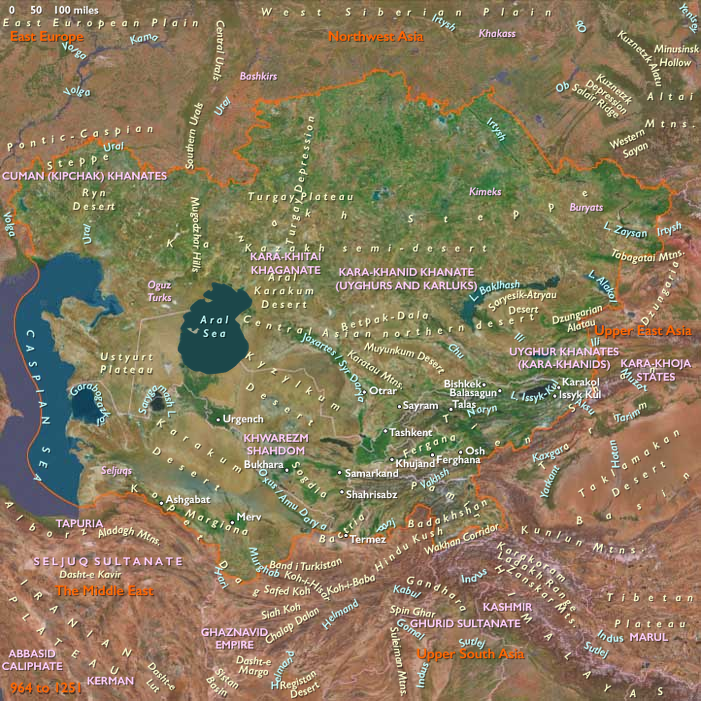
Most of Central Asia continues to be dominated by the successor Chagatai Khanate after Genghis Khan dies in 1227.
Locations
People
Groups
- Tajik people
- Persian people
- Kazakhs (also spelled Kazaks, Qazaqs)
- Karluks
- Kankalis
- Uyghur people
- Kipchaks
- Turkmen people
- Mongols
- Mongol Empire
- Khwarezm dynasty
Topics
Commodoties
Subjects
Regions
Subregions
Related Events
Filter results
Showing 10 events out of 47095 total
Genghis, upon reaching Yinchuan in 1227 and laying siege to the city, prepares to invade the Jin dynasty in order to neutralize any threat of them sending relief troops to Western Xia as well as setting the stage for a final conquest of the Jin empire.
Genghis sends a force under his son Ogedai and commander Chagaan toward the southern border, and they push into Jin territories along the Wei River and south Shaanxi, even sending some troops over the Qin Mountains to threaten Kaifeng, the Jin capital.
Genghis himself rejoins with Subutai and heads southwest to slice across an approximately one hundred and fifty kilometer-wide territory, mainly in present-day Ningxia and Gansu.
Subutai crosses the northern parts of the Liupan mountain range, zigzagging from town to town throughout February and March, and conquers the Tao River valley and Lanzhou region.
Genghis meanwhile travels due south, following the Qing Shui river.
Back in Western Xia, Yinchuan lies besieged for about six months, and Genghis, himself busy directing a siege of Longde, sends Chagaan to negotiate terms.
Chagaan reports that the emperor has agreed to capitulate, but wants a month to prepare suitable gifts.
Genghis assents, although he secretly plans to kill the emperor.
During the peace negotiations, Genghis continues his military operations around the Liupan mountains near Guyuan, rejectes an offer of peace from the Jin, and prepares to invade them near their border with the Song.
Genghis, however, dies in August 1227 of uncertain causes; his death is kept a secret in order not to jeopardize the ongoing campaign.
Emperor Mozhu in September of 1227 surrenders to the Mongols, now led by Genghis Khan’s son Tolui, and, in fear that the Western Xia will rebel, is promptly executed along his entire family.
His death marks the end of the Western Xia dynasty.
The Mongols now mercilessly pillage Yinchuan, put to the sword the intellectuals and most of the citizenry, plunder the imperial tombs west of the city, and complete the effective annihilation of the Western Xia state.
The Mongols transport their dead leader back to Mongolia, killing everyone that crosses their path, and bury their leader in a secret location.

The order of the Brothers of the Sword had conquered Southern Estonia while Denmark had taken the North, and the two agreed to divide Estonia, but quarreled over the exact borders.
The King of Denmark had agreed in 1220 to submit southern Estonian provinces Sakala and Ugaunia that were already conquered by Sword Brethren.
Bishop Albert had submitted to Denmark the Estonian provinces of Harria, Vironia and Jerwia.
The Livonian Brothers of the Sword conquer all Danish territories in Northern Estonia in 1227.
Pomerania had been rather sparsely settled before the Ostsiedlung.
A relatively dense population could be found around 1200 on the islands of Rügen, Usedom and Wollin, around the burghs of Stettin, Köslin, Pyritz (Pyritzer Weizacker) and Stargard, around the Persante river (Kolberg area), the lower Peene river, and between Schlawe and the Leba valley.
Largely unsettled were the hilly regions and the woods in the South.
The twelfth century warfare, especially the Danish raids, have depopulated many areas of Pomerania and caused severe population drops in others.
At the turn to the thirteenth century, only isolated German settlements existed, and the merchant's settlement near the Stettin burgh.
In contrast, the monasteries were almost exclusively run by Germans and Danes.
Massive German settlement has started in the first half of the thirteenth century.
Ostsiedlung is a common process at this time in all Central Europe and is largely run by the nobles and monasteries to increase their income.
Also, the settlers are expected to finish and secure the conversion of the non-nobles to Christianity.
In addition, the Danes withdraw from most of Pomerania in 1227, leaving the duchy vulnerable to its expansive neighbors, especially Mecklenburg, Brandenburg, and Henry I of Silesia.
The circumstances surrounding the failed negotiations to wed Robert, a weak and incapable ruler, to Eudocia are unclear, but George Akropolites states that the arrangement was blocked on religious grounds by the Orthodox Patriarch Manuel Sarentos: Robert's sister Marie de Courtenay was married to Emperor Theodore I Laskaris.
Accordingly, Robert, already Theodore's brother-in-law, could not also be his son-in-law.
Regardless, Robert had promised again to marry Eudocia but soon repudiated this engagement, and in 1227 (according to William of Tyre Continuator) secretly marries the Lady of Neuville, already the fiancée of a Burgundian gentleman.
Both the new wife of the Emperor and her mother are placed in a manor house owned by Robert.
The unnamed Burgundian gentleman somehow finds out and reportedly organizes a conspiracy against Robert and his new wife.
The knights of Constantinople partaking in the conspiracy proceed to capture the Empress and her mother.
The lips and nostrils of both women are cut off and then thrown to sea.
Robert flees Constantinople following the attack, seeking the assistance of Pope Gregory IX in reestablishing his authority.
The Cumans, a nomadic Turkish people comprising the western branch of the Kipchak confederation, had during the twelfth century acted as auxiliary troops for the Russian princes and in that capacity had clashed with Hungarian expeditionary forces; but, by the beginning of the thirteenth century, they had become more aggressive and launched their own raids into southeastern Transylvania.
The Cuman prince Barc and fifteen thousand of his people are baptized into the Christian faith in 1227.
John III Doukas Vatatzes of Nicaea had no sooner taken Adrianople in 1225 than Theodore had arrived and taken it from him in turn.
Theodore had also allied with the Bulgarians and had driven the Latins from Thrace.
Elated by his success, Theodore arranges for his coronation as emperor in 1225 or 1227 by the autocephalous archbishop of Ohrid, Demetrios Chomatianos, although this is not recognized by most Greeks, especially not the Patriarch in Nicaea.
Pope Urban II had recognized Toldeo’s main church, a converted mosque, in 1088 as the primate cathedral over the rest of the kingdom.
The mosque-cathedral has remained intact until the thirteenth century, when in the year 1222 a Papal bull issued by the Pope had authorized the construction of a new cathedral which was begun in 1224 (or 1225).
The official ceremony of the laying of the foundation stone takes place in 1226 (other sources say 1227), with the presence of King Ferdinand.
The plan of the cathedral is directly modeled, like that at Burgos, on the scheme of the French Gothic Cathedral of Bourges.
Elizabeth, the daughter of King Andrew II of Hungary, widowed at twenty by the death of Louis IV, Landgrave of Thuringia, in 1227, enters the newly founded Franciscan third order and places herself under Konrad’s spiritual direction, at whose behest Elizabeth enters a life of extreme austerity, devoting herself to charitable activities.
The Georgians take advantage of Jalal ad-Din’s failures in Armenia and retake Tbilisi In February 1227, but soon are forced to abandon the city—which they themselves had set alight in their battle with the occupation forces.
Honorius dies on March 18, 1227, and Cardinal Ugolino succeeds him as Pope Gregory IX, a passionate man who belongs to the intellectual world of Francis of Assisi.
Years: 1227 - 1227
Locations
People
Groups
- Tajik people
- Persian people
- Kazakhs (also spelled Kazaks, Qazaqs)
- Karluks
- Kankalis
- Uyghur people
- Kipchaks
- Turkmen people
- Mongols
- Mongol Empire
- Khwarezm dynasty