
A truce is made in September 531 …
Years: 531 - 531
September
A truce is made in September 531 on the death of Kavadh after campaigns in which Justinian's generals, among whom Belisarius is the most distinguished, have obtained considerable successes.
Bawi is a Sasanian military officer from the Ispahbudhan family who has been involved in both the Anastasian War and the Iberian War between the Sasanian and Eastern Roman Empire.
Khosrau I is the son of Kavadh I and Bawi's sister, making Khosrau I related to the House of Ispahbudhan.
Many lower class peasants support the Mazdakite movement, which Kavadh had supported also, wanting to centralize power by taking power away from the great noble families.
The Mazdakites give their loyalty to Kavadh's eldest son, Kawus, while the noble families and the Zoroastrian Magi give their support to Khosrau I.
Khosrau presents himself as an anti-Mazdakite supporter.
He, much like his father, believes in a strong centralized government.
Khosrau meets his brother Kawus in battle and defeats him as well as his Mazdakite followers.
Subsequently Mazdak, as well as a majority of his followers, are executed for his heretical beliefs and Khosrau takes the Sassanian throne.
At Khosrau's succession, Constantinople and Sassanian Persia are in open conflict with each other.
Neither empire was able to get an advantage of the other, causing Emperor Justinian and King Khosrau to agree in 531 on a peace treaty.
However, Bawi, along with other members of the Persian aristocracy, becomes involved in a conspiracy in which they try to overthrow Khosrau I and make Kavadh, the son of Kavadh I’s second eldest son Djamasp (Zames), the king of the Sasanian Empire.
Upon learning the plot, Khosrau I executes all his brothers and their offspring, along with Bawi and the other "Persian notables" who are involved.
Khosrau I also orders the execution of Kavadh, who is still a child, and is away from the court, being raised by Adergoudounbades.
Khosrau sends orders to kill Kavadh, but Adergoudounbades disobeys and will bring him up in secret, until he is betrayed to the shah in 541 by his own son, Bahram (Varranes).
Khosrau will have him executed, but Kavadh, or someone claiming to be him, will manage to flee to Constantiople.
Khosrau I represents the epitome of the philosopher king in the Sasanian Empire.
Upon his ascension to the throne, Khosrau does not restore power to the feudal nobility or the magi, but centralizes his government.
Khosrau's reign is considered to be one of the most successful within the Sassanian Empire.
The peace agreement between Rome and Persia gives Khosrau the chance to consolidate power and focus his attention on internal improvement.
His reforms and military campaigns will mark a renaissance of the Sassanian Empire, which will spread philosophic beliefs as well as trade goods from the far east to the far west.
Locations
People
Groups
- Persian people
- Babylonia, Classical
- Persian Empire, Sassanid, or Sasanid
- East, or Oriens, Praetorian prefecture of
- Mazdakites
- Roman Empire, Eastern: Justinian dynasty
Topics
Commodoties
Subjects
Regions
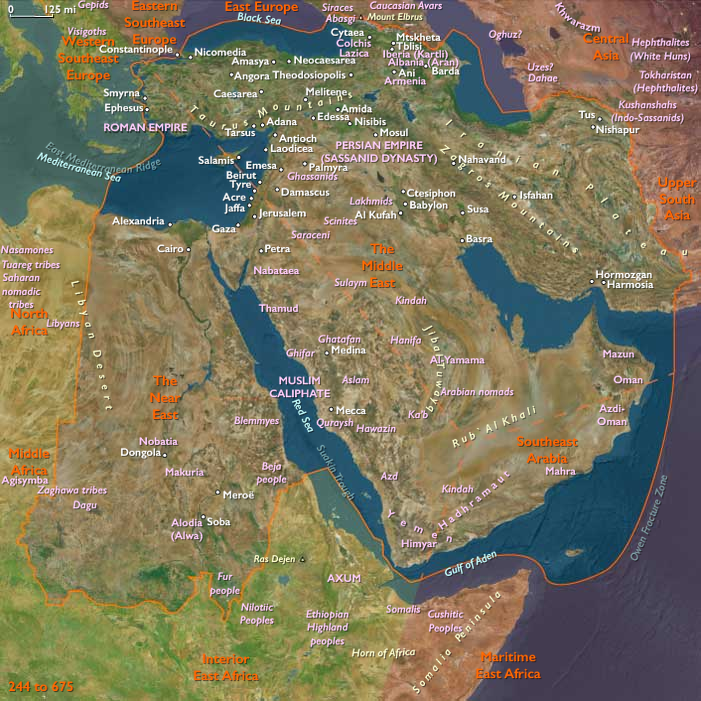
Subregions
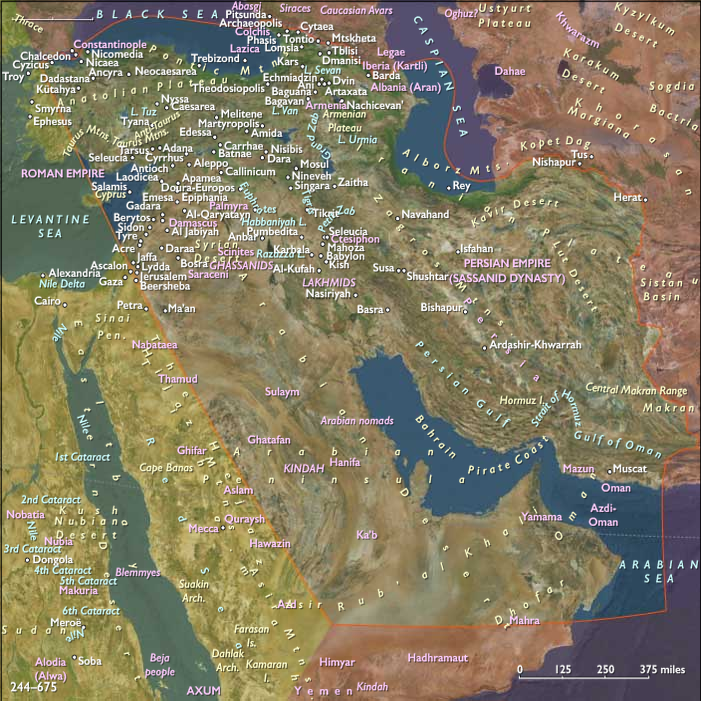
Related Events
Showing 10 events out of 58085 total
Years: 531 - 531
September
Locations
People
Groups
- Persian people
- Babylonia, Classical
- Persian Empire, Sassanid, or Sasanid
- East, or Oriens, Praetorian prefecture of
- Mazdakites
- Roman Empire, Eastern: Justinian dynasty
Topics
Commodoties
Subjects
Regions
Subregions