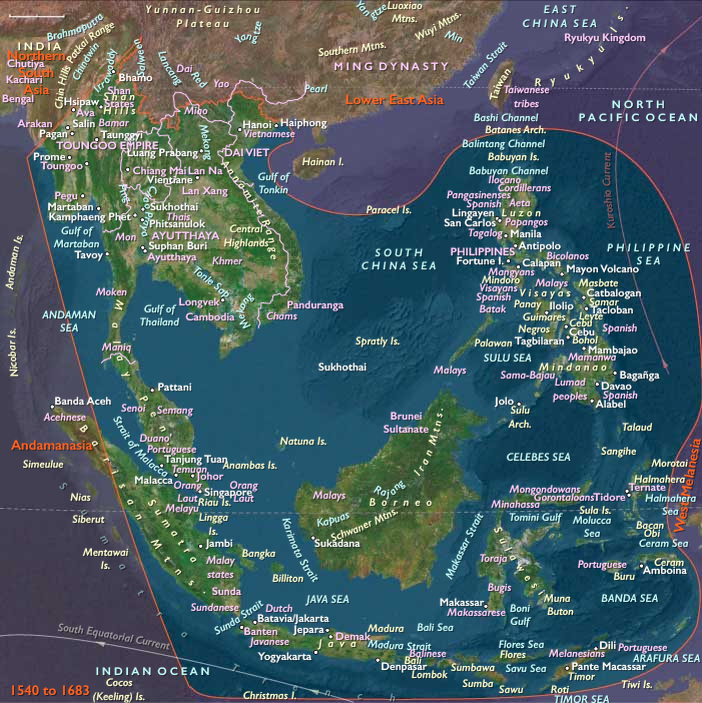
Sekar Seda Lepen and Prince Prawotoare have …
Years: 1550 - 1550
Sekar Seda Lepen and Prince Prawotoare have both died in the civil war for Demak, and Sekar's son, Arya Penangsang, wins the throne.
With a reputation for viciousness and facing heavy opposition, he is soon dethroned by a coalition of vassals led by a relative of the late Trenggana, Jaka Tingkir, Lord of Boyolali, who assumes the kingship but removes the Demak heirlooms and sacred artifacts to Pajang.
Locations
Groups
Commodoties
Subjects
Regions
Subregions
Related Events
Filter results
Showing 10 events out of 36365 total
A Mon revival had been gathering momentum in Lower Burma while Tabinshwehti had been campaigning in the east.
Tabinshwehti, depressed by his defeat in Siam and unable to control his restive subjects, has turned to drink and is assassinated in 1550 by Mon members of his own court; a Mon prince declares himself the new king of Burma, but Mon rebel leader Smim Htaw seizes control of Pegu and overthrows the usurping prince.
Ivan promulgates a new law code in 1550 and standardizes the duties and responsibilities of the aristocracy.
Russia remains isolated from sea trade, as the German merchant companies ignore the new port built by the young tsar on the river Narva in 1550 and continue to deliver goods in the Baltic ports owned by Livonia.
Eight years on, a lengthy military conflict will begin between the Tsardom of Russia and a variable coalition of Denmark, the Grand Duchy of Lithuania, the Kingdom of Poland (later the Polish-Lithuanian Commonwealth), and Sweden for control of Greater Livonia (the territory of the present-day Estonia and Latvia).
The Swedish King, as Finland’s ruler, establishes the small settlement of Helsingfors in 1550 in the south of this country on the tip of a small peninsula on the Gulf of Finland, as a fortress to maintain Sweden's control of the Baltic Sea and to keep such control from passing to Russia.
Gustav intends the town to serve the purpose of consolidating trade in the southern part of Finland and providing a competitor to Reval (today: Tallinn), a nearby Hanseatic League city that dominates local trade at this time.
In order to ensure the economic viability of the city, the King orders the citizens of several other towns to relocate to Helsingfors, but the order does not seem to have achieved its intended effect.
The Swedish acquisition of northeastern Estonia, including Reval, at the conclusion of the Livonian War in 1582, will cause the Swedish crown to lose interest in building up a competitor to Reval, and Helsingfors is to languish as a forgotten village for decades thereafter, its establishment as Finland’s capital, today a world-class city, still centuries in the future.
The Turks have left Transylvania relatively unmolested.
Martinuzzi has devised a constitution based on earlier institutions, consisting, under the prince, of representatives of the three privileged nations (Estates) of the Unio Trium Nationum compant of 1438: the nobility (mostly Hungarians), the Szeklers and the Saxon burghers.
These nations, however, correspond more to social and religious rather than ethnic divisions.
Being explicitly directed against the peasants, the Union limits the number of Estates, implicitly excluding the Orthodox from political and social life in Transylvania, as they are not allowed to build up local self-government (like the Szekelys, Saxons in Transylvania, Cumans and Iazyges in Hungary).
Transylvania is also spared internecine religious strife, when the Roman Catholic, Calvinist, Lutheran, and Uniate churches agree to coexist on a basis of equal freedom and mutual toleration.
The Greek Orthodox faith of the Romanians, who constitute the rest of the population, is only “tolerated,” since the Romanians as such, or even their nobles, do not constitute a “nation.” The Romanian ruling class, the nobilis kenezius, has the same rights as the Hungarian nobilis conditionarius.
In contrast to Maramureş, after the Decree of Turda/Torda 1366 in Transylvania proper the only possibility to remain or access nobility was for them through conversion to Roman Catholicism.
In order to conserve their positions, some Romanian families had converted to Catholicism, being subsequently magyarized (i.e., the families Hunyadi/Corvinus, Bedőházi, Bilkei, Ilosvai, Drágffy, Dánfi, Rékási, Dobozi, Mutnoki, Dési, Majláth, etc.).
Some of them even have reached the highest ranks of the society (Nicolaus Olahus will become Archishop of Esztergom, while Mathias Corvinus, the son of half-Romanian regent John Hunyadi, had become king of Hungary in 1464).
Bahadur Shah, the Sultan of Gujarat, had concluded a defensive alliance with the Portuguese in 1535, against the Mughal emperor Humayun, and allowed the Portuguese to construct the Diu Fort and maintain a garrison on the island.
The alliance had quickly unraveled, and attempts by the Sultans to oust the Portuguese from Diu between 1537 and 1546 have failed.
The Siege of Diu by the Ottoman Empire in 1538 had been unsuccessful in repelling the Portuguese.
The fortress, completed by Dom João de Castro after the siege of 1545, still stands.
The Portuguese navy has several times defeated the Ottoman fleet near Diu (1541, 1545, 1549), which has become a focal point of Portuguese and Ottoman naval combat.
Turkish marauders plague the duchies of Carinthia, Carniola, and Styria, ruled jointly under the Habsburg monarchy.
The Slovenes abandon lands vulnerable to attack and raise bulwarks around churches to protect themselves.
German nobles in the three Slovenian provinces have in the tumult of the sixteenth century clamored for greater autonomy, embraced the Protestant Reformation, and drawn many Slovenes away from the Catholic Church, sparking the Slovenes' first cultural awakening.
While the elites of these regions have mostly become Germanized, the peasants strongly resist Germanic influences and retain their unique Slavic language and culture.
A major step towards the social and cultural emancipation of the Slovenes occurs when Primoz Trubar, a Protestant preacher in Rothenburg, Germany, publishes the first printed books in the Slovene language (Catechism and Abecedarium, 1550 in Tübingen, Germany).
Trubar will later produce a translation of the New Testament and print other Slovenian religious books in the Latin and Cyrillic scripts.
Vincenzo Ruffo is one of the composers most responsive to the musical reforms suggested by the Council of Trent, especially in his composition of masses, and as such is an influential member of the Counter-Reformation.
Born at Verona, he had become a priest here in 1531, most likely studying with Biagio Rossetti, the organist at the cathedral in Verona.
Ruffo had published his first book of music in 1542, also in that year becoming maestro di cappella at the cathedral in Savona, but he only held this position for a year; the cathedral had been destroyed in 1543 by the Genoese, and Ruffo had fled.
He had gone to Milan in either 1543 or 1544 hto work for Alfonso d'Avalos, who was the governor of the city at this time.
When d'Avalos was called back to Madrid in 1546, Ruffo had returned to Verona, where in 1551 he becomes the music director at the Accademia Filarmonica, superseding Franco-Flemish composer Jan Nasco, the academy’s first director.
Ruffo
Michelangelo, seventy-five in 1550, returns to his first love, sculpture, executing his most intimate statue, the Pietá, or Deposition, that he intends to have placed on his own tomb.
This marble, unfinished and partially mutilated by Michelangelo in a fit of depression, reveals the omnipresent power of death.
In the aged and resigned features of the morning figure of Joseph of Arimathea (or, possibly, Nicodemus) supporting the dead Christ, can be seen a self-portrait.
Italian architect Giacomo da Vignola, upon being appointed papal architect to Pope Julius III in 1550, settles in Rome.
He begins work on the church of Sant’Andrea in Via Flaminia, whose oval-based plan represents a radical break with the Renaissance classical tradition (and anticipates one of the most widely used forms in baroque architecture).
Italian poet and humanist Gian Giorgio Trissino attempts to revive the Italian tradition of heroic poetry in his L'Italia liberata dai Goti (“Italy Liberated from the Goths”), written in 1547-48) in eleven-syllable rhymeless lines.
He bases his verse comedy, I simillimi, published in 1548, on the Roman playwright Plautus' “Menaechmi.”
Best remembered for his tragedy “Sonofisba,” Trissino dies at seventy-two on December 8.
Giorgio Vasari writes the important Lives of the Most Eminent Painters, Sculptors, and Architects in 1550, a thorough history of Italian Renaissance and early Mannerist art through biographies of its principal practitioners.
Lives, modeled on the ancient Greek and Roman biographies of famous men, is the first book in Western history to concentrate exclusively on art and artists.
Vasari emphasizes artistic personalities and technical progress as the measure of art, the pinnacle of which he sees in the genius of Michelangelo.
Vasari, whose concept of genius is Neoplatonic, regards art as an intellectual discipline practiced by individualistic geniuses, rather than a craft pursued by anonymous workers, and holds that the inspired artist creates earthly beauty as a reflection of the Absolute.
Vasari, himself a noted Mannerist painter as well as an architect, names “maniera” (“style) as the distinguishing mark of the arts of his own time.
Vasari expands on Giovanni Boccaccio’s fourteenth-century use of the concept of rinascita (“rebirth”) to describe contemporary Italian efforts to imitate the poetic style of the ancient Romans.
He employs the word to describe the return to the ancient Roman manner of painting by Giotto di Bondone about the beginning of the fourteenth century.
(Vasari’s text, as it turns out, contains many lacunae and errors, particularly in the biographical data supplied, and his treatment of pre-fifteenth century artists is unreliable.)
Flemish-born Adrian Willaert, one of the most versatile composers of the Renaissance, writes music in almost every extant style and form.
In force of personality, and with his central position as maestro di cappella at St. Mark's, he is the most influential musician in Europe between the death of Josquin and the time of Palestrina.
Some of Willaert’s motets and double canonic chansons had been published as early as 1520 in Venice.
Willaert owes much of his fame in sacred music to his motets.
According to Gioseffo Zarlino, writing later in the sixteenth century, Willaert is the inventor of the antiphonal style from which the polychoral style of the Venetian school evolves.
As there are two choir lofts, one of each side of the main altar of St. Mark's, both provided with an organ, Willaert had divided the choral body into two sections, using them either antiphonally or simultaneously.
Ciprian De Rore, Zarilino, Andrea Gabrieli, Donato, and Croce, Willaert’s successors, all will cultivate this style.
The tradition of writing that Willaert establishes during his time at St. Mark’s is to be continued by other composers working there throughout the 1600s.
He next composed and performed psalms and other works for two alternating choirs.
This innovation has net with instantaneous success and strongly influences the development of the new method.
A compositional style established by Willaert for multiple choirs dominates in Venice,.
He publishes in 1550 Salmi spezzati, antiphonal settings of the psalms, the first polychoral work of the Venetian school.
Willaert’s work in the religious genre establishes Flemish techniques firmly as an important part of the Italian Style.
While more recent research has shown that Willaert was not the first to use this antiphonal, or polychoral method—Dominique Phinot had employed it before Willaert, and Johannes Martini even used it in the late fifteenth century—Willaert's polychoral settings are the first to become famous and widely imitated.
Other well-known contemporary composers of madrigals include the Italian Costanzo Festa, the Franco-Netherlanders Philippe Verdelot and the celebrated Jacob Arcadelt, whose works are reprinted many times.
A five-part texture begins from about 1550 to be generally preferred for madrigals over the earlier dominant four-part texture.