
The surviving Southern Plains warriors had scattered …
Years: 1874 - 1874
September
The surviving Southern Plains warriors had scattered after Adobe Walls and raid along the frontier.
The explosion of violence has taken the government by surprise.
The "peace policy" of the Grant Administration is deemed a failure, and the Army is authorized to subdue the Southern Plains tribes with whatever force necessary.
At this time, roughly eighteen hundred Cheyennes, two thousand Comanches, and one thousand Kiowas remain at large.
Combined, they amount to about twelve hundred warriors.
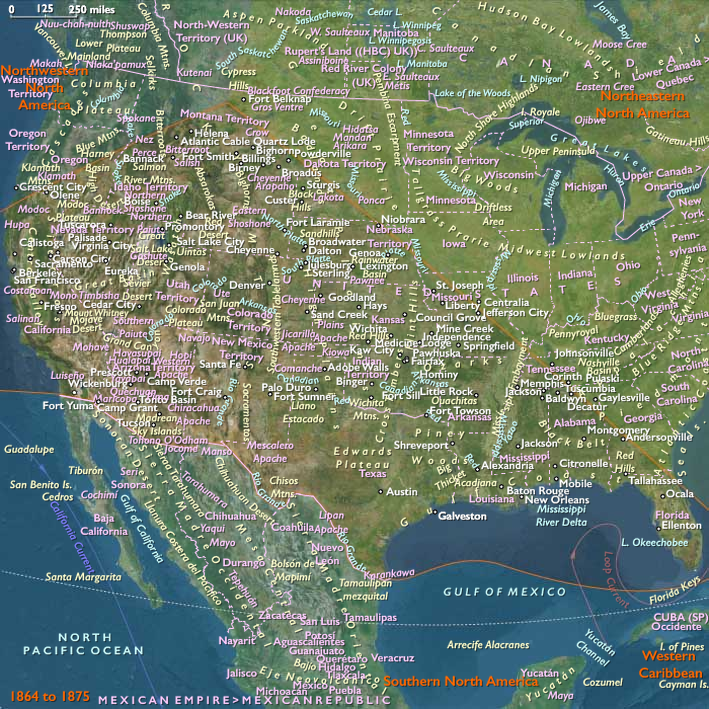
General Phillip Sheridan orders five army columns to converge on the general area of the Texas Panhandle and specifically upon the upper tributaries of the Red River.
The strategy is to deny the natives any safe haven and attack them unceasingly until they go permanently to the reservations.
Three of the five columns are under the command of Colonel Ranald S. Mackenzie.
The Tenth Cavalry, under Lieutenant Colonel John W. Davidson, comes due west from Fort Sill.
The Eleventh Infantry, under Lieutenant Colonel George P. Buell, moves northwest from Fort Griffin.
Mackenzie himself leads the Fourth Cavalry north from Fort Concho.
The fourth column, consisting of the Sixth Cavalry and Fifth Infantry, is commanded by Colonel Nelson A. Miles and comes south from from Fort Dodge.
The fifth column, the Eighth Cavalry commanded by Major William R. Price, marches east from Fort Bascom in New Mexico.
The plan calls for the converging columns to maintain a continuous offensive until a decisive defeat had been inflicted on the Indians.
As many as twenty engagements took place across the Texas Panhandle.
The Army, consisting entirely of soldiers and scouts, seeks to engage the Indians at any opportunity.
The natives, traveling with women, children and elderly, mostly attempt to avoid them.
When the two do encounter one another, the natives usually try to escape before the Army can force them to surrender.
However, even a successful escape can be disastrously costly if horses, food and equipment have to be left behind.
By contrast, the Army and its native scouts have access to essentially limitless supplies and equipment, they frequently burn anything they capture from retreating natives, and are capable of continuing operations indefinitely.
The war will continue throughout the fall of 1874, but increasing numbers of natives are forced to give up and head for Fort Sill to enter the reservation system.
Two large reservations have been established in Indian Territory, one for the Cheyennes and Arapahos, the other for the Comanches, Kiowas and Kiowa-Apaches.
Locations
People
Groups
- Cheyenne people (Amerind tribe)
- Arapaho people (Amerind tribe)
- Kiowa people (Amerind tribe)
- Plains Apache, or Kiowa Apache; also Kiowa-Apache, Naʼisha, Naisha (Amerind tribe)
- Comanche (Amerind tribe)
Topics
- Indian Wars in Upper North America
- Comanche Wars
- Texas–Indian wars
- American Civil War & Reconstruction; 1864 through 1875
- Comanche Campaign
- Red River War
Subjects
Regions
Subregions
Related Events
Showing 10 events out of 12508 total
Years: 1874 - 1874
September
Locations
People
Groups
- Cheyenne people (Amerind tribe)
- Arapaho people (Amerind tribe)
- Kiowa people (Amerind tribe)
- Plains Apache, or Kiowa Apache; also Kiowa-Apache, Naʼisha, Naisha (Amerind tribe)
- Comanche (Amerind tribe)
Topics
- Indian Wars in Upper North America
- Comanche Wars
- Texas–Indian wars
- American Civil War & Reconstruction; 1864 through 1875
- Comanche Campaign
- Red River War
Subjects
Regions
Subregions