
The Han dynasty, after which the members …
Years: 189BCE - 46BCE
The Han dynasty, after which the members of the ethnic majority in China, the "people of Han," are named, is notable also for its military prowess.
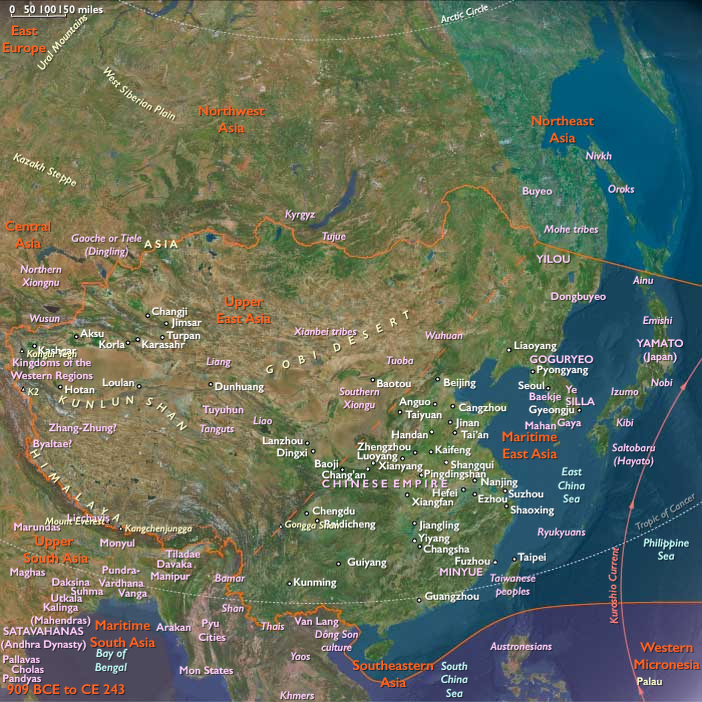
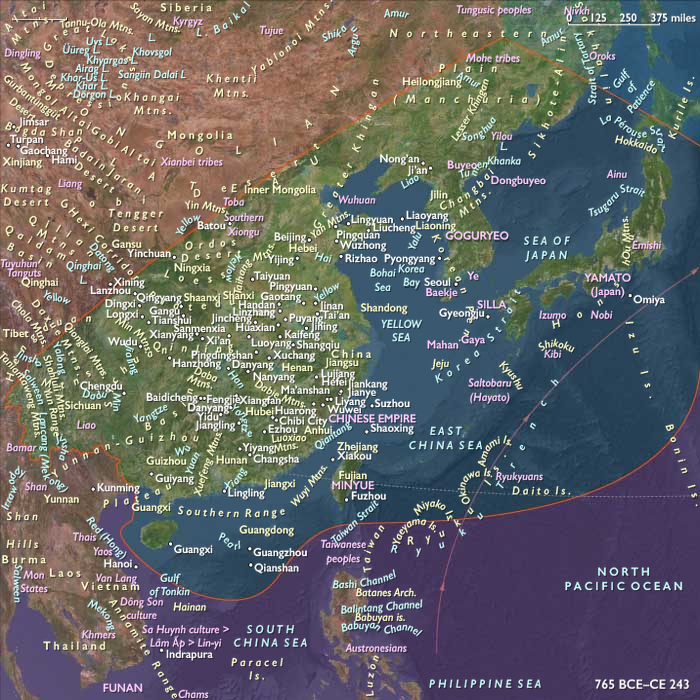
The empire expands westward as far as the rim of the Tarim Basin (in modern Xinjiang-Uygur Autonomous Region), making possible relatively secure caravan traffic across Central Asia to Antioch, Baghdad, and Alexandria.
The paths of caravan traffic are often called the "silk route" because the route is used to export Chinese silk to the Roman Empire.
Chinese armies also invade and annexed parts of northern Vietnam and northern Korea toward the end of the second century BCE.
Han control of peripheral regions is generally insecure, however.
To ensure peace with non-Chinese local powers, the Han court develops a mutually beneficial "tributary system."
Non-Chinese states are allowed to remain autonomous in exchange for symbolic acceptance of Han overlordship.
Tributary ties are confirmed and strengthened through intermarriages at the ruling level and periodic exchanges of gifts and goods.
Locations
Groups
Topics
Commodoties
Subjects
Regions
Subregions
Years: 189BCE - 46BCE
Locations
Groups
Topics
Commodoties
Subjects
Regions
Subregions