Germanicus, after a few more raids across …
Years: 17 - 17
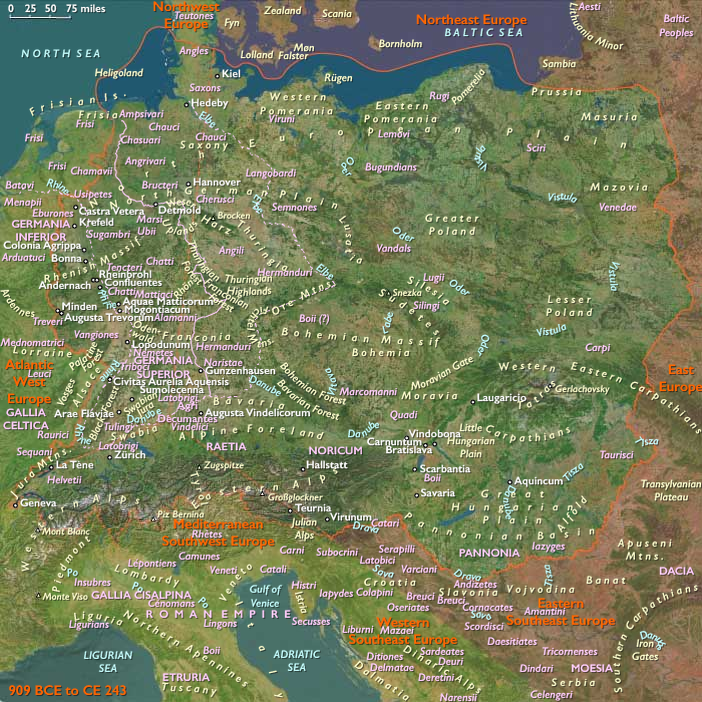
Germanicus, after a few more raids across the Rhine that result in the recovery of two of the three legion's eagles lost in 9, is recalled to Rome and informed by Tiberius that he will be given a triumph and reassigned to a different command.
Locations
People
Groups
Topics
Commodoties
Subjects
Regions
Subregions
Related Events
Filter results
Showing 10 events out of 61965 total
Another economic change instituted by Wang Mang—a fairly disastrous one—has been to issue twenty-eight types of coins, made of gold, silver, tortoise shells, sea shells, and copper.
Because there are so many kinds of coins (in contrast to the one kind used under the Han dynasty), people have become unable to recognize the kinds of coins as genuine or as counterfeit, and the money-based economy has come to a halt.
Wang is forced eventually to abolish all but two kinds of coins—the small coin that has the same value of a Han coin, and the large coin that has the value of fifty small coins.
However, the people, despite fairly severe penalties, have lost faith in the Xin coins, and continue to use Han coins in an underground trade economy.
In an attempt to refill the depleted imperial coffers in 17, Wang institutes six monopolies—of liquor, salt, iron, coinage, forestry, and fishing.
However, because of rampant corruption, the imperial treasury receives only limited benefit, while the people are greatly burdened.
Heavy rains, together with neglect of the dikes, cause the Hwang He to flood severely in 17, driving thousands from their homes.
Due to Wang Mang's incompetent rule—in particular, his implementation of his land reform policy—and this major Yellow River flood, which affects the modern Shandong and northern Jiangsu regions, the people who can no longer subsist on farming are forced into rebellion to try to survive.
The rebellions are numerous and fractured.
In Shandong, Lü Yu, a minor official at the Haiqu (in modern Rizhao, Shandong) county government, had been falsely accused of not collecting taxes from the peasants and executed by the county magistrate.
His mother, called Mother Lü, who apparently was a substantial landowner, had sold off her property and used the proceeds to befriend poor young men, of whom she gathers about one hundred, leading them in a raid against the county government and killing the magistrate to avenge her son.
As she cannot remain, she leads her men to sea and becomes a pirate.
She will return eventually to land and gain further strength.
The Lombards, a Germanic people based on the lower Elbe River, (first mentioned by classical writers in the first century CE), are thought to have fought against the Romans as early as CE 6.
From the combined testimony of Strabo (CE 20) and Tacitus (CE 117), the Lombards dwell near the mouth of the Elbe shortly after the beginning of the Common Era, next to the Chauci.
Strabo states that the Lombards dwell on both sides of the Elbe.
The German archaeologist Willi Wegewitz defined several Iron Age burial sites at the lower Elbe as Langobardic.
The burial sites are crematorial and are usually dated from the sixth century BCE through the third century CE, so that a break in settlement seems unlikely.
The lands of the lower Elbe fall into the zone of the Jastorf Culture and became Elbe-Germanic, differing from the lands between Rhine, Weser, and the North Sea.
Archaeological finds show that the Lombards were an agricultural people.
The first mention of the Lombards occurs between CE 9 and 16, by the Roman court historian Velleius Paterculus, who had accompanied a Roman expedition as prefect of the cavalry.
Paterculus described the Lombards as "more fierce than ordinary German savagery."
Tacitus counted the Lombards as a Suebian tribe, and subjects of Marobod the King of the Marcomanni.
Marobod had made peace with the Romans, and that is why the Lombards were not part of the Germanic confederacy under Arminius at the Battle of Teutoburg Forest in CE 9.
In CE 17, war breaks out between Arminius and Marobod.
Tacitus records: “Not only the Cheruscans and their confederates... took arms, but the Semnones and Langobards, both Suevian nations, revolted to him from the sovereignty of Marobod...
The armies... were stimulated by reasons of their own, the Cheruscans and the Langobards fought for their ancient honor or their newly acquired independence." (Tacitus, Ann. II, 45.).

Antiochus I Theos of Commagene (reigned 70 BCE-38 BCE), had been an ally to Roman general Pompey in his campaigns against Mithridates of Pontus in 64 BCE.
Through skilled diplomacy, Antiochus had been able to keep Commagene independent from the Romans.
Very little is known of the life and reign of grandson Antiochus III of Commagene, whose death creates major issues for the kingdom, as Commagene is currently in political turmoil.
The reasons for this situation are unclear; however, it may have been the result of his children by his sister-wife Queen Iotapa, Antiochus and Iotapa being too young to succeed their father.
This may have meant that there was no effective authority to prevent civil unrest and unite the citizens of Commagene.
After Antiochus' death, two political factions appear.
One faction is led by noblemen who want Commagene to be placed under the rule of the Roman Empire and the other faction is led by citizens who want Commagene's independence to be retained under the rule of their own king.
Both factions send embassies to Rome, seeking the advice and assistance of the Roman Emperor Tiberius to decide the future of Commagene.
Tiberius decides to make Commagene a part of the Roman province of Syria, a decision welcomed by many of Commagene’s citizens.
Cappadocia’s Ariobarzanes dynasty had ended in 36 BCE with the execution, by Mark Antony, of King Ariarathes X, and the Cappadocian nobleman Archelaus had been given the throne, by favor first of Antony and then of Octavian.
Archelaus has since maintained tributary independence, having reigned over Cappadocia for fifty years and having lived to an advanced age when, in 17, there is a shortage of funds for military pay in the Roman Empire and Tiberius wants to integrate Archelaus’ kingdom into a Roman province.
Archelaus is enticed by Tiberius to come to Rome, and on arrival is accused by the Roman Senate of harboring revolutionary schemes.
Tiberius hopes Archelaus will be condemned to death by the Senate.
However Archelaus is obliged to remain in Rome, where he dies of natural causes (Tactitus leaves open the possibility that he may have committed suicide).
Cappadocia becomes a procuratorial province and his widow with her family returns to Pontus.
The Romans give Armenia Minor to his stepson Artaxias III to rule as Roman Client King, while the Cilician and the remaining territories of his former dominion are given to his son, Archelaus of Cilicia, to rule as Roman Client King.
Germanicus has managed in the past three years to deal a significant blow to Rome's enemies, quell an uprising of troops, and once again return lost standards to Rome, actions that increase the fame and legend of the already very popular Germanicus with the Roman people.
After being recalled by Tiberius from Germania, Germanicus celebrates a triumph in Rome in CE 17, the first full triumph that the city has seen since Augustus's own in 29 BCE.
Fan Chong (who will eventually become the leader of all Chimei leaders, albeit in a collective leadership) initiates his own rebellion in 18, also in the modern Rizhao region.
Using Mount Tai as his base, he is able to gather about ten thousand men.
He soon enters into an alliance with other rebel leaders Pang An, Xu Xuan, Xie Lu, and Yang Yin, pooling resources with them, and they soon became powerful and unstoppable by the local governments.
Artabanus II had been raised to the throne in about CE 10 by those Parthian grandees who would not acknowledge Vonones I, whom the Roman Emperor Augustus had sent from Rome (where he lived as hostage), as successor of his father late Phraates IV.
The war between the two pretenders is long and doubtful; on a coin Vonones mentions a victory over Artabanus.
Artabanus in CE 12 at last defeated his rival completely and occupied the Parthian capital Ctesiphon.
Vononeshad fled to Armenia, where he was acknowledged as king, under the protection of the Romans.
But when Artabanus, demanding his deposition, invaded Armenia, Vonones fled to Syria, and the emperor Tiberius thought it prudent to support him no longer.
As Augustus does not wish to begin a war with the Parthians, he removes Vonones I into Syria, where he is kept in custody, though in a kingly style.
Tiberius' nephew and heir Germanicus, whom he sends to the East, concludes a treaty with Artabanus, in which he is recognized as king and friend of the Romans.
Germanicus organizes Cappadocia and Commagene into provinces.
During a sightseeing trip to Egypt (not a regular province, but the personal property of the Emperor) he seems to have unwittingly usurped several imperial prerogatives.
The Romans finally succeed in restoring control of Armenia, reducing it to the status of troublesome client state, ruled from CE 18 by Zeno, the son of the king of Pontus.
Germanicus, as a result of his many successes, is granted control over the eastern part of the empire in CE 18, just as both Agrippa and Tiberius had received before, and is clearly the successor to Tiberius.