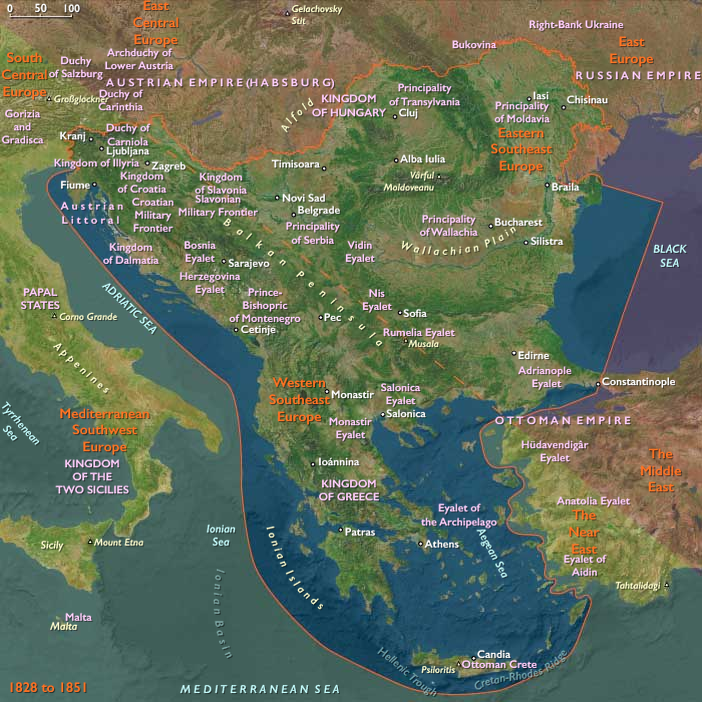
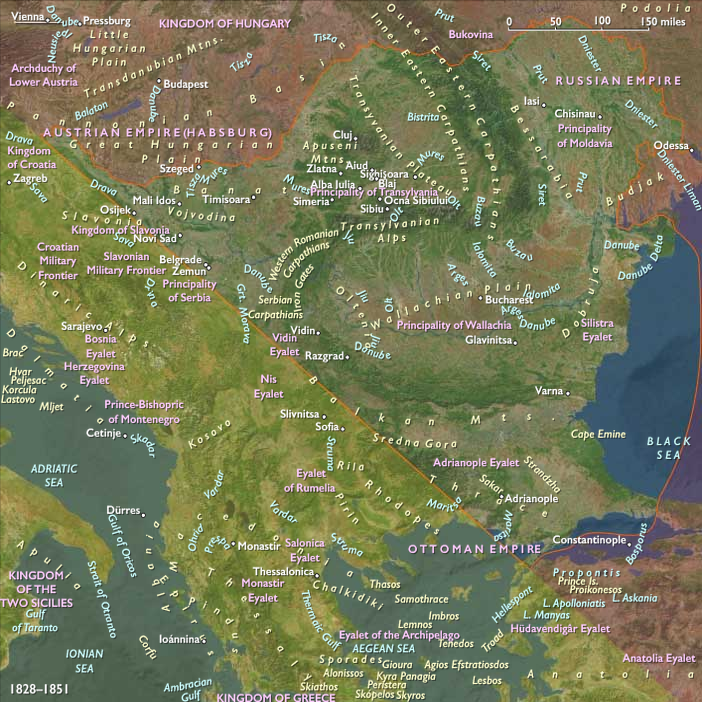
The Russian and Ottoman empires suppress the …
Years: 1850 - 1850
The Russian and Ottoman empires suppress the boyar assemblies in Wallachia and ...
Locations
Groups
- Ottoman Empire
- Moldavia (Ottoman vassal), Principality of
- Hungary, Kingdom of
- Wallachia (Ottoman vassal), Principality of
- Russian Empire
- Austrian Empire
- Transylvania, (Austrian) Grand Principality of
Subjects
Regions
Subregions
Related Events
Filter results
Showing 10 events out of 16390 total
Attempts in 1850 by both the British and the Americans to secure a more favorable treaty with Siam fail due to the intransigence of King Rama III.
China has suffered a series of natural disasters, economic problems and defeats at the hands of the Western powers—for example, the defeat by Great Britain in the First Opium War.
The Chinese majority, ethnically Han, regards the ruling Qing Dynasty, ethnically Manchu, as ineffective and corrupt.
Anti-Manchu sentiment is strongest in the south among the laboring classes, and it is these disaffected that have flocked to the charismatic Christian-influenced visionary Hong Xiuquan (a member of the Hakka minority).
The sect's militarism had grown in the 1840s, initially in response to its struggle to suppress bandits, but persecution by Qing authorities has spurred the movement into a guerrilla rebellion.
By July 1850, Hong Xiuquan has over twenty thousand followers and in preparation for an uprising, has organized them into military formations led by commanders with military ranks.
One such officer, Yang Xiuqing, who had been a salesman of firewood in Guangxi province before he joined the rebellion, had converted to Christianity in 1848 after reporting that he had experienced visions of God, and in 1850 began to claim that he could miraculously heal true believers.
The total number of officers and enlisted reaches 13,155 by the end of July and civilian ranks are also created to govern the remaining civilian followers.
Because the Imperial Chinese army in Guangxi is under strength (only around 30,000) and is extremely busy in suppressing the frequent uprisings of the secret societies known by the umbrella name of Tiandihui (literally "Heaven and Earth Society"), Hong and his followers have been able to build their forces unnoticed.
By the time the Qing Dynasty finally notices Hong and his followers, it is too late.
In late December 1850, Li Dianyuan, the local commander of the Imperial Chinese army at Xunzhou, surrounds one of Hong’s residences at Huazhoushanren village in Pingnan county in an attempt to eradicate the rebels.
However, Yang Xiuqing sends reinforcements from Jintian and defeats the governmental force, and Hong Xiuquan and his deputy Feng Yunshan safely return to Jintian.

The Daoguang emperor dies at sixty-eight on February 25, 1850.
By the time the nineteen-year-old Xianfeng Empeor succeeds to the throne, the Qing dynasty's empire is on the verge of disintegration.
Only a few months after he becomes emperor, the Manchu government orders the imperial troops to break up the God Worshippers society in South China's Kwangsi and Kwangtung provinces.
Europe's Demographic Dominance in 1850
By 1850, Europeans accounted for approximately 22% of the global population, reflecting the continent’s rapid population growth over the previous centuries. This demographic expansion was driven by agricultural advancements, declining mortality rates, and industrialization, which fueled urbanization and economic transformation.
Despite periodic economic crises, famines, and political upheavals, Europe's population continued to rise, laying the groundwork for mass emigration to the Americas, Africa, and Oceania in the second half of the 19th century. This demographic shift played a crucial role in the expansion of European influence, as migration, colonization, and industrial dominance extended the continent's impact across the globe.
The emancipation of the peasantry in Galicia (already emancipated under Prussia some two decades earlier) makes the peasant question a central issue—namely, if the peasants can be absorbed into the Polish national fabric or if their first loyalty will be to the partitioning monarchs.
The issue becomes acute in the Russian partition, which had remained passive in 1848.
Emperor Franz Joseph revokes Hungary's constitution after suppressing the Hungarian revolution, and assumes absolute control.
The emperor divides the country into four distinct territories: Hungary, ...
...Transylvania, ...
...Vojvodina, and ...
...Croatia-Slavonia.
German and Bohemian administrators manage the government, and German becomes the language of administration and higher education.
The non-Magyar minorities of Hungary receive little for their support of Austria during the turmoil.
A Croat reportedly tells a Hungarian: “We received as a reward what the Magyars got as a punishment”.
Clausius's PhD thesis concerning the refraction of light proposed that we see a blue sky during the day, and various shades of red at sunrise and sunset (among other phenomena) due to reflection and refraction of light.
Later, Lord Rayleigh will show that it is in fact due to the scattering of light, but regardless, Clausius uses a far more mathematical approach than some have used.
His most famous paper, Ueber die bewegende Kraft der Wärme ("On the Moving Force of Heat and the Laws of Heat which may be Deduced Therefrom") is published in 1850, and deals with the mechanical theory of heat.
In this paper, he shows that there is a contradiction between Carnot's principle and the concept of conservation of energy.
Clausius restates the two laws of thermodynamics to overcome this contradiction (the third law will be developed by Walther Nernst, during the years 1906–1912).
This paper makes him famous among scientists.
Years: 1850 - 1850
Locations
Groups
- Ottoman Empire
- Moldavia (Ottoman vassal), Principality of
- Hungary, Kingdom of
- Wallachia (Ottoman vassal), Principality of
- Russian Empire
- Austrian Empire
- Transylvania, (Austrian) Grand Principality of