Aetius, who fights a campaign in Raetia …
Years: 431 - 431
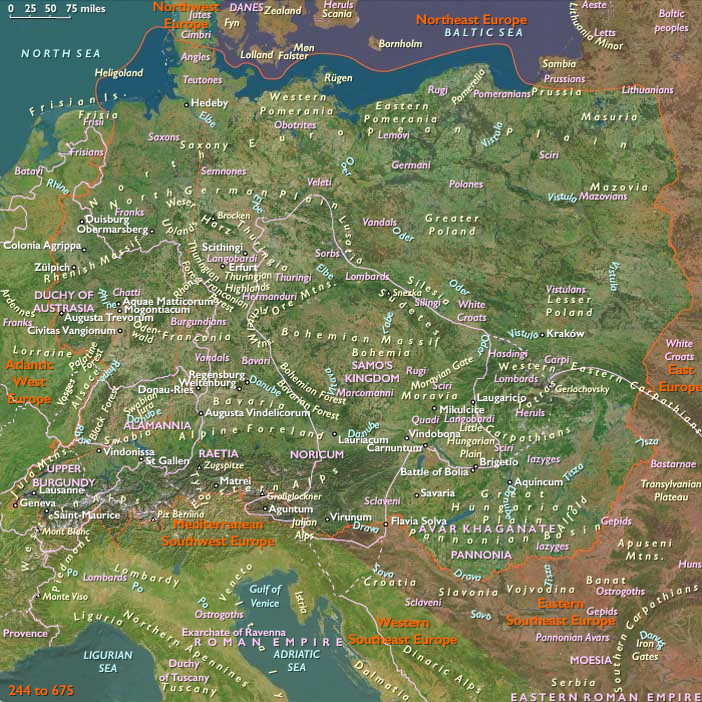
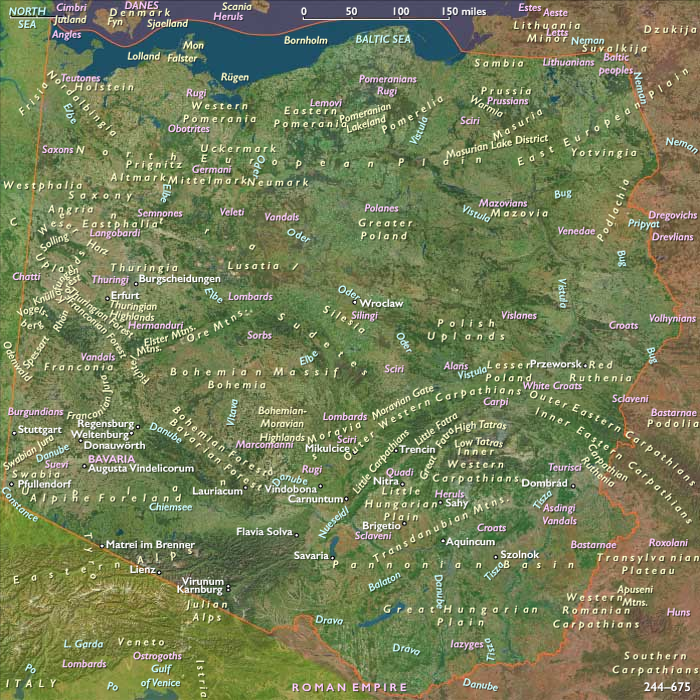
Aetius, who fights a campaign in Raetia (Switzerland) and Noricum (Austria) against the Juthungi in late 430 and 431, is attested in the city of Vindelicia (modern Augsburg), reestablishing Roman rule on the Danube frontier.
Locations
People
Groups
- Franks
- Marcomanni (Germanic tribe)
- Chatti (Germanic tribe)
- Raetia (Roman province)
- Quadi (Germanic tribe)
- Noricum (Roman province)
- Juthungi (Germanic tribe)
- Roman Empire, Western (Ravenna)
Topics
Subjects
Regions
Subregions
Related Events
Filter results
Showing 10 events out of 58926 total
The Chams had initially been closely tied to Chinese cultural and religious traditions but wars with neighboring Funan, an Indianized kingdom located around the Mekong delta, and the acquisition of Funanese territory in the fourth century had seen the infusion of Indian culture into Cham society.
Cham King Yang Mah II in 431 commands over one hundred boats in a looting expedition along Jih-nan’s coast in Tonkin, held by China’s Liu-Song dynasty.
In his absence, the Liu-Song retaliate by laying siege to Ch’u-su, breaking it only after severe weather compels them to withdraw.
Yang Mah’s troops, while fighting on Tonkin, attempt, unsuccessfully, to enlist the aid of Funan soldiers.
Skirmishing continues sporadically between the Chinese and the Chams.
Ardaburius Aspar, a Roman general of Alani descent, had played a crucial role in his father's expedition to defeat Joannes and to install Galla Placidia and her son in his place.
He leads an East Roman fleet in 431 to expel the Vandals from Africa.
Theodosius, with the approval of Pope Celestine, in 431 convokes the third ecumenical council, the Council of Ephesus, specifically to deal with the Nestorian doctrine.
Celestine's representative, Cyril of Alexandria, in protracted debates that continue even after the end of the council, reaches an accord in which the appellation "mother of God" (“Theotokos,” or "God-bearer"), formally decreed by the council, is accepted by all.
The Council, thus condemning Nestorianism as heresy, again reaffirms the Nicene Creed and refines church dogma on the human and divine aspects of Christ's person, now declared to be of two separate natures perfectly united in Christ.
Nestorius' teaching is condemned and he himself is deposed from his see.
Theodosius is induced to ratify these decisions, and Nestorius is relegated to his former monastery near Antioch.
Hippo Regius, hunger and the inevitable diseases ravaging both the city inhabitants and the Vandals outside the city walls, falls to the Vandals after fourteen months, and Genseric makes it the capital of the Vandal kingdom.
Emperor Theodosius II sends a imperial fleet with an army under command of Aspar.
Landing at Carthage, Aspar is routed by the Vandals and Marcian, future Eastern emperor, is captured during the fighting.
Born in 392 in Illyricum or Thracia as the son of a soldier, Marcian had spent his early life as an obscure soldier, member of a military unit located at Philippopolis.
Marcian had been dispatched with his unit for a war against the Sassanids (probably the Roman-Sassanid war of 421–422), but along the road East he fell ill in Lycia; at this time he might have already been tribunus and commander of his unit.
After recovering from his illness, he went to Constantinople, where he served for fifteen years as domesticus under the generals Ardaburius and Aspar.
According to a later legend, he was brought before King Genseric, who knew by an omen that Marcian was to be Emperor and was released on his oath never to take up arms against the Vandals.
The Rise of the Suebi Kingdom in Hispania
Following the departure of the Vandals for North Africa in 429 CE, the Suebi establish a powerful kingdom in Hispania, nominally federated to Rome but, in reality, operating as an independent state. Centered in Gallaecia (modern-day northwestern Spain and northern Portugal), this Suebi kingdom becomes the first post-Roman barbarian realm to emerge in the former Western Roman Empire.
Despite its official foederati status, the Suebi increasingly govern without imperial oversight, issuing their own laws, striking coinage, and expanding their influence across Lusitania and Baetica. Their independence is further solidified through their alliance with the Visigoths, led by Theodoric I, who had been settled in the Garonne region of Gaul as federates of Rome since 418.
This Suebi-Visigothic alliance strengthens both kingdoms at the expense of the Western Roman Empire, which remains too weak to assert control over its former provinces. Over the next century, tensions between the Suebi and Visigoths will fluctuate between cooperation and conflict, culminating in the Visigothic conquest of the Suebi kingdom in 585 CE, but for now, the Suebi remain a dominant force in Hispania, marking one of the earliest permanent post-Roman successor states in Western Europe.
Aetius and the Containment of the Salian Franks
In 431 CE, Flavius Aetius, the powerful magister militum of the Western Roman Empire, launches a counteroffensive against the Salian Franks, who had been steadily expanding southward into northern Gaul under King Chlodio.
Aetius, often called the last great Roman general of the West, successfully pushes the Franks back across the Somme, halting their incursion into Roman-controlled Gaul. The decisive battle takes place at Helena (modern Hélesme), strategically located between Tournai and Cambrai. In this engagement, Aetius' forces defeat the Franks, preventing them from making further gains southward.
While this victory temporarily stalls Frankish expansion, it does not eliminate their presence. Instead, the Franks remain entrenched in northern Gaul, waiting for an opportunity to expand once again. Over the next few decades, as Roman authority in Gaul continues to weaken, the Franks will reassert themselves, ultimately laying the foundation for the emergence of the Frankish Kingdom in the post-Roman West.
Chlodio and the Establishment of Tournai as the Frankish Capital
Following his expansion across the Scheldt River, Chlodio, king of the Salian Franks, consolidates his rule over northern Gaul. Despite suffering a setback against Aetius in 431 CE, he maintains control over the lands east of the Somme, where the Franks are firmly entrenched.
Recognizing the strategic and symbolic importance of the region, Chlodio establishes Tournai as the capital of the Salian Franks. Situated along key trade and military routes, Tournai becomes the center of Frankish power in northern Gaul. Though still under nominal Roman authority, the Salian Franks increasingly operate as an independent force, waiting for Rome’s further decline to resume their expansion.
In the decades to come, Tournai will remain a political and military stronghold, serving as the seat of future Merovingian rulers, including Clovis I, who will ultimately unite the Franks and lay the foundation for the Frankish Kingdom.
The Palladii are reckoned among the noblest families of France and several of them held high rank in the Church of Gaul.
Palladius is the son of Exuperantius of Poitiers, of whom the contemporary pagan poet Rutilius Claudius Namatianus wrote: "Even now his father Exuperantius trains the Armoric sea-board to love the recovery of peace; he reestablishes the laws, brings freedom back and suffers not the inhabitants to be their servants' slaves."
Exuperantius was apparently praefectus praetorio Galliarum ("Praetorian prefect of the Gallic provinces") in 424 when killed in an army mutiny at Arles.
Prosper of Aquitaine describes him as a deacon.
Some writers regard Palladius as deacon of St. Germanus, but it appears more probable that he held the high rank of Deacon of Rome; it can hardly be supposed that a deacon of Auxerre would exercise such influence in Rome as that assigned to Palladius, and it is in accordance with St. Prosper's usage to indicate the Roman deacon by the simple title diaconus.
Palladius was married and had a young daughter.
He is described as a friend and younger kinsman by Namatianus.
In Rome, he had kissed his family goodbye in the manner of the Apostles, and lived as an ascetic in Sicily about 408/409, giving his daughter to a convent on that island.
He seems to have been ordained a priest about 415.
He had lived in Rome between 418–429, and appears to be the "Deacon Palladius" responsible for urging Pope Celestine I to send the bishop Germanus to Britain, where he guided "the Britons back to the Catholic faith."
It is a question whether or not it is the same person who, in 431, was sent as first bishop to the Christians of Ireland: Palladius, having been ordained by Pope Celestine, was sent as first bishop to the Irish believing in Christ.
Palladius landed at Hy-Garchon, where the town of Wicklow now stands.
The Irish writers of the lives of St. Patrick say, that St. Palladius had preached in Ireland a little before St. Patrick, but that he was soon banished by the king of Leinster, and returned to North Britain.
According to Muirchu, who lived two centuries later, in the Book of Armagh, God hindered him...and neither did those fierce and cruel men receive his doctrine readily, nor did he himself wish to spend time in a strange land, but returned to him who sent him.
Palladius was accompanied by four companions: Sylvester and Solinus, who remained after him in Ireland; and Augustinus and Benedictus, who followed him to Britain, but returned to their own country after his death.
Palladius is most strongly associated with Leinster, particularly with Clonard, County Meath.

Palladius, after leaving Ireland, had arrived among the Scots in North Britain, according to St. Prosper, in the consulate of Bassus and Antiochus, in the year of Christ 431.
There is also a cluster of dedications in the Mearns in Scotland, where the village of Auchenblae is believed to be his last resting place.
Years: 431 - 431
Locations
People
Groups
- Franks
- Marcomanni (Germanic tribe)
- Chatti (Germanic tribe)
- Raetia (Roman province)
- Quadi (Germanic tribe)
- Noricum (Roman province)
- Juthungi (Germanic tribe)
- Roman Empire, Western (Ravenna)