
Adrian VI had published Quaestiones in quartum …
Years: 1523 - 1523
Adrian VI had published Quaestiones in quartum sententiarum praesertim circa sacramenta (Paris, 1512, 1516, 1518, 1537; Rome, 1522), and Quaestiones quodlibeticae XII. (1st ed., Leuven, 1515).
He holds no beatifications in his pontificate but on May 31, 1523, canonizes Saints Antoninus of Florence and Benno of Meissen.
The Pope is not successful as a peacemaker among Christian princes, whom he hopes to unite in a war against the Turks.
He had in August 1523 been forced into an alliance with the Empire, England, and Venice against France; the Sultan Suleiman I in 1522 had meanwhile conquered Rhodes.
He makes only one cardinal in the course of his pontificate, Willem van Enckevoirt, made a cardinal priest in a consistory held on September 10, 1523.
Charles V's ambassador in Rome, Juan Manuel, lord of Belmonte, wrote that he was worried that Charles' influence over Adrian waned after Adrian's election, writing, "The Pope is "deadly" afraid of the College of Cardinals.
He does whatever two or three cardinals write to him in the name of the college."
The pope is mocked by the people of Rome on the Pasquino, and the Romans, who have never taken a liking to a man they see as a "barbarian", rejoice at his death on September 14, 1523, after a somewhat brief tenure as pope.
Most of his official papers are lost after his death.
He is buried in the Santa Maria dell'Anima church in Rome.
He bequeaths property in the Low Countries for the foundation of a college at the University of Leuven that becomes known as Pope's College.
Giulio de’Medici, one of Giuliano de’Medici's illegitimate sons, who has enjoyed a successful career as manager of the affairs of the Medici family and as vice chancellor of the church, overcomes the opposition of the French king and finally succeeds in being elected Pope Clement VII in the next conclave on November 19, 1523.
A devout mans, he brings to the papal throne a high reputation for political ability and possesses in fact all the accomplishments of a wily diplomat.
However, he is considered by his contemporaries as worldly and indifferent to the perceived dangers of the Protestant Reformation by the people of the papacy.
He attempts to follow a middle road in the political struggles between Francis and Charles V. At his accession, Clement VII sends the Archbishop of Capua, Nikolaus von Schönberg, to the Kings of France, Spain, and England, in order to bring the Italian War to an end.
An early report from a protonotary to the emperor records: "As the Turks threaten to conquer Christian states, it seems to him that it is his first duty as Pope to bring about a general peace of all Christian princes, and he begs him (the Emperor), as the firstborn son of the Church, to aid him in this pious work."
The pope's attempt fails, however.
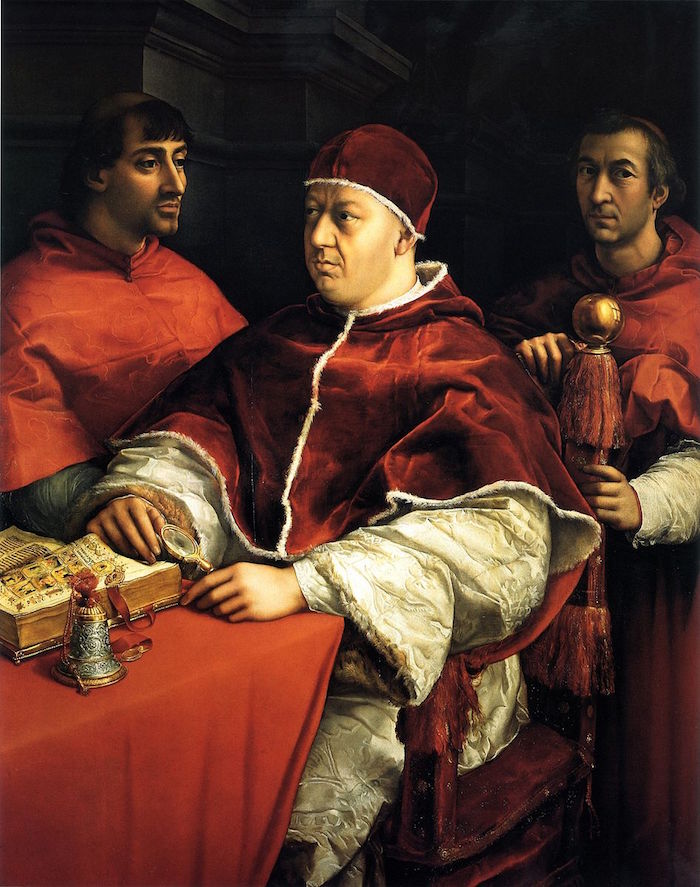
Raphael: Portrait of Pope Leo X and his cousins, cardinals Giulio de' Medici and Luigi de' Rossi (between 1518 and 1519); oil on panel; 154 × 119 cm (60.6 × 46.9 in); Uffizi Gallery.
Locations
People
- Charles V, Holy Roman Emperor
- Francis I of France
- Martin Luther
- Pope Adrian VI
- Pope Clement VII
- Suleiman I “the Magnificent”
Groups
- Papal States (Republic of St. Peter)
- Christians, Roman Catholic
- Venice, (Most Serene) Republic of
- France, (Valois) Kingdom of
- Holy Roman Empire
- Ottoman Empire
- England, (Tudor) Kingdom of
- Spain, Habsburg Kingdom of
- Lutheranism
- Protestantism
Topics
- Portraits, Renaissance
- Renaissance, Italian
- Western Art: 1516 to 1528
- Protestant Reformation
- Italian War of 1521–26
Commodoties
Subjects
- Commerce
- Painting and Drawing
- Labor and Service
- Fashion
- Conflict
- Faith
- Government
- Scholarship
- Custom and Law
- Technology
- Movements
Regions
Subregions
Years: 1523 - 1523
Raphael: Portrait of Pope Leo X and his cousins, cardinals Giulio de' Medici and Luigi de' Rossi (between 1518 and 1519); oil on panel; 154 × 119 cm (60.6 × 46.9 in); Uffizi Gallery.
Locations
People
- Charles V, Holy Roman Emperor
- Francis I of France
- Martin Luther
- Pope Adrian VI
- Pope Clement VII
- Suleiman I “the Magnificent”
Groups
- Papal States (Republic of St. Peter)
- Christians, Roman Catholic
- Venice, (Most Serene) Republic of
- France, (Valois) Kingdom of
- Holy Roman Empire
- Ottoman Empire
- England, (Tudor) Kingdom of
- Spain, Habsburg Kingdom of
- Lutheranism
- Protestantism
Topics
- Portraits, Renaissance
- Renaissance, Italian
- Western Art: 1516 to 1528
- Protestant Reformation
- Italian War of 1521–26
Commodoties
Subjects
- Commerce
- Painting and Drawing
- Labor and Service
- Fashion
- Conflict
- Faith
- Government
- Scholarship
- Custom and Law
- Technology
- Movements
Regions
Subregions