
The Bedford Master and the Evolution of …
Years: 1421 - 1421
The Bedford Master and the Evolution of Portraiture in Manuscript Illumination (15th Century)
During the early 15th century, actual portraits began appearing in illuminated manuscripts, marking a significant shift in medieval art toward individualized representation. This development can be seen in the works of the Limbourg brothers, particularly in Très Riches Heures du Duc de Berry, and in the Bedford Workshop, named after the illuminations commissioned by John of Lancaster, 1st Duke of Bedford.
The Bedford Master, the principal illuminator of the Bedford Hours (British Library, Add. MS 18850) and the Salisbury Breviary (Bibliothèque nationale de France, MS lat. 17294), was a key figure in this artistic evolution.
I. The Bedford Master and His Workshop
- The Bedford Master was an illuminator active in Paris between 1415 and 1435, producing works for English and French noble patrons.
- His name comes from two major commissions for John, Duke of Bedford, the English regent of France during the Hundred Years’ War:
- The Bedford Hours (before 1422) – A luxurious book of hours featuring portraits within initials.
- The Salisbury Breviary – Another highly detailed manuscript, now housed in the Bibliothèque nationale de France.
- His workshop was a large collaborative enterprise, employing numerous assistants, including the Chief Associate of the Bedford Master.
II. The Evolution of Portraiture in Manuscripts
- The Bedford Hours (executed before 1422) features portraits of donors and noble patrons within decorated initials.
- This trend reflected a new emphasis on individual identity and dynastic representation, coinciding with:
- The rise of personal piety among nobility.
- The growing interest in realism and naturalistic depictions in art.
- The influence of contemporary panel painting and sculpture, which also saw a shift toward individualized portraiture.
III. The Bedford Trend and Later Developments
- Art historians now refer to the "Bedford Workshop" rather than a single "Bedford Master", acknowledging the collaborative nature of manuscript production.
- Millard Meiss (1967) introduced the term "Bedford Trend", recognizing a wider stylistic period leading up to the Bedford manuscripts.
- A "Master of the Bedford Trend" has been proposed for some of the later works.
IV. The Identity of the Bedford Master
- One potential candidate for the Bedford Master is Haincelin of Hagenau, a documented Alsatian illuminator active in Paris between 1403 and 1424.
- His son, Jean Haincelin, was active from at least 1438 to 1449 and may have been the "Dunois Master,"associated with a group of late Bedford-style manuscripts.
V. The Impact of the Bedford Workshop on 15th-Century Art
- The Bedford Workshop’s innovations in portraiture influenced later Netherlandish and French manuscript illumination.
- The trend toward realism and individuality in manuscripts mirrored developments in panel painting, leading toward the Renaissance tradition of portraiture.
The Bedford Master and his workshop played a crucial role in the emergence of individualized portraiture in manuscripts, bridging medieval decorative traditions with the realism of early Renaissance art.
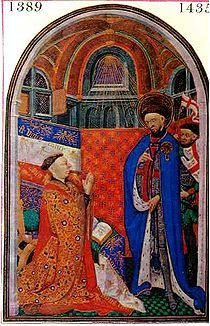
John of Lancaster, 1st Duke of Bedford (left)
Locations
People
Groups
Topics
Subjects
Regions
Subregions
Related Events
Showing 10 events out of 11 total
Years: 1421 - 1421
John of Lancaster, 1st Duke of Bedford (left)
Locations
People
Groups
Topics
Subjects
Regions
Subregions