The legend of the Seven Sleepers of …
Years: 251 - 251
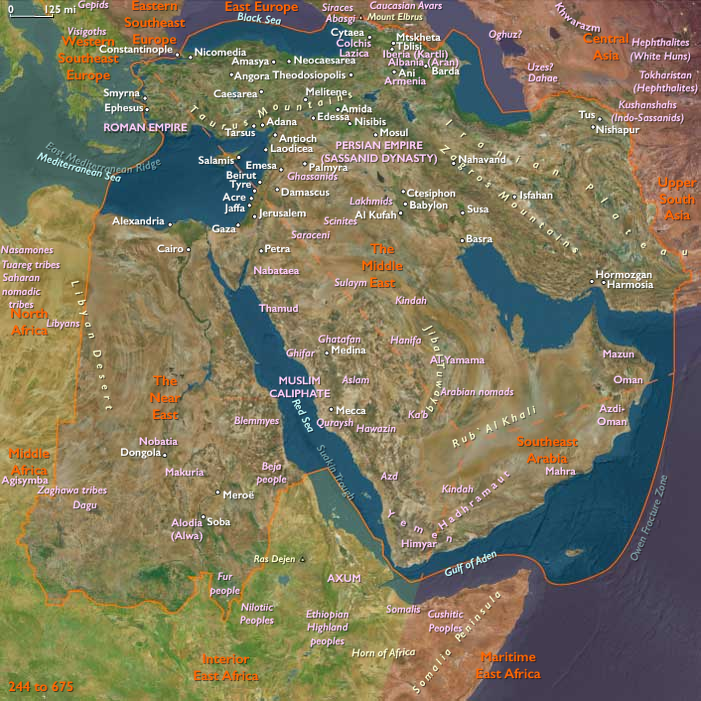
The legend of the Seven Sleepers of Ephesus, thought to be of Syrian origin, tells of seven young Christians had sought refuge in a cave in Ephesus in western Anatolia to escape the persecutions of Decius.
The emperor supposedly has the cave's entrance boarded up, and the martyrs fall into a deep sleep, to awaken two centuries later.
Locations
People
Groups
Topics
Commodoties
Subjects
Regions
Subregions
Related Events
Filter results
Showing 10 events out of 60376 total
Wang Ling's family had fled to the countryside after his uncle, Wang Yun, was executed in 192 CE for fomenting Lü Bu's assassination of Dong Zhuo.
Later he was declared xiaolian, a crucial nomination to be considered for civil service appointments, and became the Grand Administrator of Zhongshan.
His excellent public service record had been noticed by Cao Cao, the penultimate chancellor of the Han Dynasty, who had moved him into his office.
In Cao Cao's army, Wang Ling had engaged in several battles with Eastern Wu.
As the Inspector of Yanzhou, he had attacked Sun Quan under Zhang Liao.
His victory led to his promotion to General Jianwu.
In another battle against Eastern Wu, Wang Ling had rescued the besieged general Cao Xiu, and had been promoted to General of Chariots and Cavalry after a major victory against Quan Cong.
In the second year of Cao Fang's reign as emperor of Cao Wei, Wang Ling had been appointed Minister of Works, while his nephew Linghu Yu had become the Inspector of Yanzhou.
Wang Ling had lost faith in Cao Fang's ability to rule after Sima Yi's coup d'etat in the incident at Gaoping Tombs succeeded in turning the emperor against Sima Yi's rival, the late Cao Shuang.
As a result, Wang Ling conspires to replace emperor Cao Fang with his uncle, Cao Biao, the Prince of Chu, a son of Cao Cao.
Wang Ling in 251 convinces Cao Biao to attempt a coup d'etat against Sima Yi, but the conspiracy suffers a setback when Linghu Yu dies of an illness.
The plot is soon discovered and Sima Yi goes on the offensive, leading an army against Wang before he can prepare his defenses.
Knowing that they are unprepared to do battle with Sima Yi, the two surrender to him with the promise of a pardon, but Wang Ling, together with Cao Bei, is forced to commit suicide, and his family members and associates are condemned to family annihilation.
In order to prevent any more rebellions, Sima Yi puts the entire Cao family under house arrest in Ye.
From this point on, he prevents any of them from having any contact with one another.
With the entire royal family of Wei out of his way, Sima Yi has effectively made the kingdom's nominal rulers irrelevant.
He dies later in the year, leaving his legacy to his sons Sima Shi and Sima Zhao.
His success and subsequent rise in prominence paves the way for his grandson Sima Yan's foundation of the Jin Dynasty, which will eventually bring an end to the Three Kingdoms era.

Decius takes the field against Cniva’s Goths.
The final engagement in this campaign takes place on swampy ground at Abritus in the Dobruja, in June 251, and ends in the defeat and death of Decius and his son, Herennius Etruscus, largely owing to the failure of the general Gaius Vibius Trebonianus Gallus to attack aggressively.
Herennius had died in battle, struck by an enemy arrow.
Decius had survived the initial confrontation, only to be slain with the rest of the army before the end of the day.
Herennius and Decius are the first two emperors to be killed by a foreign army in battle.
With the news of the death of the emperors, the army proclaims as emperor Trebonianus Gallus, who, under duress, negotiates a treaty with the Goths that allows them to keep their booty and return to their homes on the other side of the Danube, while at the same time promising an annual tribute in return for the Goths' promise to respect Roman territory.
Ammianus Marcellinus (31.5.12-17) rates this reverse with the most serious military disasters of the Roman Empire to his time: Varus' defeat at the Battle of the Teutoburg Forest, the incursions of the Marcomanni during the reign of Marcus Aurelius, and the Battle of Adrianople.
The Gothic army has taken a number of captives, predominantly female, many of which are Christian.
This is assumed to represent the first lasting contact of the Goths with Christianity.
Dionysius of Alexandria, born to a wealthy pagan family here, has spent most of his life reading books and carefully studying the traditions of heretics.
After having converted to Christianity at a mature age, he had joined the Catechetical School of Alexandria and been a student of Origen and Heraclas.
Dionysius later became leader of the school and presbyter of the Christian church, in 231 succeeding Heraclas.
He had in 248 succeeded the deceased Heraclas as Bishop of Alexandria.
Dionysius in his later writings describes the period during which the city of Alexandria is subject to the legal persecution instituted by Decius against Christians.
The many extreme horrors faced by Alexandrians during the persecution had included death by stoning, the gouging of eyes, and being dragged through the streets as well as being burnt alive.
Dionysius himself had been captured during the persecution, but was later freed by a mob of Christian passersby and fled into the desert.
The emperor Decius, while absent from Rome, had evidently selected Publius Licinius Valerianus, or Valerian, commander of the armies of the Upper Rhine, to direct the government.
Consul under Severus Alexander, Valerianus had played a leading role in inducing the Senate to risk support for the rebellion of Gordian I against Maximinus.
He may have been one of the twenty consulars who successfully defended Italy against the emperor.
However, Trebonianus Gallus, who has served with loyalty and distinction as legate of Moesia, is the emperor's immediate successor.
Gallus comes from an ancient family of Perusia (modern Perugia, Italy), whose ancestry can be traced to the pre-Roman Etruscan aristocracy.
He adopts Decius's younger son Hostilian as his co-ruler and at the same time makes his own son, Volusianus, a secondary and later co-emperor.
A severe outbreak of plague, possibly either measles or smallpox, enters the Roman Empire in 251, where it will rage for fifteen years; Hostilian dies of this plague shortly after receiving his title.
The Plague of Cyprian is the name given to this pandemic, probably of smallpox.
It is named after St. Cyprian, an early Christian writer who witnesses and describes the plague, which will cause widespread manpower shortages in agriculture and the Roman army.
Rome's suppression of Christianity has strengthened rather than weakened the movement, for public opinion condemns the government's violence and applauds the passive resistance of the martyrs.
Early in 251, the persecution of Christians ceases.
(Decius has provided the model for a more thorough persecution of Christians that will begin in 303 under Diocletian's reign.)
Novatian, the first Roman theologian who uses the Latin language, writes De Trinitate, an orthodox interpretation of early church doctrine on the Trinity.
The region of Wu, in the south of the Yangtze River surrounding Nanjing, had during the decline of the Han dynasty been under the control of the warlord Sun Quan, who had succeeded his brother Sun Ce as the lord over the Wu region paying nominal allegiance to Emperor Xian of Han (who was, at that point, under the control of the warlord Cao Cao).
Sun Quan, unlike his competitors, lacked sufficient ambition ambition to be Emperor of China, and had ruled from 200 to 222 as Wu Wang (King/Prince of Wu).
After Cao Pi of the Kingdom of Wei and Liu Bei of the Kingdom of Shu each declared themselves to be the Emperor, Sun Quan had decided to follow suit in 229, claiming to have founded the Wu Dynasty.
Formally Emperor Da of the Wu Dynasty, one of the Three Kingdoms competing for control of China after the fall of the Han Dynasty, he dies in 252 and is succeeded by Sun Liang, his youngest son.
Southern China, regarded in early history as a barbaric "jungle", has developed under the rule of Eastern Wu into one of the commercial, cultural, and political centers of China.
The development of Southern China will surpass that of the north within five centuries, during the Five Dynasties and Ten States period.
The achievements of Wu mark the beginning of the cultural and political division between Northern and Southern China that will repeatedly appear in Chinese history well into modernity.
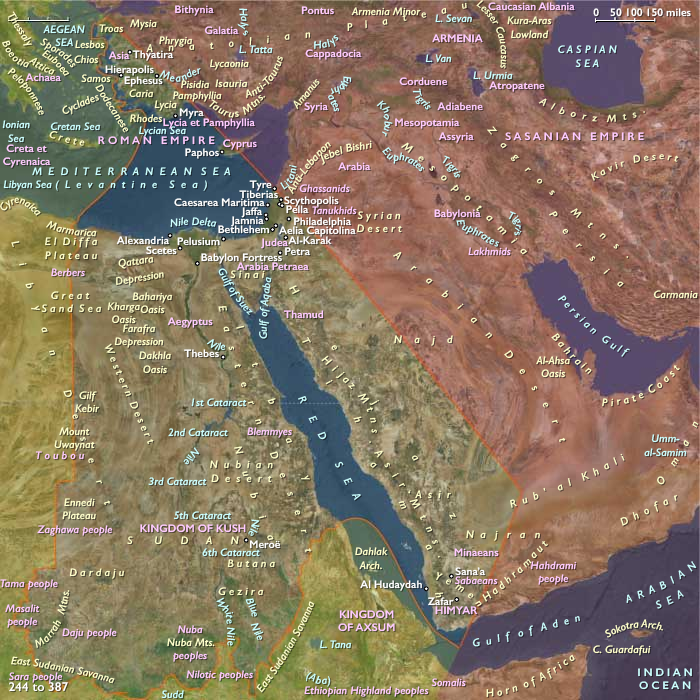
Shapur, taking advantage of the internal chaos within the Roman Empire in 252, with a large army at his command, …
…imposes his son Artavasdos on Armenia, …
…attacks Mesopotamia, and …