
Ahab’s wife, the Sidonian princess Jezebel, zealously …
Years: 849BCE - 838BCE
Ahab’s wife, the Sidonian princess Jezebel, zealously promotes the worship of the Phoenician god Baal and supports four hundred and fifty prophets of Baal, according to the Hebrew scriptures (1 Kings).
When the prophet Elijah opposes her and rouses popular sentiment against the pagan prophets, she orders his death, forcing him to flee.
Jehoram of Israel, the son of Ahab and Jezebel and king of Israel, maintains close relations with Judah.
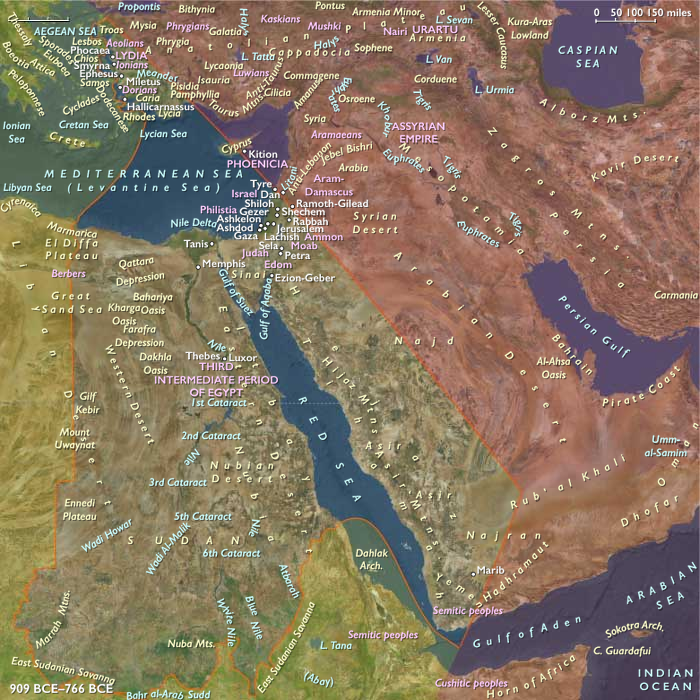
Together with Jehoshaphat, king of Judah, Jehoram unsuccessfully attempts to subdue a revolt of Moab against Israel.
As had his father, Jehoram later endeavors to recover Ramoth-gilead from Hazael, king of Damascus.
His nephew Ahaziah, who had succeeded his father as king of Judah, aids him in this matter.
Wounded during the fighting at Ramoth-gilead, Jehoram has retired to Jezreel in Judah.
During his convalescence, Jehu, a commander of chariots on Israel's frontier facing Damascus and Assyria, leads a coup to overthrow the dynasty of Omri (II Kings 9-10) on the instructions of Elijah.
Jehu's revolt, which extinguishes the dynasty of Omri (including Jehoram, Ahaziah—who was visiting him—and Ahab's wife, Jezebel), takes place in the 840s, when the dynasty is already in decline.
Jehu slaughters the entire royal family in about 843 and purges Israel of the idolatrous Baal worship.
Jezebel, at Jehu’s order, is cast from a palace window by her eunuchs; dogs, as Elijah had supposedly prophesied, devour her body.
Elijah in 842 anoints Jehu king.
Jehu's success ends the Phoenician alliance, and the spirit of fanaticism makes its renewal impossible.
Israel alone is no match for the incursions of Assyria's Shalmaneser III, who moves westward in 841, investing Damascus and exacting tribute both from Jezebel's city of Sidon and from Jehu.
According to the Hebrew scriptures (1 Kings), the prophet Elisha, using Elijah’s mantle, carries on his late master’s attempt to shape the national destiny by announcing the divine will.
Unlike Elijah, a prophet characterized by his simplicity, Elisha is a man of political dexterity.
Locations
People
Groups
- Moabites, Kingdom of the
- Hebrews
- Aram-Damascus (Syria), Kingdom of
- Judah, Kingdom of
- Israel (Northern Kingdom of)
- Assyria, (New) Kingdom of (Neo-Assyrian Empire)
Topics
- Younger Subboreal Period
- Iron Age, Near and Middle East
- Assyrian Wars of c. 909-c. 746 BCE
- Iron Age Cold Epoch
Commodoties
Subjects
Regions
Subregions
Related Events
Showing 10 events out of 66579 total
Years: 849BCE - 838BCE
Locations
People
Groups
- Moabites, Kingdom of the
- Hebrews
- Aram-Damascus (Syria), Kingdom of
- Judah, Kingdom of
- Israel (Northern Kingdom of)
- Assyria, (New) Kingdom of (Neo-Assyrian Empire)
Topics
- Younger Subboreal Period
- Iron Age, Near and Middle East
- Assyrian Wars of c. 909-c. 746 BCE
- Iron Age Cold Epoch
Commodoties
Subjects
Regions
Subregions