
Filters:
The Assyrian king Ashu-rnirari is compelled to …
Years: 753BCE - 742BCE
The Assyrian king Ashu-rnirari is compelled to stay "in the land" for four years, according to the Assyrian eponym canon.
It is customary for the Assyrian king to campaign every year, and such an indication usually means the kingship has been seriously weakened.
A revolution overthrows the Assyrian royal family in 745.
Ashu-rnirari’s successor, a general elevated by the coup, takes the throne as Tiglath-Pileser III.
He immediately sets himself to the task of restoring Assyria’s imperial power.
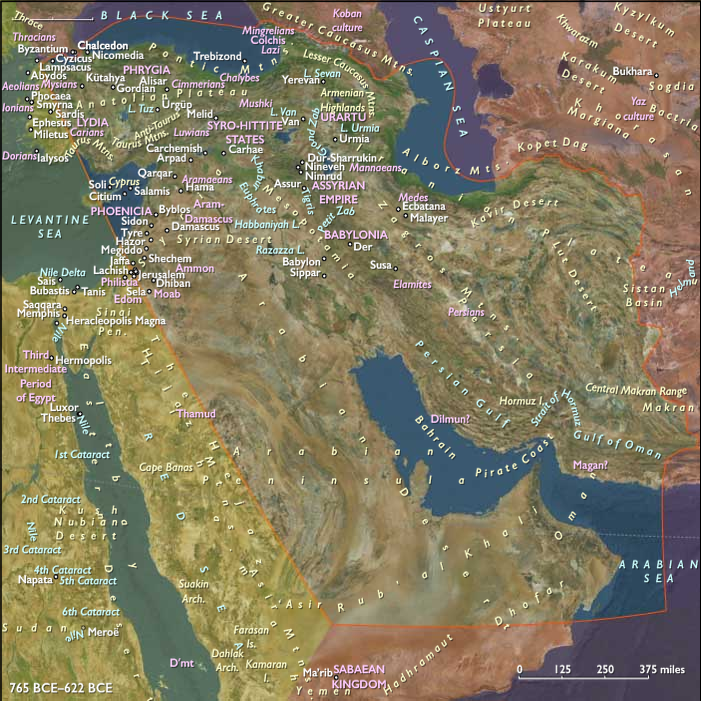
Tiglath-Pileser and his autonomous vassals bring the rebellious Babylonians to heel as other Assyrian forces wage a successful campaign in 743 BCE to roll back the Syrian-Armenian kingdom of Urartu, increasingly a menace to the frontier.
Locations
People
Groups
- Mesopotamia
- Assyria, (New) Kingdom of (Neo-Assyrian Empire)
- Assyrian people
- Urartu, Kingdom of
- Assyria, (New) Kingdom of (Neo-Assyrian Empire)
Topics
- Younger Subboreal Period
- Iron Age, Near and Middle East
- Iron Age Cold Epoch
- Classical antiquity
- Assyrian Wars of c. 745-609 BCE
Commodoties
Subjects
Regions
Subregions
Years: 753BCE - 742BCE
Locations
People
Groups
- Mesopotamia
- Assyria, (New) Kingdom of (Neo-Assyrian Empire)
- Assyrian people
- Urartu, Kingdom of
- Assyria, (New) Kingdom of (Neo-Assyrian Empire)
Topics
- Younger Subboreal Period
- Iron Age, Near and Middle East
- Iron Age Cold Epoch
- Classical antiquity
- Assyrian Wars of c. 745-609 BCE
Commodoties
Subjects
Regions
Subregions