
Polish national custom identifies the starting date …
Years: 964 - 1107
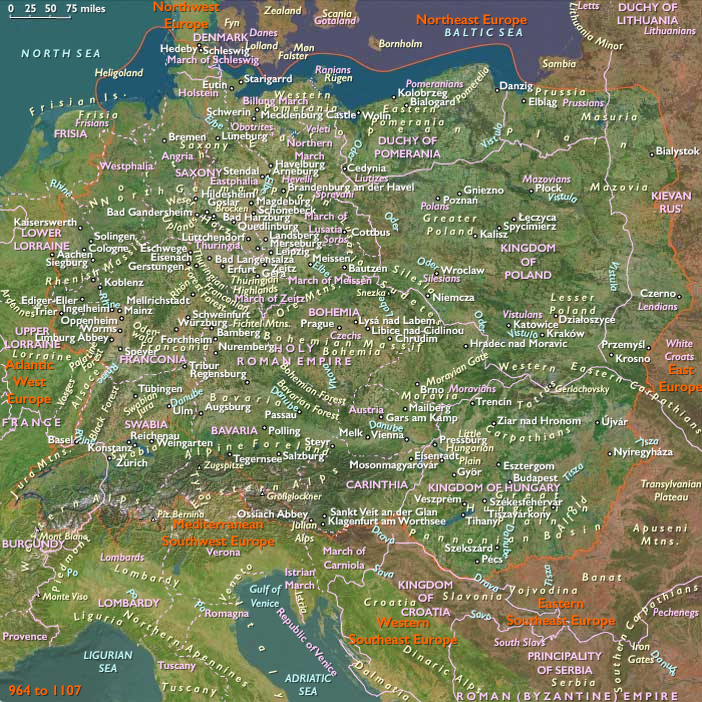
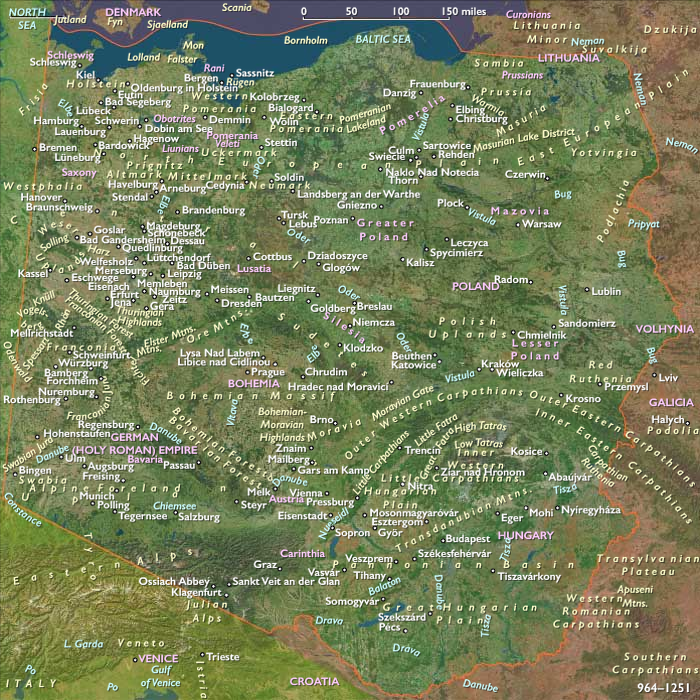
Polish national custom identifies the starting date of Polish history as 966, when Prince Mieszko (r. 963-92) accepts Christianity in the name of the people he rules, in spite of convincing fragmentary evidence in Poland of prior political and social organization.
In return, Poland receives acknowledgment as a separate principality owing some degree of tribute to the German Empire (later officially known as the Holy Roman Empire).
Under Otto I, the German Empire is an expansionist force to the West in the mid-tenth century.
Mieszko accepts baptism directly from Rome in preference to conversion by the German church and subsequent annexation of Poland by the German Empire.
This strategy inaugurates the intimate connection between the Polish national identity and Roman Catholicism that will become a prominent theme in the history of the Poles.
Locations
People
Groups
- Germans
- Papal States (Republic of St. Peter)
- Germany, Kingdom of (within the Holy Roman Empire)
- German, or Ottonian (Roman) Empire
- Poland, Principality of
- Poles (West Slavs)
- Czechs [formerly Bohemians] (West Slavs)
- Slovaks (West Slavs)
- Poland of the first Piasts, Kingdom of
- Christians, Roman Catholic
Subjects
Regions
Subregions
Related Events
Filter results
Showing 10 events out of 25 total
Portugal, which had already established its dominance as a maritime power in the Atlantic, is exploring new waters by the late fifteenth century.
In 1497 Vasco da Gama sails around the Cape of Good Hope and discovers an ocean route connecting Europe with India, thus inaugurating a new era of maritime supremacy for Portugal.
The Portuguese are consumed by two objectives in their empire-building efforts: to convert followers of non-Christian religions to Roman Catholicism and to capture the major share of the spice trade for the European market.
To carry out their goals, the Portuguese do not seek territorial conquest, which would be difficult given their small numbers.
Instead, they try to dominate strategic points through which trade passes.
By virtue of their supremacy on the seas, their knowledge of firearms, and by what has been called their "desperate soldiering" on land, the Portuguese gain an influence in South Asia that is far out of proportion to their numerical strength.
Portuguese official Afonso de Albuquerque, sent to India in command of the Fifth Portuguese Indian Armada, builds a fortified trading station at Cochin.
The South Indian port city becomes the first European community in India.
A Portuguese emissary, accompanied by a Christian picked up in Calicut, is set ashore on Vasco da Gama’s arrival in Cochin to make contact with the Trimumpara Raja (Unni Goda Varma), the Nair Hindu prince of Cochin kingdom.
The Portuguese are greeted warmly, the bombardment of the hated Zamorin's Calicut outweighing the earlier matter of the war elephants.
The official pleasantries and hostage-swapping quickly fulfilled, Cabral himself goes ashore and negotiates a treaty of alliance between Portugal and the Cochin kingdom, directed against the Zamorin's Calicut.
Cabral promises to make the Trimumpara Raja of Cochin the ruler of kingdom of Calicut, upon the city's capture.
A Portuguese factory has been set up in Cochin, with Gonçalo Gil Barbosa as chief factor (the pre-designated Aires Correia having perished in the Calicut Massacre).
The spice markets of Cochin, a smaller, poorer city are not nearly as well supplied as Calicut, but the trade is good enough to begin loading ships.
The stay in Cochin is not without incident—the factory is set ablaze one evening (probably at the instigation of Arab traders in the city), but the Trimumpara Raja will not countenance a repeat of the events of Calicut.
He cracks down on the arsonists, takes the Portuguese under his protection (the factors stay in his palace), and assigns his personal Nair guards to escort the Portuguese factors in the city's markets and protect the factory against any further incidents.
News arrives on January 16 that the Zamorin has assembled and dispatched a fleet of around eighty boats against the Portuguese in Cochin.
Despite the Trimumpara Raja of Cochin's offer of military assistance against the Calicut fleet, Cabral decides to precipitously lift anchor and slip away rather than risk a confrontation.
Cabral's fleet leaves behind the factor Gonçalo Gil Barbosa and six assistants in Cochin.
In their hasty departure, the Portuguese inadvertently take along two of the Trimumpara's officers (Idikkela Menon and Parangoda Mennon), who have been serving as noble hostages aboard the vessels.
João da Nova, arriving in Cochin, encounters the factor left behind by Cabral, Gonçalo Gil Barbosa.
Barbosa reports trading difficulties in the local markets.
Indian spice merchants require payment in cash (silver principally), but Cabral had left him only with a stock of Portuguese goods (cloth mainly), expecting him to use the revenues from their sale to buy up the spices.
European goods have little appeal in Indian markets, however, and Barbosa is still saddled with his unsold stock, unable to raise the cash to buy the spices.
Barbosa seems to suspect that the Arab merchant guilds have engineered a boycott of Portuguese goods on Indian markets.
He also reports that the Trimumpara Raja of Cochin, despite his alliance and protection of the factory, is in fact furious at the Portuguese because Cabral's Second Armada had departed so suddenly (without official pleasantries and taking two noble Cochinese noble hostages with them).
The lack of silver cash seems to be the pressing problem that Nova did not anticipate.
He certainly has not brought much cash with him, having also expected to sell Portuguese goods in India to raise it.
Gama, his blockade of Calicut in place, arrives in Cochin with the bulk of the armada.
He is received by Trimumpara Raja, ruler of Cochin, not without a touch of anxiety, but diplomacy soon sets that to rest.
The Nair hostage taken accidentally by the Second Armada the previous year is delivered, along with the letter of the other Nair who stayed back in Lisbon.
Gama concludes negotiates a new commercial treaty with the ruler of Cochin, this time with a fixed-price schedule, like at Cannanore.
Diogo Fernandes Correia, the new designated factor for Cochin, relieves Cabral's factor Gonçalo Gil Barbosa (now slated to be transferred to Cannanore).
They promptly set about their business of buying spices and loading ships in Cochin for the return journey.
While conducting business at Cochin, Vasco da Gama receives a letter from the queen-regent of Quilon (Coulão, Kollam), on behalf of her young son, the raja Govardhana Martanda.
The queen invites the Portuguese fleet to load up with spices at Quilon.
Gama declines politely, noting that he cannot do anything without the permission of his Cochinese hosts.
As a result, the queen-regent dispatches a messenger to the prince of Cochin.
Trimumpara Raja prevaricates at first, fearing that competition from Quilon's more amply-supplied markets will hurt his own.
But Cochin's slender supply is worrying the Portuguese factors.
At length, an agreement is reached between all parties: Gama is to dispatch only two ships to load up with spices at Quilon, and promises not to set up a permanent factory in that city.
The two ships, carrying temporary factor João de Sá Pereira, the first Portuguese to enter Quilon, will load up quickly, and return to Cochin within ten days.
While at Cochin, Gama receives a message on November 19 from the Syrian Christian community of nearby Cranganore offering to place themselves under the protection of the King of Portugal.
Gama accepts their gift of a red silver-tipped scepter, a symbolic command staff, but notes that he personally cannot do much, as he will be leaving soon.
But he promises that the community can call on the Portuguese naval patrol of Vicente Sodré at any time, should they need anything.
A wealthy Brahmin, accompanied by his son and nephew, shows up at Cochin and requests permission from Vasco da Gama to take passage on the Fourth Armada to Portugal.
At first the Brahmin claims he seeks to learn more about Christian religion in Europe, but eventually reveals he is in fact a plenipotentiary ambassador of the Zamorin, and that he hopes to speak directly with King Manuel I of Portugal in Lisbon, and negotiate a permanent peace treaty between Portugal and Calicut, as (in the Zamorin's estimation) the Portuguese armada captains, coming and going every year, do not seem empowered to negotiate durable treaties.
Gama assures him he is fully empowered by the king, at which point the Brahmin then offers to mediate a peace treaty between Gama and the Zamorin.
Gama agrees, and the Brahmin returns to Calicut, coming back to Cochin shortly after accompanied by a Nair of the Zamorin's household, with an concrete offer to compensate the Portuguese for the goods lost in the Calicut factory.
It seems a fair offer, so Gama decides to personally finalize the arrangement.
On January 5, 1503, da Gama takes his cousin's ship, the Flor de la Mar, plus one caravel, to carry the Brahmin and the Nair back to Calicut, to finalize the peace treaty with the Zamorin.
Gama leaves the rest of the Armada in Cochin under Dom Luis Coutinho. (Rumors of the imminent peace with Calicut angers the merchants of Cochin, who feel they will be shortchanged by any agreement with Calicut; Coutinho has a difficult time securing the continued purchasing and loading of spices).
Gama is taking only a light escort, but he imagines Vicente Sodré is in the vicinity and will provide additional security.
However, as it happens, Vicente Sodré had left Calicut a few days earlier.
He had been maintaining a continuous blockade on Calicut harbor, and engaging in repeated cat-and-mouse chases with small Calicut fishing ships that dared venture out.
At one point, Sodré had given a couple of fishing boats chase into a side-channel, and sailed into a trap: forty armed Calicut paraus quickly surrounded him.
A lucky cannon shot on the lead ship had broken up the ambush, allowing Sodré to extricate himself from there quickly, sailing out and racing back to Cannanore to pick up the rest of his patrol.
Escorted by Sodré's patrol, Gama had returned to Cochin after the ambush.
Although the Portuguese are aware that the Zamorin had ordered his Malabari vassals to assemble an armada in Calicut, Gama seems to have been confident that the coastal patrol is keeping a lid on it, perhaps not quite realizing that smaller ships throughout the region can make their way to Calicut unmolested via the Kerala backwaters.
The Trimumpara Raja of Cochin relays the news that the Zamorin has hired the services of a Red Sea Arab privateer, Khoja Ambar, and several large ships have slipped past the Portuguese blockade and are now in Calicut, joining the fighting fleet under the command of Calicut admiral Khoja Kassein).
The assembled Calicut fleet is estimated at twenty large ships, forty gun-mounted sambuks (large dhows) and an innumerable number of smaller oar-powered paraus, carrying several thousand armed men.
Although a large Calicut fleet had failed against the much smaller Third Armada of João da Nova the previous year, the Zamorin might have calculated that the addition of the large ships and more experienced captains might tip the balance, particularly against the heavily loaded and less-maneuverable large naus of the Fourth Armada.
The Trimumpara Raja of Cochin urges Gama to avoid the fleet and just set sail for Portugal at once, but Gama refuses to revise his plans.
He needs to return to Cannanore to deposit the factor Barbosa there and pick up a cargo of ginger he had ordered, and is burning for revenge for the ambush.
After a final audience with Raja Trimumpara in early February, 1502, Gama's fleet of around ten fully laden ships finally leaves Cochin.
Gama has taken aboard his ambassador to the Lisbon court, leaving Diogo Fernandes Correia as factor in Cochin, and has taken Cabral's old factor Gonçalo Gil Barbosa, to serve as factor in Cannanore.
They are soon joined by Sodré's caravel squadron, and set sail warily towards Cannanore, guns ready for the Calicut ambush.
Gama and Sodré spot the Calicut fleet of Coja Casem and Arab privateer Cojambar, near the coast, out of Calicut harbor.
In one of the first recorded instances of a naval line of battle, Gama's spice naus and escort caravels sail in a line end-to-end, concentrating all their immense firepower as they pass against the twenty large Arab ships of Cojambar, before they can get organized, sinking a number of them and doing immense damage to the remainder.
Although the Arab squadron is out of commission too soon, Coja Casem nonetheless proceeds forward with his fleet of Malabari sambuks, hoping to use their speed to outmaneuver the guns of the heavy-laden naus and reach for the grapple.
Gama sends the escort caravels under Vicente Sodré to intercept them in their tracks, while the cargo naus hurry on toward Cannanore.
Although the caravels are outnumbered, the fight is essentially over when Pero Rafael and Gil Matoso quickly board and capture Coja Casem's flagship (oddly, found with a lot of women and children on board).
The Calicut fleet breaks up and rushes back to port.
The pursuing caravels capture a number of sambuks, which they proceed to tow and set on fire before Calicut.
Danger dispelled, the caravels proceed to Cannanore to make junction with the main fleet.
The Battle of Calicut, like the previous year's naval battle of Cannanore, has once again demonstrated the critical importance of the technical superiority of Portuguese ships and naval artillery.
It also demonstrates to the Portuguese that the Zamorin of Calicut is not as easy to intimidate as they had expected.
Despite the terror actions, the bombardment and the naval blockade, the Zamorin has steadfastly refused to capitulate to Vasco da Gama's terms.
On the contrary, the hiring of an Arab privateer fleet demonstrates a certain resourcefulness and willingness to continue fighting and take the fight to the Portuguese.
The Zamorin clearly understands he has to appeal to foreigners to help close the technical gap between Indian and Portuguese forces.
Gama clearly understands that he has insufficient resources to secure continued Portuguese access to the spice markets; he will return to Lisbon with this message.
His priority now is to do everything he can to to protect the Portuguese factories and Indian allies of Cochin and Cannanore from the Zamorin's inevitable revenge when the Fourth Armada departs.
If the battle of Calicut impresses something on Vasco da Gama, it is precisely that the Portuguese in India are living on borrowed time, that it is going to take more resources than he has to bring the Zamorin to heel and secure continued Portuguese access to the spice markets.
And this is the message he will bring back to Lisbon.
The Zamorin, as expected, arrives in March 1503 before Cochin with an army of fifty thousand, and seizes and burns down the city.
The Portuguese factors, along the Cochin's ruler, manage to escape to the nearby island of Vypin, where they will continue to hold out until August, when the next armada arrives.
Years: 964 - 1107
Locations
People
Groups
- Germans
- Papal States (Republic of St. Peter)
- Germany, Kingdom of (within the Holy Roman Empire)
- German, or Ottonian (Roman) Empire
- Poland, Principality of
- Poles (West Slavs)
- Czechs [formerly Bohemians] (West Slavs)
- Slovaks (West Slavs)
- Poland of the first Piasts, Kingdom of
- Christians, Roman Catholic
