Jerusalem's Jewish Christian community according to Eusebius …
Years: 73 - 73
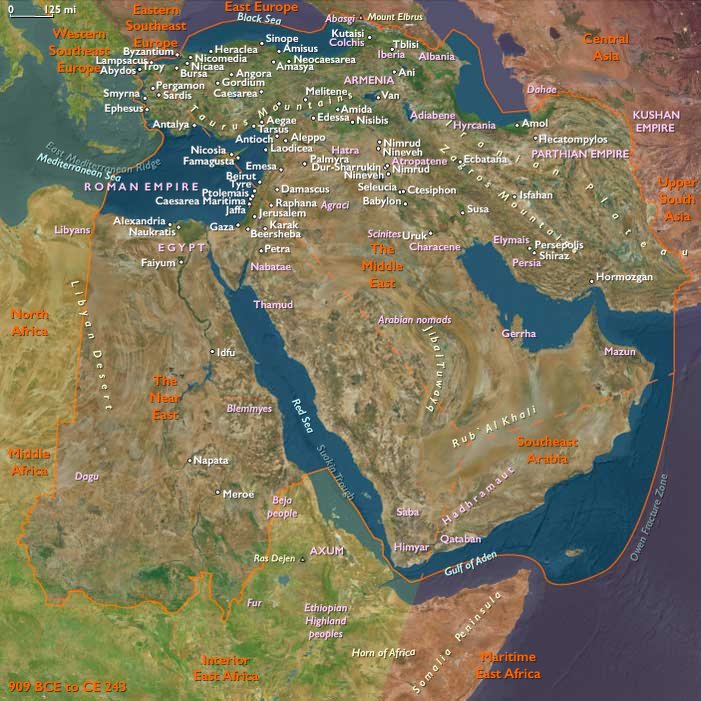
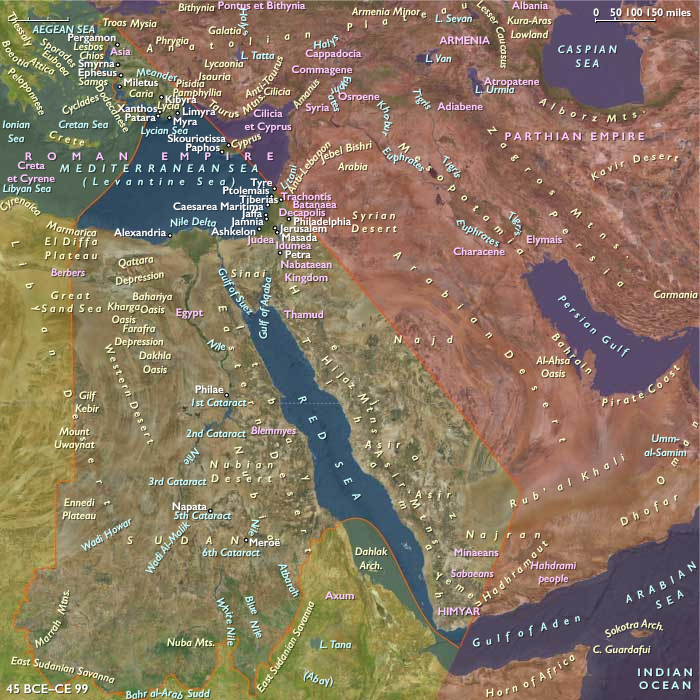
Jerusalem's Jewish Christian community according to Eusebius of Caesarea, writing around 300 CE, had moved to Pella, a city beyond the Jordan, following the Jewish Revolt, and refused to continue the struggle against the Romans.
Pella will serve as a refuge for Jerusalem’s Christian community fleeing the Jewish–Roman wars.
Locations
People
Groups
Topics
- Classical antiquity
- Roman colonization
- Pax Romana
- First Jewish-Roman War, or Jewish Revolt of 66-73
- Jewish–Roman wars
Commodoties
Subjects
Regions
Subregions
Related Events
Filter results
Showing 10 events out of 61573 total
A similar incident takes place in 73, when Prince Yan of Huaiyang is reported to have hired warlocks to curse Emperor Ming.
Several of Prince Yan's associates are executed, and there are also many others who are executed or exiled after Chu-style interrogations are carried out.
Prince Yan himself is not executed, but is demoted from his prefecture-level principality to be the Prince of Fulin, with only two counties in his principality.
Emperor Ming, annoyed at the Northern Xiongnu's constant incursions against Han domains, in 73 commissions his generals Geng Bing and Dou Gu to lead a major expedition against them.
They have only minor successes, but the campaign demonstrates to the Northern Xiongnu that the Han dynasty is now in a position to retaliate.
Dou, as part of his campaign, sends his assistant Ban Chao to visit the Xiyu (modern Xinjiang and former Soviet central Asia) kingdom of Shanshan (on the eastern edge of the Taklamakan Desert. (Xiyu kingdoms had long submitted to the authority of the Northern Xiongnu, and, unable to bear the heavy taxes, have often requested that the Eastern Han dynasty emperors step in and reassert the suzerainty that had been established during the Western Han Dynasty, starting with the reign of Emperor Wu. They had been constantly rebuffed however by Emperors Guangwu and Ming, who had judged their realm to be insufficiently strong to engage in a Xiyu campaign.)
Initially, the king of Shanshan is very pleased and welcomes the Han ambassadors as honored guests, but the welcome eventually fades.
Ban realizes that the Northern Xiongnu ambassadors must have arrived.
He discovers their location and, in a night raid, massacres them.
The king of Shanshan is shocked but pleased, and submits to Han suzerainty.
Emperor Ming promotes Ban and commissions him to next visit Yutian (Khotan), at this time the most powerful kingdom in southern Xiyu, which has a strong alliance with the North Xiongnu.
Guangde, the King of Yutian, trusts his chief warlock, who demands Ban's horse.
Ban agrees to give him the horse, and then, when the warlock arrives to pick up the horse, immediately executes him, and sends his head back to Guangde.
Impressed, Gunagde submits to Han suzerainty.
With Yutian having submitted, the Xiyu kingdoms largely all submit as well.
The Han dynasty during the turbulent reign of Wang Mang had lost control over the Tarim Basin, which was conquered by the Northern Xiongnu in 63 CE and used as a base to invade the Eastern Han dynasty's Hexi Corridor in Gansu.
Dou Gu (d. 88 CE) defeats the Northern Xiongnu at the Battle of Yiwulu in 73 CE, evicting them from Turpan and chasing them as far as Lake Barkol before establishing a garrison at Hami.
All Jewish resistance in the province has ceased by mid-73.
Caesarea Maritima following the destruction of Jerusalem has become the most important city in Palestine.
The Romans, placing Palestine under Roman governors, scatter rebellious segments of the Jewish population, selling thousands of Jews into slavery and thus intensifying the Jewish Diaspora throughout the Roman world.
The Romans obliterate the last vestiges of ancient Hebrew statehood and, with it, Jewish national autonomy.
Masada's three hundred and seventy-five-foot (one hundred and fourteen meters) high assault ramp consisted mostly of a natural spur of bedrock that required a ramp only thirty feet (9.1 meters) high built atop it in order to reach the Masada defenses.
According to Dan Gill (Gill, Dan. "A natural spur at Masada", Nature 364, pp. 569–570 [12 August 1993]), geological investigations in the early 1990s confirmed earlier observations to this effect.
This discovery diminishes both the scope of the construction and of the conflict between the Sicarii and Romans, relative to the popular perspective in which the ramp was an epic feat of construction.
The rampart is complete in the spring of 73, after probably two to three months of siege, allowing the Romans to finally breach the wall of the fortress with a battering ram on April 16.
According to Josephus, when Roman troops entered the fortress, they discovered that its nine hundred and sixty inhabitants, led by Eleazar ben Ya'ir, had set all the buildings but the food storerooms ablaze and committed a mass suicide.
The account of the siege of Masada was supposedly related to Josephus by two women who survived the suicide by hiding inside a cistern along with five children, and repeated Eleazar ben Ya'ir's exhortations to his followers, prior to the mass suicide, verbatim to the Romans.
Because Judaism prohibits suicide, Josephus reported that the defenders had drawn lots and killed each other in turn, down to the last man, who would be the only one to actually take his own life.
Josephus says that Eleazar ordered his men to destroy everything except the foodstuffs to show that the defenders retained the ability to live, and so had chosen death over slavery.
Modern archaeologists have found no evidence of mass burial at the location and only some thirty skeletons have been recovered on the site.
The lack of such evidence and the absence of any first person historical references has led to the idea that a mass suicide is a myth.
In the area in front of the northern palace, eleven small ostraca were recovered by archaeologists, each bearing a single name.
One reads "ben Yair" and could be short for Eleazar ben Ya'ir.
It has been suggested that the other ten names are those of the men chosen by lot to kill the others and then themselves, as recounted by Josephus.
Archaeologist Yigael Yadin's excavations uncovered the skeletal remains of twenty-eight people at Masada.
The remains of a male twenty to twenty-two years of age, a female seventeen to eighteen, and a child approximately twelve years old, were found in the palace.
The remains of two men and a full head of hair with braids belonging to a woman were also found in the bath house.
Forensic analysis showed the hair had been cut from the woman's head with a sharp instrument while she was still alive (a Jewish practice for captured women) while the braids indicated she was married.
Based on the evidence, anthropologist Joe Zias, the Curator of Archaeology and Anthropology for the Israel Antiquities Authority from 1972 until his retirement in 1997, believed the remains may have been Romans whom the rebels captured when they seized the garrison.
The remains of twenty-five people were found in a cave at the base of the cliff.
Carbon dating of textiles found with the remains in the cave indicate they are contemporaneous with the period of the Revolt and it is believed that as they were buried with pig bones (a Roman practice), this indicates the remains may belong to Romans who garrisoned Masada after its recapture.
Others, nevertheless, still maintain that the remains are those of the Jewish Zealots who committed suicide during the siege of Masada, and all were reburied with full military honors on July 7, 1969 at Masada.

Cyprus receives many more Jews after the Zealot rebellion, as thousands are sent by the Romans to work as slaves in the copper mines.
Legio X Fretensis, ("Tenth legion of the sea strait") is stationed in Jerusalem after the conclusion of the Jewish revolt.
Their main camp is positioned on the Western Hill, located in the southern half of the old city, now leveled of all former buildings.
The camp of the Tenth is built using the surviving portions of the walls of Herod the Great's palace, demolished by order of Titus.
The camp is at the end of the cardo maximus of Aelia Capitolina.
Legio X is at this time the sole legion assigned to maintain the peace in Iudaea, and is directly under the command of the governor of the province, who is also legatus of the legion.
Jews, who form a considerable minority group in the Roman province of Cyrenaica, and have their own organizations at Berenice and Cyrene, had not participated actively in the Jewish Revolt of 66-70.
However, in 73, a zealot from Israel, Jonathan the Weaver, incites the poor of the Jewish community in Cyrene to revolt, promising them as a “prophet” that he will walk them through the desert.
The Romans react with swift vengeance, murdering Jonathan and his followers.
They also execute wealthy Jews—possibly some few thousand—and appropriate their property.
Dou and Geng lead a major military expedition in 74 against a major remaining ally of the Northern Xiongnu, Cheshi (roughly modern Changji Hui Autonomous Prefecture, Xinjiang).
Cheshi submits, and at Dou's suggestion, the office of the Protector General of Xiyu is reinstituted.
Years: 73 - 73
Locations
People
Groups
Topics
- Classical antiquity
- Roman colonization
- Pax Romana
- First Jewish-Roman War, or Jewish Revolt of 66-73
- Jewish–Roman wars