
Umayyad interest in the the Indus valley …
Years: 711 - 711
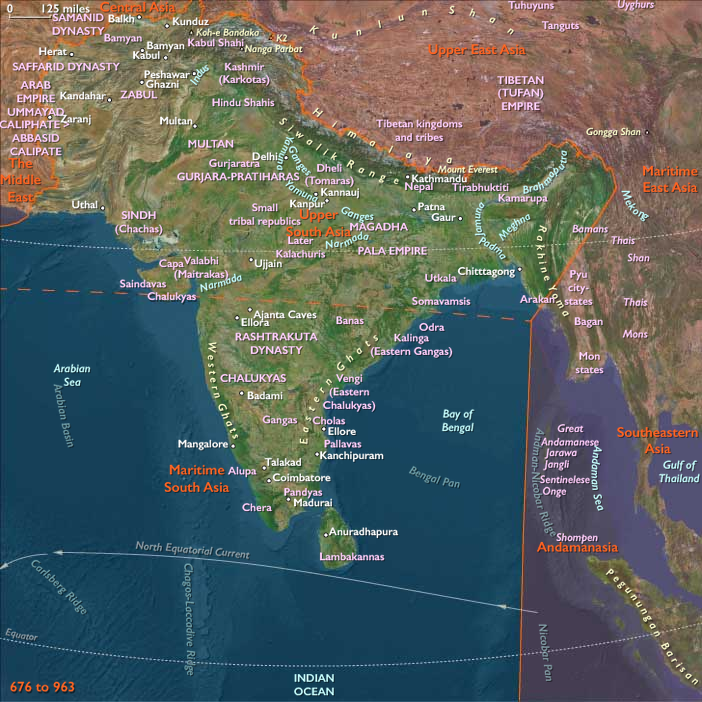
Umayyad interest in the the Indus valley occurred because of attacks from Sindh Raja Dahir on ships of Muslims and their imprisonment of Muslim men and women, according to Berzin.
They had earlier unsuccessfully sought to gain control of the route, via the Khyber Pass, from the Turki-Shahis of Gandhara, but by taking Sindh, Gandhara's southern neighbor, they would be able to open a second front against Gandhara; a feat they had, on occasion, attempted before.
According to Wink, Umayyad interest in the region was galvanized by the operation of the Meds and others.
Meds (a tribe of Scythians living in Sindh) had pirated upon Sassanid shipping in the past, from the mouth of the Tigris to the Sri Lankan coast, in their bawarij and now are able to prey on Arab shipping from their bases at Kutch, Debal and Kathiawar.
At the time, Sindh is the wild frontier region of al-Hind, inhabited mostly by semi-nomadic tribes whose activities disturb much of the Western Indian Ocean.
Muslim sources insist that it was these persistent activities along increasingly important Indian trade routes by Debal pirates and others which forced the Arabs to subjugate the area, in order to control the seaports and maritime routes of which Sindh was the nucleus, as well as, the overland passage.
During Hajjaj's governorship, the Mids of Debal in one of their raids had kidnapped Muslim women traveling from Sri Lanka to Arabia, thus providing a causus belli to the rising power of the Umayyad Caliphate that will enable them to gain a foothold in the Makran, Balochistan and Sindh regions.
Also cited as a reason for this campaign is the policy of providing refuge to Sassanids fleeing the Arab advance and to Arab rebels from the Umayyad consolidation of their rule.
All the above reasons have their own importance for a first attack on Sindh, but the immediate cause for the conquest of Sindh is the plunder of the gifts of Ceylon's ruler to Hajjaj and the attack on Arab ships that ware carrying the orphans and widows of Muslim soldiers who had died in Jihad against Africa.
These Arab had later been imprisoned by the Governor Deebal Partaab Raye.
A letter written by an escaped Arab girl from the Arab asks Hajjaj for help.
When Hajjaj asks Dahir forth release of prisoners and compensation, the latter refuses on the ground that he has no control over these.
Hajjaj sends his nephew Muhammad ibn Qasim to fight his way into the Indus Valley in 711.
Through conquest, the Umayyad Caliphate intends to protect its maritime interest, while also cutting off refuge for fleeing rebel chieftains as well as Sindhi military support to the Sassanid rump state; akin to those received at several prior major battles during the their conquest of Persia—such as those at Salasal and Qādisiyyah and the finally at the Battle of Rasil.
An actual push into the region had been out of favor, in accord with an Arab policy since the time of the Rashidun Caliph Umar bin Khattab, who upon receipt of reports of Sindh being an inhospitable and poor land, had stopped further expeditionary ventures into the region.
Hajjaj superintended this campaign from Kufa by maintaining close contact with Muhammad bin Qasim in the form of regular reports and then regularly issuing orders.
The army that departed from Shiraz in 710 CE under Muhammad bin Qasim is six thousand Syrian cavalry and detachments of mawali from Iraq.
The mawali are new non-Arab converts, usually allied with Hajjaj's political opponents and thus frequently forced to participate in the Jihads on the frontier—such as Kabul, Sindh and Transoxania.
At the borders of Sindh, Muhammad bu Qasim is joined by an advance guard and six thousand camel riders and later reinforcements from the governor of Makran transferred directly to Debal by sea along with five catapults ("manjaniks").
The army that eventually captures Sindh will later be swelled by the Jats and Mids as well as other irregulars that had heard of successes in Sindh.
When Muhammad bin Qasim passes through Makran while raising forces, he has to re-subdue the restive Umayyad towns of Fannazbur and Arman Belah (Lasbela).
Locations
People
Groups
Topics
Commodoties
Subjects
Regions
Subregions

Related Events
Showing 10 events out of 26 total
Years: 711 - 711
Locations
People
Groups
Topics
Commodoties
Subjects
Regions
Subregions