The site of the later castle famous …
Years: 1031 - 1031
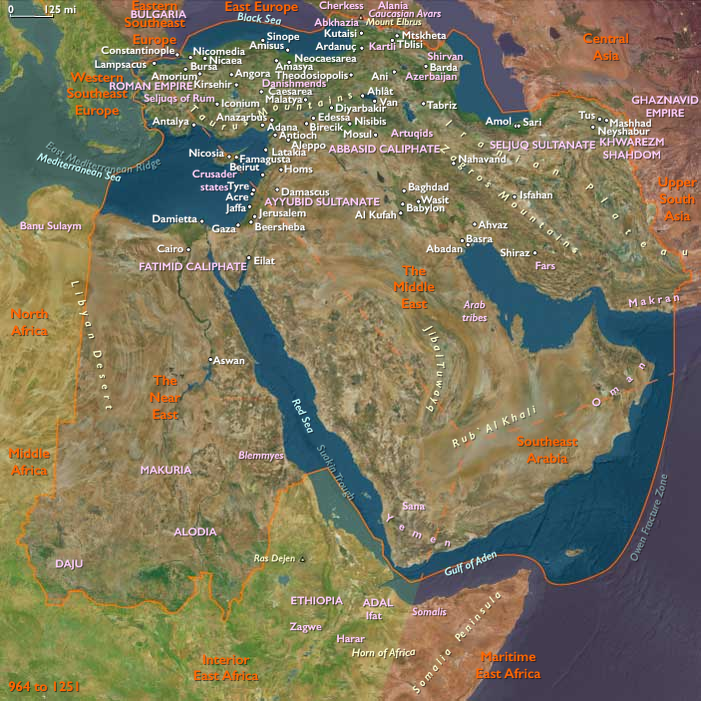
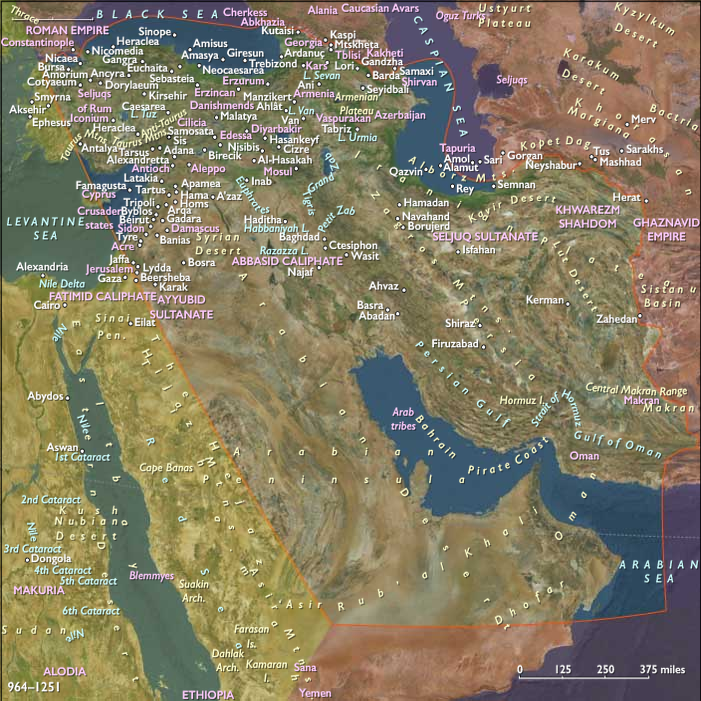
The site of the later castle famous in the Crusader era as the Krak des Chevaliers, located in Syria near the present northern border of Lebanon, is first occupied in 1030 by a group of Kurds, according to Arab sources, and it is from this settlement that the site derives its name, from the Levantine Arabic “Karak,” meaning "fortress".
When building castles, Muslims often choose elevated sites upon hills and mountains that provide natural obstacles.
Locations
Groups
Subjects
Regions
Subregions
Related Events
Filter results
Showing 10 events out of 51536 total
Yaroslav relies on the Scandinavian alliance and attempts to weaken imperial influence on Kiev.
The Norwegian Viking Harald Hardrada and his men have reached the land of the Kievan Rus, where they serve in the armies of Yaroslav, whose wife Ingigerd is a distant relative of Harald.
He and Eilifr, son of that Rognvaldr, who had originally come to Novgorod with Ingigerd, have become joint chiefs of Yaroslav's bodyguard.
Harald serves a military apprenticeship in spring 1031, fighting in the Polish campaign of 1030-1031, which has as its object the recovery of territories previously lost in 1018.
Yaroslav reconquers the area later known as Red Rus', or Red Ruthenia, from the Poles and concludes an alliance with King Casimir I of Poland, sealed by the latter's marriage to Yaroslav's sister Maria.
King Olaf—stubborn, rash and prone to torturing and murdering those who refused to submit to Christianity—will, in an ironic twist, become Norway's patron saint.
His canonization is performed only a year after his death by the bishop of Nidaros.
The cult of Olaf will not only unify the country, it will also fulfill the conversion of the nation, something for which the king had fought so hard.
He will later be canonized and become the patron saint of Norway and Rex perpetuum Norvegiae ('the eternal king of Norway').
Cnut has installed his English concubine Aelgifu as regent, but her increasing unpopularity among the Norwegians threatens his hold on the country.
Bezprym had taken refuge in Kievan Rus and probably used the weakened position of Mieszko II as an excuse to gain the alliance of the Rurikid rulers Yaroslav I the Wise and Mstislav.
In 1031, while Mieszko is defending the western border from the German expedition of Conrad II, Bezprym and the Kievan forces enter into Poland.
Busy defending Lusatia and consequently unable to repel the Kievan attack, Mieszko II is forced to escape to Bohemia.
Yaroslav annexes Red Ruthenia to his domains and Bezprym ascends to the Polish throne.
Having degraded the power structure in Poland, Bezprym loses his authority shortly after taking power, and is forced to surrender the royal crown and regalia to the Emperor.
Thus, he resigns from the royal title and accepts the primacy of his western neighbor.
The crown and regalia are personally delivered by Mieszko's wife, Queen Richeza, who together with her children Casimir, Ryksa and Gertruda, leaves the country in 1031 for the court of Emperor Conrad II, where the deposed Queen is received with all honors and allowed to continuous use of the royal title.
The departure of Richeza, and especially of her son, is extremely beneficial for Bezprym, because this eliminates (at least temporarily) a possible pretender to the throne.
Mieszko II isn't considered too dangerous at this time, since he is imprisoned and castrated in Bohemia by orders of Duke Oldrich.
This is a retaliation for Boleslaw I Chrobry’s blinding of Duke Boleslaus III the Red, Oldřich's brother, thirty years before.
Mieszko and his wife will never reunite again; according to some sources they were either officially divorced or only separated.

Judith of Schweinfurt, whose parents were Henry, Margrave of Nordgau (Bavaria), and his wife Gerberga, is a scion of the House of Babenberg.
The House of Premysl wished to confirm its good relationship with the Babenbergs through a marriage to Judith in 1020.
Judith was a desirable bride, but Oldrich of Bohemia had only one son, Bretislaus, and he was of illegitimate birth, thus complicating the prospect of a marriage with the highborn Judith.
Bretislaus had solved the problem by kidnapping Judith from a monastery, although he is never punished for the crime.
He had married Judith some time later.
Their first son, Spytihněv, was born after almost ten years, which led to the hypothesis that the kidnapping happened in 1029, although Judith may have given birth to daughters before her first son.
Oldrich and his son Bretislaus had sought to win back Moravia from the Poles and in 1029 Bretislaus had driven the Poles out of the eastern lands.
Bretislaus' efforts in today’s Slovakia against Hungary had failed in 1030 due to the jealousy of the Emperor Conrad II.
In the following year, Czech forces refuse to take the field for the emperor.
Lusatia had become part of the territory of the Polish Duke Boleslaw I after the 1018 Peace of Bautzen.
However, Germans and Poles continue struggling for administration of the region.
It is regained in a 1031 campaign by Emperor Conrad II in favor of the Saxon German rulers of the March of Meissen.
The failure of Emperor Romanos III had been partly offset by the victory of George Maniakes, governor of Telouch, against eight hundred Arabs returning from the debacle at Azaz.
The Arabs, emboldened by their victory, had demanded that he evacuate his province.
Maniakes had at first pretended to comply, sending food and drink to the Arabs, but then attacked and overwhelmed them.
Maniakes's success had been followed soon after by a sustained imperial campaign against the Arab border lords, who had risen up against Constantinople’s rule in the aftermath of Azaz.
Romanos himself had departed for Constantinople, leaving behind Niketas of Mistheia and Symeon the protovestiarios as the katepano of Antioch and as Domestic of the Schools respectively.
These two generals had scored a number of successes, taking several fortresses, including Azaz after a short siege in December 1030.
Over the next two years, they will systematically take the hill forts of the local tribes and reduce them to submission, restoring the imperial position in Syria.
In the meantime, Nasr of Aleppo, seeking to conciliate his powerful neighbor, sends his own son 'Amr to Constantinople in April 1031 to ask for a treaty whereby he returns to tributary and vassal status towards the Empire.
The imperial resurgence in the East culminates in the capture of Edessa in 1031 by Maniakes.
The civil war between Berbers and Arabs has engendered the reduction of the Umayyad territory to the Spanish heartland, with Berber emirates controlling the southwest and Arab emirates controlling the southeast.
For the past two decades, the Córdoba-based caliphate of al-Andalus, founded in 736 by Abd al-Rahman, has been a prize fiercely contested by the Umayyad and Hammudid dynasties.
Hisham III, the brother of Abd ar-Rahman IV, had been chosen as Caliph in 1026 after long negotiations between the governors of the border regions and the people of Córdoba.
He could not enter Cordoba until 1029 as the city was occupied by the Berber armies of the Hammudids.
Although he had tried to consolidate the Caliphate, the raising of taxes (to pay for mosques among other things) had led to heavy opposition from the Muslim clerics.
After the murder of his Visir al-Hakam by a conspiracy of Córdoban patricians, Hisham is imprisoned.
He manages to escape, but will die in exile in 1036 in Lerida.
The Umayyad dynasty will end with his death.
After the Caliphate falls with the overthrow of Hisham III in 1031, the Caliphate's land holdings—already much diminished from its height in power just 100 years past—devolve into a number of militarily weak but culturally advanced taifas.
Granada, located on the Genil River, a tributary of the Guadalquivir, in a small but intensively cultivated plain, first rises to prominence in 1031 when a local Muslim dynasty, the Banu Ziri, or Zirids, make the city the seat of the kingdom they form after the Umayyad collapse.
The Death of Robert II and Constance of Arles' Conflict with Her Sons (1031)
Following the death of King Robert II on July 20, 1031, Queen Constance of Arles quickly found herself at odds with both of her surviving sons, Henry I and Robert of Burgundy. Rather than accepting Henry’s rightful succession, she seized her dower lands and refused to surrender them, escalating tensions into open conflict.
Constance’s Defiance and Henry’s Flight to Normandy
- Despite Henry I’s coronation at Reims in 1027, Constance continued to oppose his rule, preferring her younger son, Robert of Burgundy, as king.
- Upon Robert II’s death, Constance refused to recognize Henry’s authority, taking control of her dower landsand seeking to rally nobles to her side.
- Facing immediate hostility, Henry was forced to flee the royal domain, seeking refuge in Normandy, where he received support from his younger brother, Robert of Normandy.
- Robert of Normandy provided weapons, soldiers, and strategic aid, helping Henry regroup and launch a counteroffensive against their mother.
Henry’s Siege of Poissy and Constance’s Escape
- With Norman reinforcements, Henry returned to France with an army, determined to assert his authority.
- He besieged Constance at Poissy, a key stronghold where she had entrenched herself with her supporters.
- However, before Henry could capture her, Constance escaped to Pontoise, prolonging the conflict.