
Abul Ala, later to be known as …
Years: 1058 - 1058
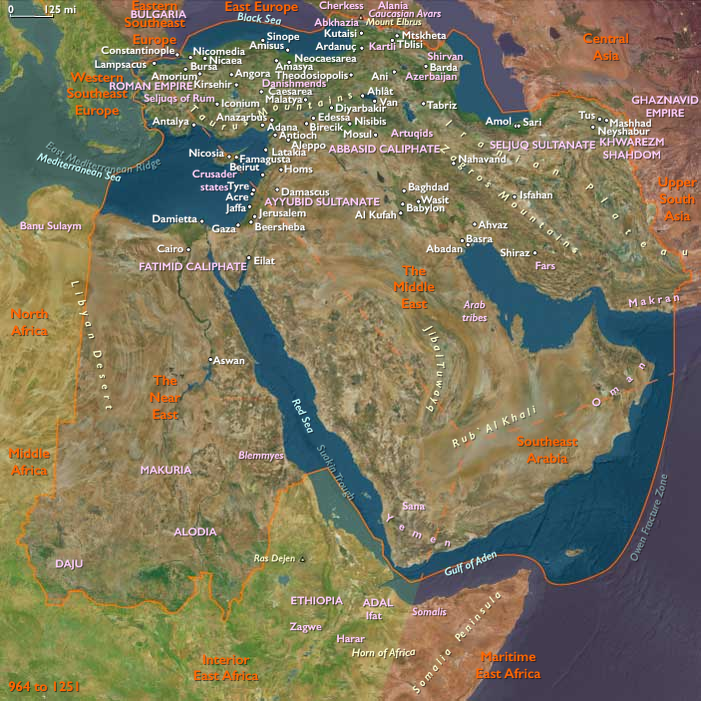
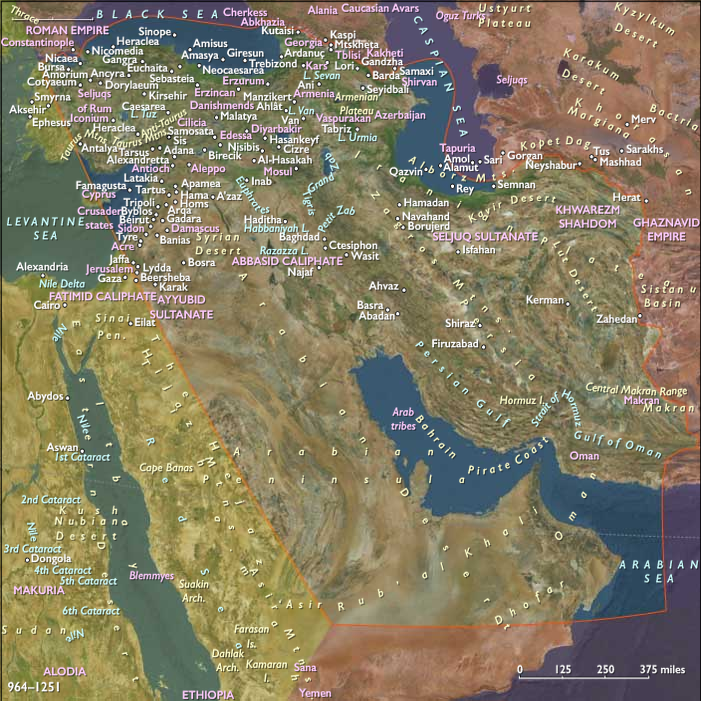
Abul Ala, later to be known as al-Maʿarri, was born in Maʿarra (now Ma'arat al-Nu'man), Syria (region).
He is a member of the Banu Sulayman, a notable family of Maʿarra, belonging to the larger Tanukh tribe.
His paternal great-great-grandfather had been the city's first qadi.
Some members of the Bany Sulayman had also been noted as good poets.
He had lost his eyesight at the age of four due to smallpox.
He had started his career as a poet at an early age, at about eleven or twelve years old.
He had been educated at first in Maʿarra and Aleppo, later also in Antioch and other Syrian cities.
Among his teachers in Aleppo were companions from the circle of Ibn Khalawayh.
This grammarian and Islamic scholar had died in 980/981, when Al-Maʿarri was still a child.
Al-Maʿarri nevertheless laments the loss of Ibn Khālawayh in strong terms in a poem of his Risālat al-ghufrān.
Al-Qifti reports that when on his way to Tripoli, Al-Maʿarri visited a Christian monastery near Latakia where he listened to debates about Hellenic philosophy, which planted in him the seeds of his later skepticism and irreligiosity; but other historians such as Ibn al-Adim deny that he had been exposed to any theology other than Islamic doctrine.
He had also spent eighteen months at Baghdad, where he was well received in the literary salons of the time.
He had returned to his native town of Maʿarra in about 1010 blaming his return on a lack of money and hearing that his mother was ill (she died before he arrived).
He remains in Ma'arra for the rest of his life, where has opted for an ascetic lifestyle, refusing to sell his poems, living in seclusion and observing a strict vegan diet.
He nevertheless enjoys great respect and attracts many students locally, as well as actively holding correspondence with scholars abroad.
Al-Maʿarri is a skeptic in his beliefs and denounces superstition and dogmatism in religion.
Thus, he has been described as a pessimistic freethinker.
One of the recurring themes of his philosophy is the rights of reason against the claims of custom, tradition, and authority.
Al-Maʿarri teaches that religion is a "fable invented by the ancients", worthless except for those who exploit the credulous masses.
He criticizes many of the dogmas of Islam, such as the Hajj, which he calls "a heathen's journey."
He rejects claims of any divine revelation.
His creed is that of a philosopher and ascetic, for whom reason provides a moral guide, and virtue is its own reward.
Al-Maarri's fundamental pessimism is expressed in his anti-natalist recommendation that no children should be begotten, so as to spare them the pains of life.
In an elegy composed by him over the loss of a relative, he combines his grief with observations on the ephemerality of this life.
His religious skepticism and positively anti-religious views are expressed in a poem which states, "The inhabitants of the earth are of two sorts: those with brains, but no religion, and those with religion, but no brains."
He is equally sarcastic towards the religion of Islam as he is towards Judaism and Christianity.
Al-Ma'arri remarks that monks in their cloisters or devotees in their mosques are blindly following the beliefs of their locality: if they were born among Magians or Sabians they would have become Magians or Sabians.
He dies at an advanced age in 1058.
Locations
People
Groups
Commodoties
Subjects
Regions
Subregions
Related Events
Showing 10 events out of 51072 total
Years: 1058 - 1058
Locations
People
Groups
Commodoties
Subjects
Regions
Subregions