
Abu Ishaq Ibrahim is the son of …
Years: 876 - 876
Abu Ishaq Ibrahim is the son of the Aghlabid emir Ahmad of Ifriqiya.
After his father's death in 863, the emirate of Ifriqiya had passed to his father's brother Ziyadat Allah II, but he died shortly after, and the succession had passed back to the main line, to Ibrahim's brother Abu 'l-Gharaniq Muhammad II, who proves to be a frivolous and pleasure-loving ruler.
During his brother's emirate, Ibrahim had been assigned the governorship of Kairouan, an office he had executed with exemplary efficiency and seriousness, which had earned him much admiration.
Hopes were high when the dissolute Muhammad II died prematurely in February 875 and the emirate had passed to Ibrahim II, his candidacy pushed forward by popular crowds and endorsed by the jurists of Kairouan, who had set aside the claims of his young nephew, the son of Muhammad II.
Although Ibrahim II had inherited a kingdom depopulated by the plague of 874, his reign is economically prosperous.
He revives the religious police and is said to have rid the roads of banditry and secured the safety of commerce.
He seeks to develop agriculture by building up the irrigation system.
Among his public works, Ibrahim completes the Zaytuna mosque of Tunis, enlarges the Uqba mosque of Kairouan, builds a vast new water reservoir for the city, erects the walls of Sousse, and establishes a line of new naval signal towers along the Ifriqiyan coast (it reportedly takes one night to dispatch a message from Ceuta in Morocco to Alexandria in Egypt).
Locations
People
Groups
Topics
Commodoties
Subjects
- Commerce
- Language
- Architecture
- Watercraft
- Engineering
- Labor and Service
- Conflict
- Faith
- Government
- Technology
- Economics
Regions
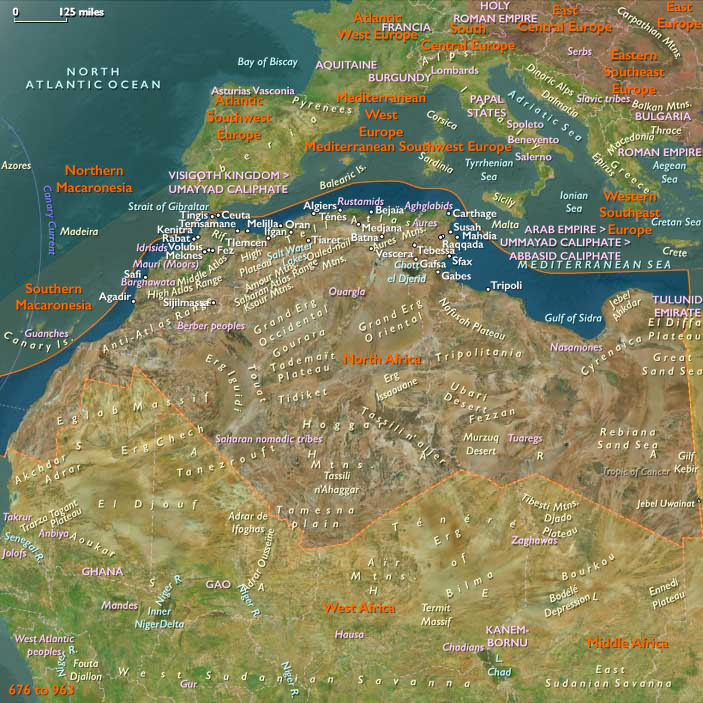
Subregions
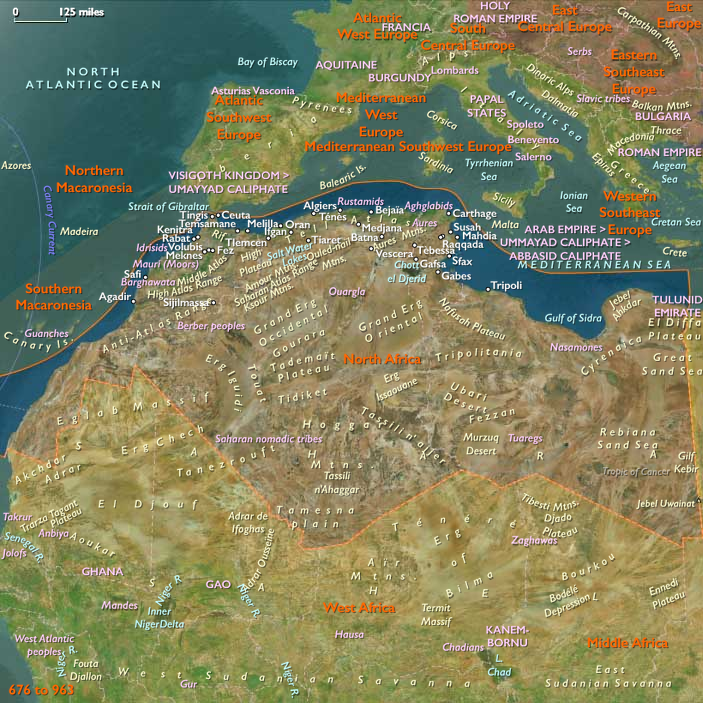
Related Events
Showing 10 events out of 53888 total
Years: 876 - 876
Locations
People
Groups
Topics
Commodoties
Subjects
- Commerce
- Language
- Architecture
- Watercraft
- Engineering
- Labor and Service
- Conflict
- Faith
- Government
- Technology
- Economics
Regions
Subregions