
Abu Harb, the third son of Muhammad, …
Years: 1045 - 1045
Abu Harb, the third son of Muhammad, had rebelled against his older brother and called upon help from the Buyids of Fars.
Faramurz had defeated him, however.
Relations with Faramurz and Tughril are highly important.
It seems that Faramurz was present with the Seljuqs at the battle of Dandanaqan against the Ghaznavids.
When Faramurz ascended to the Kakuyid throne, Tughril had secured his allegiance by sending a tribute of payment to Faramurz.
However, neither Faramurz nor his brother Garshasp I are willing to turn to the side of Seljuqs.
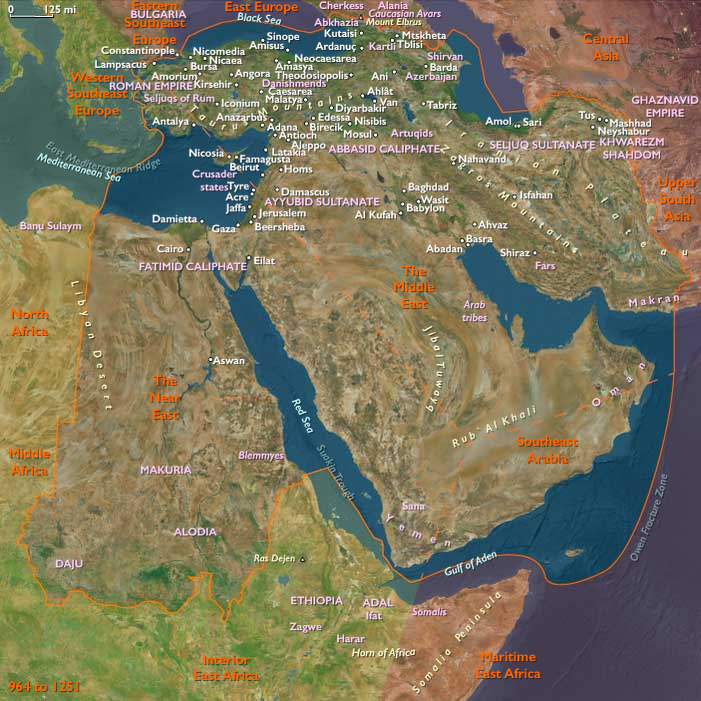
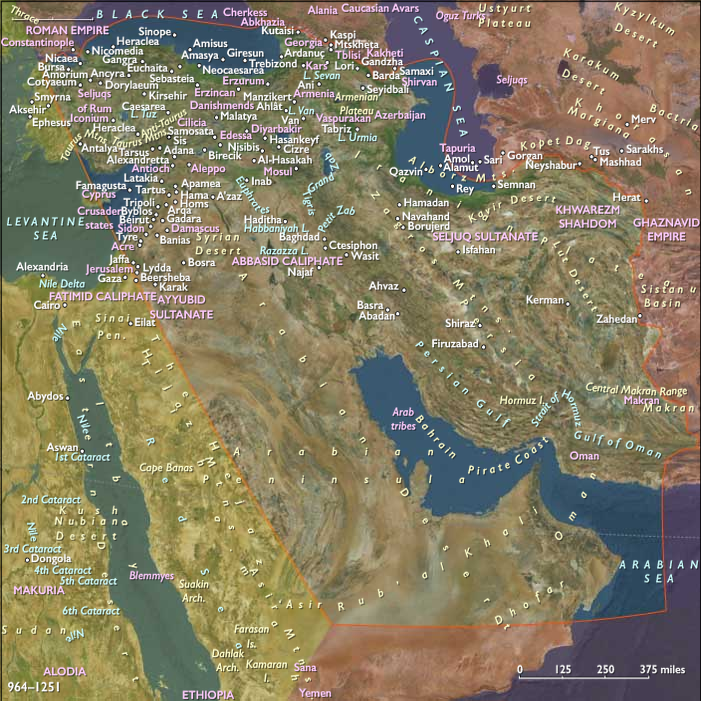
In 1045, the Dailamites and Kurds of Jibal make a stand together to resist the advance of the Turkmens from Khorasan.
Locations
People
Groups
- Kurdish people
- Khorasan, Greater
- Daylamites
- Abbasid Caliphate (Baghdad)
- Buyid dynasty
- Ghaznavids
- Turkmen people
- Annazids
- Kakūyids
- Seljuq Empire (Neyshabur)
Commodoties
Subjects
Regions
Subregions
Related Events
Filter results
Showing 10 events out of 27 total
The Formation of the Armagnac League and the Renewed Civil War (1410)
By 1410, Charles, Duke of Orléans, still seeking to avenge the assassination of his father, Louis of Orléans (murdered in 1407 on the orders of John the Fearless, Duke of Burgundy), had begun actively opposing Burgundian power. Although the Peace of Chartres (1409) had briefly halted hostilities, tensions quickly reignited following Charles’ marriage to Bonne d’Armagnac on April 15, 1410, at Gien.
The marriage solidified a powerful anti-Burgundian alliance, formally uniting Charles with his father-in-law, Bernard VII, Count of Armagnac, who became the leader of the anti-Burgundian faction, now known as the Armagnac party.
I. The Formation of the Armagnac League (April 1410)
- At the wedding of Charles of Orléans and Bonne d’Armagnac, prominent noblemen gathered to form a league against John the Fearless and his Burgundian allies.
- This coalition provided the Orléanist faction with a new leader, as Bernard VII of Armagnac assumed the role of protector of Charles of Orléans and his mother, Valentina Visconti.
- With a new figurehead and a unified cause, the faction rebranded itself as the "Armagnac party."
II. Key Members of the Armagnac Alliance
- Charles, Duke of Orléans – The son of the murdered Louis, seeking revenge against Burgundy.
- Bernard VII, Count of Armagnac – The father-in-law of Charles, assuming leadership of the faction.
- John, Duke of Berry – The uncle of both Charles VI and Charles of Orléans, serving as a mediator turned ally of the Armagnacs.
- Louis II, Duke of Bourbon – A longtime opponent of Burgundian influence.
- John V, Duke of Brittany – Bringing Brittany’s considerable military strength to the faction.
- John I, Count of Alençon – Another key supporter opposing Burgundian control.
- Charles, Count of Clermont (later Charles I, Duke of Bourbon) – Son of the Duke of Bourbon, committed to resisting John the Fearless.
III. Renewed Civil War: The Armagnacs vs. the Burgundians
- With the formation of the Armagnac League, open war resumed between:
- The Armagnacs, supporting Charles VI’s son, the Dauphin, and the Orléanist cause.
- The Burgundians, led by John the Fearless, who controlled Paris and much of northern France.
- The conflict paralyzed France, leading to:
- Further foreign intervention, particularly from England, which exploited French divisions during the Hundred Years' War.
- A bloody civil war that would last until 1435, exacerbating the weakness of the French monarchy.
IV. Impact and Legacy
- The creation of the Armagnac party in 1410 ensured that the civil war would not be resolved peacefully.
- The feud between the Houses of Orléans and Burgundy would define French politics for the next 25 years, weakening the kingdom during a crucial period in the Hundred Years' War.
- The internal strife allowed England to advance, culminating in Henry V’s victory at Agincourt (1415) and the Treaty of Troyes (1420), which disinherited the Dauphin in favor of the English king.
The Armagnac-Burgundian conflict, which began in earnest with the marriage alliance of 1410, tore France apart, paving the way for English dominance and further political instability in the early 15th century.
Rodrigo de Villandrando: Mercenary Power and Influence in France (1410–1433)
Originally from Biscay, Rodrigo de Villandrando—son of Pedro de Villandrando and Agnes de Corral—became a significant figure in the mercenary conflicts that defined Atlantic West Europe during the turbulent late stages of the Hundred Years' War. Initially admitted into the mercenary company led by Amaury de Séverac around 1410, Rodrigo swiftly rose through the ranks to become captain of the routiers, bands of professional mercenaries employed by seneschals, powerful nobles, and even ecclesiastical authorities throughout northern and western France.
Following the death of his protector, Amaury, in 1427, Rodrigo entered the service of King Charles VII of France, solidifying his position by appointing Juan Salazar as his lieutenant the next year. His early exploits were notorious for violence and brutality, marked by the pillaging of towns such as Treignac, Meymac, and Tulle.
In June 1430, Rodrigo’s forces took part in the Battle of Anthon, fighting with rudimentary yet effective weaponry, including billhooks, sledgehammers, and spades. In the aftermath, he continued aligning himself with Charles VII, notably against Louis II of Chalon-Arlay, Prince of Orange, a prominent vassal of Philip the Good of Burgundy.
Rodrigo's prominence grew rapidly: in 1431, he was rewarded by King John II of Aragon with the county of Ribadeo and bestowed the honorific privilege of dining annually at the king’s table. Despite royal favor, Rodrigo's ruthlessness persisted—demonstrated vividly when he brutally suppressed a peasant rebellion in Saint-Romain-le-Puy, massacring refugees to restore order on behalf of the French crown.
In September 1432, Rodrigo's mercenaries, funded by the influential minister Georges de La Trémoille, successfully defended Les Ponts-de-Cé against the forces of Jean V de Bueil. At the peak of his influence around 1433, Rodrigo commanded roughly ten thousand mercenaries—mostly English fighters known as Rodrigoys—who terrorized the Médoc countryside. His men habitually extorted protection money, ransomed local nobles, and systematically plundered towns and bastides, significantly destabilizing the region.
Demonstrating both military prowess and strategic cunning, Rodrigo seized the castle of Lagarde Viaur in 1433, extracting an exorbitant ransom for its return. That same year, further consolidating his status, he married Margaret, half-sister of Charles I, Duke of Bourbon, and illegitimate daughter of the imprisoned Duke John I. Leveraging familial connections, he acquired castles at Ussel and ...
...Châteldon from his brother-in-law for six thousand écus, reinforcing his power and territorial influence.
Rodrigo de Villandrando exemplifies the volatile intersection of mercenary warfare, political ambition, and economic exploitation in early 15th-century Atlantic West Europe. His career highlights the broader regional struggle between royal authority, noble ambitions, and the pervasive violence of mercenary bands, shaping the political and social landscape during this critical phase of the late Hundred Years' War.
Armagnac leader Jean I, 4th Duke of Bourbon, captured in 1415 at the Battle of Agincourt and brought to England, has never received his freedom from the crown, despite payment of several ransoms, and promises to support the king of England as king of France.
In 1400 in Paris, he had married his niece Marie, Duchess of Auvergne, daughter of John, Duke of Berry, who inherited the Auvergne title from her father.
Their three sons are Charles de Bourbon, born 1401, who will inherit his father’s title; Louis, born 1403, Count of Forez, and Louis de Bourbon, born 1405, Count of Montpensier.
John's illegitimate daughter Margaret had in 1433 married the Spanish routier Rodrigo de Villandrando.
John dies in 1434 a prisoner in London.
The Praguerie Revolt and the Assertion of Royal Authority (1439–1440)
By the late 1430s, after decades of prolonged Anglo-French warfare, the authority of the French crown had significantly diminished, compromised by powerful regional nobility and widespread lawlessness. The Peace of Arras (1435), rather than stabilizing France, had left many regions vulnerable to disbanded mercenaries and brigands, creating conditions of near-anarchy.
Seeking to restore order and reinforce royal control, King Charles VII took decisive action by prohibiting the raising or maintenance of private armies without royal authorization, effectively outlawing private warfare. These measures culminated in the ordinances passed by the Estates of langue d'oïl at Orléans in 1439, establishing royal monopoly over military recruitment, standardizing the organization, pay, and oversight of troops, and granting the king an aid of one hundred thousand francs. Charles later interpreted this aid as a perpetual grant, significantly reducing his dependence on parliamentary approval for taxation—thus distinguishing French royal authority from the parliamentary fiscal control prevalent in England. Additionally, the ordinances mandated royal appointments to military leadership, directly challenging traditional noble privileges.
The creation of France’s first permanent standing army and the expansion of royal prerogative prompted immediate resistance from the nobility, culminating in the Praguerie revolt of 1440. The primary instigator was Charles I, Duke of Bourbon, who had previously led a failed rebellion in 1437. Allied with his illegitimate brother Alexander, the former royal favorite Georges de la Trémoille, John VI, Duke of Brittany (who sought English support), Jean II, Duke of Alençon, the Count of Vendôme, and influential mercenary leaders such as Antoine de Chabannes and Jean de la Roche, Bourbon directly challenged royal authority. Their resistance stemmed partly from economic self-interest—mercenary captains, in particular, saw their livelihoods endangered by the king’s reforms.
Most dangerously for Charles VII, the rebellious nobles succeeded in enlisting his sixteen-year-old son, the Dauphin Louis, in their cause, proposing to remove Charles from power and install the Dauphin on the throne, with Bourbon acting as regent.
The Praguerie thus represented a crucial test of Charles VII’s strengthened royal authority and set the stage for a significant confrontation between centralized monarchy and entrenched noble interests, a conflict that would shape the governance and power structure of France well beyond the mid-15th century.
The Praguerie Revolt and its Suppression (1440)
In 1440, tensions arising from the centralizing policies and growing royal authority of King Charles VII erupted into open rebellion in an event known as the Praguerie. Named after a recent revolt in Prague, Bohemia—then closely linked to France through the House of Luxembourg—the Praguerie represented a coordinated aristocratic challenge to royal authority. The uprising was actively supported by Philip the Good, Duke of Burgundy, who, despite his reconciliation with Charles VII in the 1435 Treaty of Arras, reversed course in 1439 due to Charles's centralizing reforms, aligning himself once more against the French king.
Central to the rebellion was the ambitious Charles I, Duke of Bourbon, who sought to undermine royal control along with prominent nobles including Jean, Duke of Alençon, and mercenary captains such as Antoine de Chabannes. The rebels secured the symbolic leadership of the sixteen-year-old Dauphin Louis, proposing to replace his father as king and establish a regency controlled by the nobles.
Responding swiftly, Arthur de Richemont, Constable of France, led royal troops into Poitou, historically a contested region associated with previous conflicts against royal minister Georges de la Trémoille. Within two months, Richemont decisively subdued much of the region, deploying the new royal artillery effectively to breach noble strongholds and quickly restoring order.
Efforts by the Dauphin and Alençon to incite broader uprisings in Auvergne failed, isolating the revolt. Although royal forces could not entirely prevent mercenary bands from pillaging parts of Poitou and ...
Saintonge, the Praguerie rapidly collapsed. Its failure marked a decisive reaffirmation of Charles VII's authority, revealing both the effectiveness of his recent reforms—particularly the establishment of a standing army—and the declining political influence of the nobility. The swift suppression of this rebellion underscored the growing power of the central monarchy, reshaping political dynamics and consolidating royal power in northern and western France during the mid-15th century.
The Peace of Cusset and the End of the Praguerie (September 1440)
In September 1440, the aristocratic rebellion known as the Praguerie concluded with the Peace of Cusset, a settlement demonstrating King Charles VII's diplomatic prudence and political acumen. Despite their earlier defiance, the leading rebels—including prominent figures such as Jean II, Duke of Alençon (a veteran of Joan of Arc's victory at Orleans), and Jean, comte de Dunois—received notably lenient treatment. Under the treaty’s generous terms, most rebel leaders, notably the Dauphin Louis himself, were quickly reintegrated into royal favor.
Charles VII’s approach emphasized reconciliation over retribution. He secured the loyalty of Charles I, Duke of Bourbon, a key instigator of the rebellion, through the strategic grant of a substantial pension, signaling forgiveness and renewed trust. Furthermore, Charles extended amnesty broadly to rebellious nobles and placed the Dauphin in Dauphiné, effectively removing him from the immediate orbit of rebellious influence and potential intrigue.
With the enforcement of the Ordinance of Orléans, Charles VII consolidated his authority by maintaining centralized royal control over military organization and restricting the power of the nobility to raise private forces. Crucially, France avoided a devastating civil war through the decisive actions of royal commanders, notably Constable Arthur de Richemont, and the unwavering support from loyal urban centers—France’s "good cities."
The outcome of the Praguerie thus not only strengthened the monarchy's political position but also underscored the effectiveness of Charles’s policies and administration, marking a significant step towards greater royal centralization and stability in mid-15th century France.
Jean Bureau and the French Military Revival (1449)
In 1449, hostilities between England and France reignited due to English violations of the peace agreement established by the Treaty of Tours, offering France a strategic opportunity to renew its offensive against remaining English-held territories. Central to France’s military resurgence during this critical phase was Jean Bureau, a talented artillery commander appointed by King Charles VII as Master of Artillery.
Jean Bureau, assisted closely by his brother Gaspard Bureau, revolutionized French siege warfare through highly effective use of advanced gunpowder artillery. Their mastery dramatically accelerated the recapture of key English-held fortresses in northern France. Notable among these successes were the sieges of Pontoise (1441), Harfleur (1449–1450), and the strategic capture of Bayeux. Bureau’s command proved crucial to French victories, demonstrating both tactical innovation and effective integration of artillery into broader military strategy.
Previously, the English had violated terms of the peace agreement established by the Treaty of Tours (1444), providing Charles VII the justification and momentum to resume military operations. The Bureaus' technological and strategic advancements in artillery contributed decisively to the rapid erosion of English control in Normandy and other occupied territories, fundamentally reshaping the military landscape in favor of France.
Jean and Gaspard Bureau's accomplishments not only marked a turning point in the Hundred Years' War but also signaled the rising importance of technological innovation and central royal control in military affairs, contributing significantly to the consolidation of French royal authority in Atlantic West Europe.
The Reconquest of Normandy and the Capture of Rouen (1449)
In August 1449, French military momentum accelerated sharply, resulting in the rapid reconquest of key strategic locations in Normandy, long held by the English. Towns such as Pont-Audemer, ...
Years: 1045 - 1045
Locations
People
Groups
- Kurdish people
- Khorasan, Greater
- Daylamites
- Abbasid Caliphate (Baghdad)
- Buyid dynasty
- Ghaznavids
- Turkmen people
- Annazids
- Kakūyids
- Seljuq Empire (Neyshabur)
