
Abu Bakr moves in the fourth week …
Years: 632 - 632
September
Abu Bakr moves in the fourth week of August 632 to Zhu Qissa with all available fighting forces.
Here he plans the strategy of the Campaign of the Apostasy to deal with the various enemies who occupy the entire land of Arabia except for the small area in the possession of the Muslims.
The battles which he had fought recently against the apostate concentrations at Zhu Qissa and Abraq had been in the nature of immediate preventive action to protect Medina and discourage further offensives by the enemy.
These actions have enabled Abu Bakr to secure a base from which he can fight the major campaign that lies ahead, thus gaining time for the preparation and launching of his main forces.
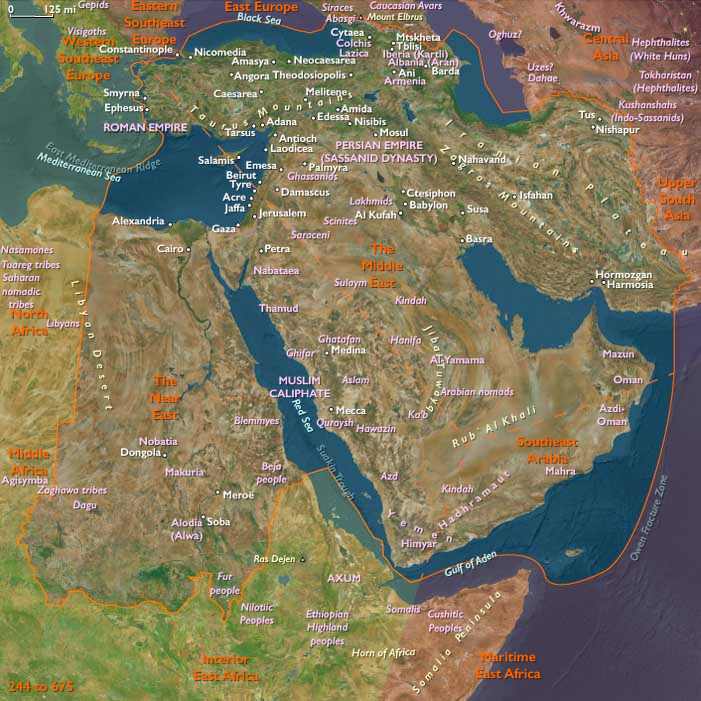
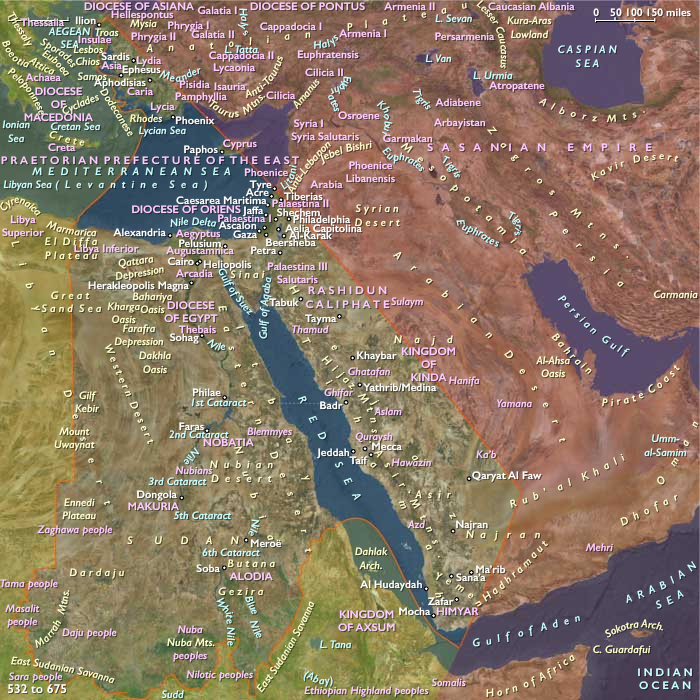
Abu Bakr has to fight not one but several enemies: Tulayha at Buzakha, Malik bin Nuwaira at Butah, Musaylima at Yamamah.
He has to deal with widespread apostasy on the eastern and southern coasts of Arabia: in Bahrain, in Oman, in Mahra, in Hadhramaut and in Yemen.
There is apostasy in the region south and east of Mecca and by the Khuza’ah in northern Arabia.
Abu Bakr forms the army into several corps.
The strongest corps, the main striking arm of the Muslims, is that of Khalid ibn Walid, used to fight the most powerful of the rebel forces.
Other corps are given areas of secondary importance in which to subdue the less dangerous apostate tribes.
The first corps to go into action is that of Khalid.
The timing of the dispatch of other corps hinges on the operations of Khalid, who is tasked with fighting the strongest enemy forces one after the other.
As soon as the organization of the corps is complete, Khalid marches off, to be followed a little later by Ikrimah and 'Amr ibn al-'As.
The other corps are held back by the caliph to be dispatched weeks and even months later.
Before the various corps leave Zhu Qissa, however, envoys will be sent by Abu Bakr to all apostate tribes in a final attempt to induce them to submit.
Apart from their specific objectives, the corps commanders are given the following instructions: Seek the tribes that are your objectives Call the Azaan.
If the tribe answers with the Azaan, do not attack.
After the Azaan, ask the tribe to confirm its submission, including the payment of zakat.
If confirmed, do not attack.
Those who submit will not be attacked.
Those who do not answer with the Azaan, or after the Azaan do not confirm full submission, will be dealt with by the sword.
All apostates who have killed Muslims will be killed.
With these instructions, Abu Bakr launches the forces of Islam against the apostates.
His plan is first to clear the area of west central Arabia (the area nearest to Medina), then tackle Malik bin Nuwaira, and finally concentrate against the most dangerous and powerful enemy: the self-proclaimed prophet Musaylima, who is mainly supported by the powerful tribe of Banu Hanifa, in the fertile region of Yamamah.
Locations
People
- Abu Bakr
- Abu Sufyan ibn Harib
- Aishah
- Ali
- Malik ibn Nuwaira
- Muhammad
- Talhah
- Tulayha
- Umar
- Usama bin Zayd
- Uthman ibn Affan
- Zubayr ibn al-Awam
Groups
- Arab people
- Tayy (Arabic tribe)
- Banū Hāshim (Arabic tribe)
- Banu Tamim (Arabic tribe)
- Banu Hanifa (Arabic tribe)
- Banu Assad (Arabic tribe)
- Banū Khuza'ah (Arabic tribe)
- Banū Kalb (Arabic tribe)
- Banū Ghatafan (Arabic tribe)
- Ha'wa zin (Arabic tribe)
- Ghassan, Kingdom of
- Roman Empire, Eastern: Heraclian dynasty
- Islam
- Rashidun Caliphate
Topics
Commodoties
Subjects
Regions
Subregions
Related Events
Showing 10 events out of 56729 total
Years: 632 - 632
September
Locations
People
- Abu Bakr
- Abu Sufyan ibn Harib
- Aishah
- Ali
- Malik ibn Nuwaira
- Muhammad
- Talhah
- Tulayha
- Umar
- Usama bin Zayd
- Uthman ibn Affan
- Zubayr ibn al-Awam
Groups
- Arab people
- Tayy (Arabic tribe)
- Banū Hāshim (Arabic tribe)
- Banu Tamim (Arabic tribe)
- Banu Hanifa (Arabic tribe)
- Banu Assad (Arabic tribe)
- Banū Khuza'ah (Arabic tribe)
- Banū Kalb (Arabic tribe)
- Banū Ghatafan (Arabic tribe)
- Ha'wa zin (Arabic tribe)
- Ghassan, Kingdom of
- Roman Empire, Eastern: Heraclian dynasty
- Islam
- Rashidun Caliphate
Topics
Commodoties
Subjects
Regions
Subregions