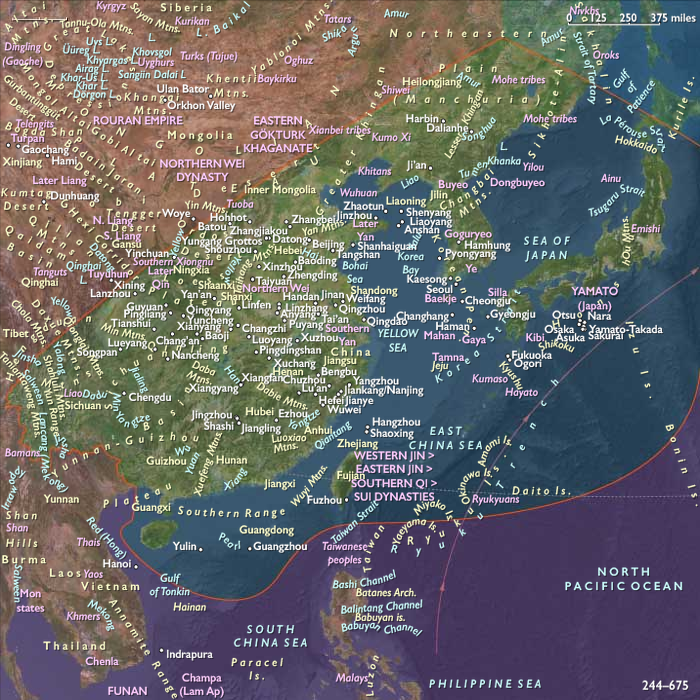
The Taika Reform—influenced by Chinese practices—starts with …
Years: 640 - 651
The Taika Reform—influenced by Chinese practices—starts with land redistribution, aimed at ending the existing landholding system of the great clans and their control over domains and occupational groups.
What were once called "private lands and private people" become "public lands and public people," as the court now seeks to assert its control over all of Japan and to make the people direct subjects of the throne.
Land is no longer hereditary but reverts to the state at the death of the owner.
Taxes are levied on harvests and on silk, cotton, cloth, thread, and other products.
A corvée (labor) tax is established for military conscription and building public works.
The hereditary titles of clan chieftains are abolished, and three ministries are established to advise the throne (the minister of the left, minister of the right, and minister of the center, or chancellor).
The country is divided into provinces headed by governors appointed by the court, and the provinces are further divided into districts and villages.
Locations
People
Groups
Topics
Subjects
Regions
Subregions
Related Events
Filter results
Showing 10 events out of 56578 total
Srivijaya, centered in today’s Palembang, South Sumatra, launches a military expedition against Java, according to the seventh century Kota Kapur inscription; the period coincides with the decline of Tarumanagara.
It is very likely that the Taruma Kingdom is attacked and defeated by Srivijaya around 650 CE.
Tarumanegara's influence over its neighbors begins to decline after this.
Court intrigues over the succession and the threat of a Chinese invasion lead to a palace coup against the Soga oppression in 645, about twenty years after the deaths of Shotoku (in 622), Soga Umako (in 626), and Empress Suiko (in 628).
The revolt is led by Prince Naka and Nakatomi Kamatari, who seizes control of the court from the Soga family and introduces the Taika Reform (Taika means great change) to centralize the state.
The Goguryeo–Tang War, which begins in 645, is initially fought between the Goguryeo kingdom and Tang empire.
The two powers during the course of the twenty-three year war will ally with various other states.
Emperor Taizong of Tang, after subjugating the Eastern Turkic Khaganate, begins to exert his military power toward the Western Regions, at this time dominated by the Western Turkic Khaganate as well as a number of city-states loosely allied with the Western Turks.
East Central Europe (640–651 CE): Samo’s Consolidation, Kubrat’s Bulgar Stability, and Radulf’s Thuringian Revolt
Between 640 and 651 CE, East Central Europe—encompassing Poland, Czechia, Slovakia, Hungary, and those portions of Germany and Austria lying east of 10°E and north of a line stretching from roughly 48.2°N at 10°E southeastward to the Austro-Slovenian border near 46.7°N, 15.4°E—experienced a critical phase marked by internal consolidation and regional realignment. The Slavic federation under King Samo (r. ca. 623–658 CE) maintained stability and cohesion, effectively managing external pressures. Concurrently, Khan Kubrat’s Old Great Bulgaria, a Turkic-speaking Bulgar state, remained stable north and east of the Carpathians, substantially reducing Avar influence. Notably, around 640 CE, Radulf (Rudolf), Duke of Thuringia, rebelled against Frankish authority, decisively defeating Frankish royal forces sent by the Merovingian king Sigebert III. Radulf’s successful revolt established Thuringia as a nearly autonomous political entity, clearly demonstrating the weakened authority of the Merovingian monarchy and highlighting the emerging power of local aristocracies—the hallmark of the era of the rois fainéants (“do-nothing kings”).
Political and Military Developments
Stability and Consolidation under Samo’s Leadership
-
Samo’s Slavic federation maintained internal unity, successfully resisting pressures from neighboring Franks and Avars. Samo’s sustained governance provided enduring political stability and effective regional defense, allowing for stronger cultural and political integration across Bohemia, Moravia, and neighboring Slavic territories.
Stability of Old Great Bulgaria under Kubrat
-
Khan Kubrat maintained a stable Turkic-speaking Bulgar state, significantly reducing Avar influence north and east of the Carpathians. Old Great Bulgaria remained diplomatically influential, particularly through continued contacts with Byzantium.
Radulf’s Revolt and the Autonomy of Thuringia (ca. 640 CE)
-
Around 640 CE, Duke Radulf of Thuringia, appointed by the Merovingian king Dagobert I, openly rebelled against Frankish royal authority. Radulf decisively defeated armies sent by Dagobert’s successor, King Sigebert III, establishing de facto independence and effectively ruling Thuringia autonomously.
-
Radulf’s rebellion significantly demonstrated the declining authority of the Merovingian kings, who became increasingly symbolic rulers reliant on powerful dukes and local aristocratic elites. His successful defiance served as a prominent example of the emerging rois fainéants period, characterized by weak Merovingian monarchs and influential local leaders.
Internal Reorganization of the Avar Khaganate
-
Having suffered territorial losses to Samo’s Slavs and Kubrat’s Bulgars, the Avar Khaganate entered a phase of internal stabilization, focusing on maintaining cohesion and control over their diminished territories.
Economic and Technological Developments
Sustained Regional Trade
-
Trade continued robustly despite political fragmentation, notably among Frankish, Slavic, Bulgar, Bavarian, and Byzantine territories. Key commodities included agricultural products, iron goods, textiles, luxury items, and regional crafts.
Development of Defensive Fortifications
-
Both Samo’s federation and Old Great Bulgaria strengthened their defensive infrastructure, building sophisticated fortifications to maintain security against potential invasions by weakened, yet still dangerous, Avar and Frankish forces.
Cultural and Artistic Developments
Cultural Consolidation of Slavs and Bulgars
-
Samo’s Slavic federation solidified a unified West Slavic identity visible archaeologically through consistent settlement organization, pottery styles, jewelry, and burial customs.
-
Kubrat’s Old Great Bulgaria similarly reinforced a distinctive Turkic Bulgar cultural identity, clearly differentiated from later medieval Slavicized Bulgarians.
Continued Avar Cultural Influence
-
Despite military setbacks, Avar cultural traditions persisted notably in regional metalwork and decorative arts, influencing neighboring Slavic, Bulgar, and Bavarian communities.
Settlement and Urban Development
Expansion of Slavic and Bulgar Fortified Settlements
-
Both Samo’s Slavic federation and Kubrat’s Old Great Bulgaria actively expanded fortified urban settlements and rural communities, supporting greater regional stability and economic prosperity.
Thuringian and Bavarian Stability
-
Bavarian urban centers (notably Regensburg) and Thuringian settlements remained strategically important frontier zones despite the political turmoil associated with Radulf’s rebellion.
Social and Religious Developments
Hierarchical Leadership among Slavs, Bulgars, and Thuringians
-
Societies in Samo’s kingdom, Kubrat’s Old Great Bulgaria, and Radulf’s Thuringia developed strong leadership structures featuring powerful warrior-aristocratic elites capable of centralized governance and military leadership.
Decline in Merovingian Royal Authority
-
Radulf’s successful Thuringian rebellion starkly illustrated the waning power of Merovingian kings, who increasingly became symbolic rulers overshadowed by influential dukes and local aristocrats.
Long-Term Consequences and Historical Significance
The era 640–651 CE, significantly marked by Samo’s continued stability, Kubrat’s Old Great Bulgaria, and Radulf’s successful rebellion in Thuringia, reshaped East Central Europe’s geopolitical landscape. Radulf’s rebellion highlighted the significant weakening of Merovingian royal authority—the beginning of the era of the rois fainéants. These developments permanently influenced political structures, regional alliances, cultural identities, and settlement patterns, establishing enduring historical trajectories across the region.
Eastern Southeast Europe (640–651 CE): Religious Controversy and Imperial Authority
Settlement and Migration Patterns
Continued Stability and Integration
From 640 to 651 CE, Eastern Southeast Europe maintained relative demographic stability, continuing the integration of Slavic and Bulgar populations into established settlements. These communities progressively influenced local culture, enhancing regional cohesion.
Political and Military Developments
Imperial Authority and Religious Tension
A significant political event was Emperor Constans II’s imposition of Monothelitism, a theological doctrine asserting a single divine will in Christ. In a highly controversial act, Constans imprisoned Pope Martin I, reflecting deepening religious divisions and imperial attempts to enforce theological unity. These actions exacerbated internal tensions, creating lasting divisions within the imperial domains.
Ongoing Defensive Efforts
Throughout this period, the Eastern Roman Empire continued to strengthen its defensive structures, addressing both external threats and internal disruptions arising from religious controversies and political instability.
Economic and Technological Developments
Economic Resilience
The regional economy exhibited resilience amidst ongoing religious and political controversies. Stable agricultural productivity and active trade networks persisted, bolstering economic continuity and regional stability.
Fortification and Infrastructure Maintenance
Continued investment in fortifications and infrastructure was critical for regional defense and administration. These developments supported economic stability and facilitated effective governance in the face of internal and external pressures.
Cultural and Artistic Developments
Religious Influence on Culture
Cultural and artistic expression during this era was deeply influenced by ongoing theological debates. Artistic endeavors often reflected religious themes, illustrating the profound impact of religious controversy on regional culture and identity.
Intellectual Continuity
Despite religious and political upheavals, educational and scholarly institutions continued their efforts in preserving and transmitting classical and theological knowledge, contributing to ongoing intellectual resilience and cultural stability.
Social and Religious Developments
Impact of Monothelitism
The imperial imposition of Monothelitism significantly affected societal structures, intensifying religious divisions and leading to political unrest. This theological dispute underscored tensions between imperial authority and religious autonomy.
Expanding Role of Christianity
Christianity continued to profoundly shape social dynamics, with religious institutions playing central roles in community cohesion and support amid the era's controversies and challenges.
Long-Term Consequences and Historical Significance
The period from 640 to 651 CE was marked notably by theological controversies initiated by Emperor Constans II’s religious policies. These developments had enduring impacts, influencing ecclesiastical structures, imperial governance, and societal cohesion within Eastern Southeast Europe.

Emperor Constans II, theological disputes having divided the East Roman Empire, imprisons the pope and imposes Monothelitism upon the remaining imperial domains.
The Middle East: 640–651 CE
Islamic Expansion and the End of the Sassanian Empire
Arab Conquest of Persia
Between 640 and 651 CE, the Islamic Caliphate under the Rashidun Caliphs decisively defeats the remnants of the once-powerful Sassanian Empire, rapidly extending Islamic control into Persian territories. Arab armies under Caliph Umar ibn al-Khattab and his successor, Uthman ibn Affan, achieve a series of remarkable victories, capturing major Persian cities such as Ctesiphon (the Sassanian capital), Nishapur, and Isfahan. The critical Battle of Nahavand in 642, often termed the "Victory of Victories," decisively ends Sassanian military resistance, heralding the empire's complete collapse.
Fall of the Sassanian Dynasty
The weakening Sassanian regime, internally fragmented after decades of war and succession disputes, is unable to mount sustained resistance against the advancing Arab forces. The last Sassanian emperor, Yazdegerd III, flees eastward, attempting to gather support from regional governors and allies. Despite his efforts, Yazdegerd is ultimately unable to restore his authority and is killed in 651, marking the definitive end of the Sassanian dynasty and its centuries-long rule.
Establishment of Islamic Rule
With the fall of the Sassanian Empire, Arab rulers establish firm control over Persia, integrating the region into the expanding Islamic Caliphate. Administratively, Persian territories are reorganized into Islamic provinces, governed by appointed Arab officials. Nonetheless, the caliphate initially adopts a pragmatic approach, retaining many Persian bureaucrats and administrators, allowing for continuity and relative stability during the transitional period.
Cultural Integration and Legacy
The conquest profoundly alters the cultural and religious landscape of Persia. While Zoroastrianism, the state religion under the Sassanians, loses its privileged status, Islamic rulers generally exhibit tolerance towards local religious traditions during this initial period of conquest. Over time, however, Persian culture and administrative traditions significantly influence Islamic civilization, contributing substantially to its rich intellectual and cultural heritage.
By the end of this era, the Middle East witnesses the decisive transformation from ancient Persian and Byzantine dominance to Islamic leadership, setting the stage for profound cultural and historical developments in the centuries to come.
The Muslim forces swiftly conquer the entire Sassanid Empire, and reorganize former imperial Roman and Sassanid domains in Iran, Iraq, Syria, Palestine, Anatolia, Egypt, and Libya, as domains of the caliphate.
Caliph Umar, having disseminated Islam by conquest, establishes the principles of Islamic law and administration in the conquered areas.
Islam tolerates other faiths, but it also encourages conversions and facilitates immigration of Muslim Arab tribes into the conquered territories.
Famine is widespread throughout India in 650.