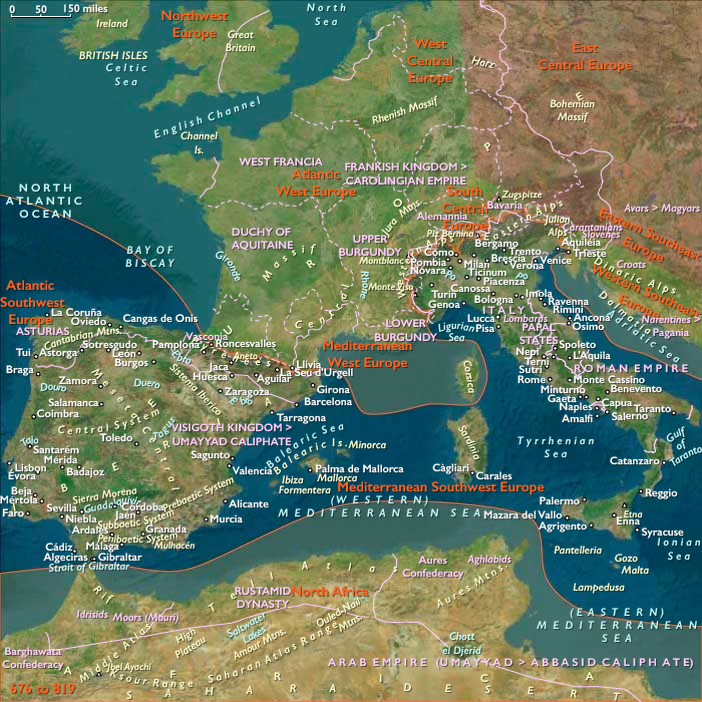
Abd al-Rahman lands at Almuñécar in al-Andalus, …
Years: 755 - 755
September
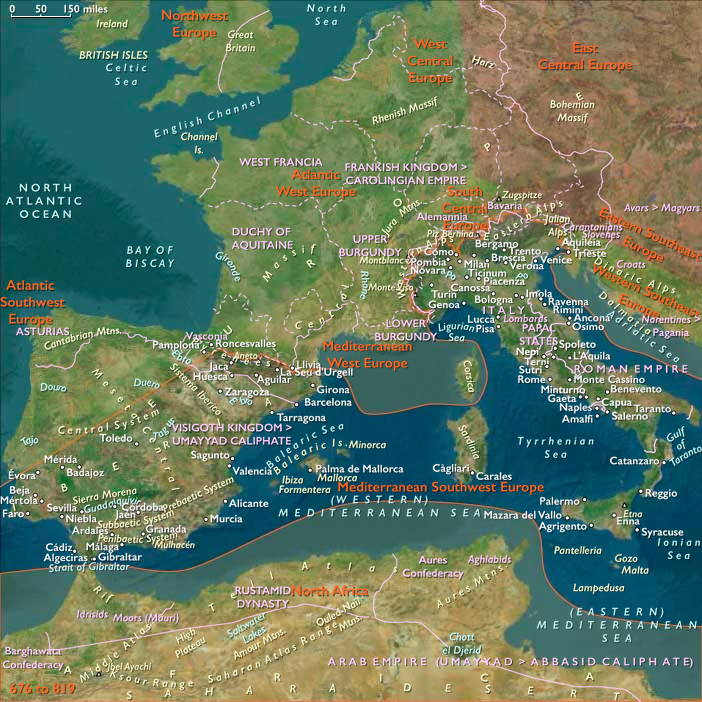
Abd al-Rahman lands at Almuñécar in al-Andalus, to the east of Málaga, in September 755; however, his landing site is unconfirmed.
Locations
People
Groups
- Arab people
- Berber people (also called Amazigh people or Imazighen, "free men", singular Amazigh)
- Qais (Arabian tribe)
- Muslims, Sunni
- Muslims, Shi'a
- Syrian people
- al-Andalus (Andalusia), Muslim-ruled
- Ifriqiya, Fihrid Emirate of
- Abbasid Caliphate (Kufa)
Topics
Commodoties
Subjects
Regions
Subregions
Related Events
Filter results
Showing 10 events out of 55237 total
A number of revolts break out in caliphal territory in which some of the pre-Islamic religions of Iran are involved.
These are perhaps in reaction to the 'Abbasids' policy of disassociation from their “extremist” supporters.
In 755 in Khorasan, a certain Sunpadh, described as a magi (here probably meaning a follower of the Mazdakite heresy, not an orthodox Zoroastrian), revolts, demanding vengeance for the murdered Abu Muslim, his close friend.
Sunpadh also preaches a syncretism melding Islam and Zoroastrianism.
In combination with his unusual and heretical vow to advance towards the Hejaz and raze the Ka’aba, this leads to the belief that he was in fact a Zoroastrian, rather than a Muslim.
The enraged Sunpadh swears to march on Mecca and destroy the Kaaba.
Sunpadh further preaches that "Abu Muslim has not died, and when Mansur meant to slay him, he chanted God's great name, turned into a white dove and flew away. Now he is standing with Mahdi and Mazdak in a castle of copper and they shall emerge by and by."
His doctrine receives wide support among Persian Shi'i Muslims, Zoroastrians and Mazdakites and revolts occurre in Ray, Herat and Sistan.
Within only seventy days, Sunpadh's forces are however defeated by one of Caliph al-Mansur's generals, Juhar ibn Murad.
Sunpadh then flees to Khurshid of Tabaristan, but there he is murdered by one of Khurshid's cousins, because he had failed to show the man proper respect.
Constantinople’s successes in the east make it possible to pursue an aggressive policy in the Balkans, where the Bulgarians now dominate Thrace.
With the resettlement of Christian populations from Armenia and Syrian into Thrace, Constantine aims to enhance the prosperity and defense of the area, causing concern to the Empire's northern neighbor, Bulgaria, and leading the two states to clash in 755.
The reign of Kormisosh inaugurates a prolonged period of war with the Empire.
Kormisosh demands the payment of tribute, perhaps constituting an increase in the traditional payments.
Rebuffed, Kormisosh raids into Thrace, reaching the Anastasian Wall stretching between the Black Sea and the Sea of Marmara forty kilometers in front of Constantinople.
Constantine marches out with his army, defeats the Bulgarians and turns them to flight.
Abd al-Rahman and Bedr reach modern day Morocco near Ceuta.
Their next step will be to cross the sea to al-Andalus, where Abd al-Rahman cannot have been sure whether or not he would be welcomed.
Following the Berber Revolt of the 740s, the province is in a state of confusion, with the Muslim community torn by tribal dissensions among the Arabs and racial tensions between the Arabs and Berbers.
At this moment, the nominal ruler of al-Andalus, emir Yusuf ibn 'Abd al-Rahman al-Fihri (another member of the Fihrid family, and a favorite of the old Arab settlers (baladiyun), mostly of south Arabian or 'Yemenite' tribal stock) is locked in a contest with his vizier (and son-in-law) al-Sumayl ibn Hatim al-Qilabi, the head of the new settlers (shamiyum, the Syrian junds or military regiments, mostly of north Arabian Qaysid tribes, which had arrived only in 742).
Among the Syrian junds are contingents of old Umayyad clients, numbering perhaps five hundred, and Abd al-Rahman believes he might tug on old loyalties and get them to receive him.
Bedr is dispatched across the straits to make contact.
Bedr manages to line up three Syrian commanders—Obeid Allah ibn Uthman and Abd Allah ibn Khalid, both originally of Damascus, and Yusuf ibn Bukht of Qinnasrin.
The trio approach the Syrian arch-commander al-Sumayl (at this time in Zaragoza) to get his consent, but al-Sumayl refuses, fearing Abd al-Rahman will try to make himself emir.
As a result, Bedr and the Umayyad clients send out feelers to their rivals, the Yemenite commanders.
Although the Yemenites are not natural allies (the Umayyads are a Qaysid tribe), their interest is piqued.
The emir Yusuf al-Fihri has proven himself unable to keep the powerful al-Sumayl in check and several Yemenite chieftains feel their future prospects are poor, whether in a Fihrid or Syrian-dominated Spain, that they have a better chance of advancement if they hitch themselves to the glitter of the Umayyad name.
Although the Umayyads do not have a historical presence in the region (no member of the Umayyad family is known to have ever set foot in al-Andalus before) and there are grave concerns about young Abd al-Rahman's inexperience, several of the lower-ranking Yemenite commanders feel they had little to lose and much to gain, and agree to support the prince.
Bedr returns to Africa to tell Abd al-Rahman of the invitation of the Umayyad clients in al-Andulus.
Shortly thereafter, they set off with a small group of followers for Europe.
When some local Berber tribesmen learn of Abd al-Rahman's intent to set sail for al-Andalus, they quickly ride to catch up with him on the coast.
The tribesmen might have figured that they could hold Abd al-Rahman as hostage, and force him to buy his way out of Africa.
He does indeed hand over some amount of dinars to the suddenly hostile local Berbers.
Just as Abd al-Rahman launches his boat, another group of Berbers arrives.
They also try to obtain a fee from him for leaving.
One of the Berbers holds on to Abd al-Rahman's vessel as it makes for al-Andalus, and allegedly has his hand cut off by one of the boat's crew.

Ibn Habib had soon changed his mind about welcoming the Umayyads, fearing the presence of prominent Umayyad exiles in Ifriqiya, a family more illustrious than his own, might become a focal point for intrigue among local nobles against his own usurped powers.
Believing he has discovered plots involving some of the more prominent Umayyad exiles in Kairouan, Ibn Habib turns against them around 755.
At this time, Abd al-Rahman and Bedr are keeping a low profile, staying in Kabylie, at the camp of a Nafza Berber chieftain friendly to their plight.
Ibn Habib dispatches spies to look for the wayward Umayyad prince.
When Ibn Habib's soldiers enter the camp, the Berber chieftain’s wife Tekfah hides Abd al-Rahman under her personal belongings to help him go unnoticed.
Once they are gone, Abd a-Rahman and Bedr immediately set off westwards.
It is not known when An Lushan's son An Renzhi was born, although he was said to be not yet twenty when Emperor Xuanzong gave him the mostly honorary title of minister of vassal affairs, likely in 751.
He is An Lushan's second son, and his mother is An Lushan's first wife Lady Kang.
At some point, Emperor Xuanzong had given him the name of Qingxu.
The first definitive historical references to him were in 752, when, in a defeat that An Lushan suffered against the Xi, An Lushan was said to have fallen into a hole and was only saved through the effort of An Qingxu and others.
Also that year, when An Lushan's close associate Ji Wen went to meet An Lushan before departing for the Tang capital Chang'an, it was An Qingxu that An Lushan sent to accompany Ji to the borders of his territory.
When An Lushan rebelled at his post at Fanyang Circuit (headquartered in modern Beijing) in 755, An Qingxu was apparently with his father and accompanied his father south.
In response to An Lushan's rebellion, An Qingxu's mother Lady Kang and older brother An Qingzong, then at Chang'an, were executed, and after An Lushan captures Chenliu Prefecture (roughly modern Kaifeng, Henan), it is An Qingxu who realizes that An Qingzong had been executed and who tearfully informs his father, sending his father into a rage in which he executes the Tang soldiers who had surrendered to him at Chenliu.
Tang military commanders have begun to accumulate independent political strength in the latter years of Xuoyang’s reign.
When the emperor's concubine, Yang Guifei, becomes a power at the imperial court, one such general, An Lushan, rebels against the empire rather than lose influence.
A semi-barbarian of Persian and Turkish descent, raised in Mongolia, An Lushan had moved to China as a young man and joined the army, rising rapidly through the ranks to become a court favorite of the emperor and military governor of three northern Chinese provinces.
At the death of the emperor’s powerful chief minister, An Lushan had applied for the vacant post but was denied it; Yang Guifei’s appointment had been the final straw.
An launches his rebellion on December 16, 755, claiming that he has received a secret edict from Emperor Xuanzong to advance on Chang'an to remove Yang.
The imperial officials are all apprehensive, because An has the strongest troops of the realm at the time, except for Yang, who believes that An can be suppressed easily.
Emperor Xuanzong, meanwhile, commissions the general Feng Changqing as the military governor of Fanyang and Pinglu, intending to have him replace An after An's rebellion is defeated.
The Emperor also sends Feng to the eastern capital, Luoyang, to build up the defense there; another general, Gao Xianzhi, is ordered to command a secondary defense at Shan Prefecture (roughly modern Sanmenxia, Henan).
He also executes An Qingzong and An's first wife Lady Kang, and forces An Qingzong's wife Lady Rongyi to commit suicide.
The wife of Japanese emperor Shomu dedicates his household effects to the Todai-ji; the many decorated objects, mostly Chinese imports, are placed in the temple storehouse in 756.
Greek-Bulgarian conflict is resolved with a peace treaty between Kormisosh and Constantine V that probably confirms the existing frontier.
It is sometimes supposed that this defeat brought the reign of Kormisosh to its end through a palace coup, but the next ruler Vinekh may have been from the same royal house.
Vinekh ascends the Bulgarian throne after the defeat of his predecessor Kormisosh by the Eastern Roman Emperor Constantine V, which has led some scholars to assume that he was an usurper.
Around 756 Constantine V campaigns against Bulgaria by land and sea, and defeats the Bulgarian army led by Vinekh at Marcellae (Karnobat).
The defeated monarch sues for peace and undertakes to send his own children as hostages.
Ibn al-Muqaffa, though a resident of Basra, was originally from the town of Jur (or Gur, Firuzabad, Fars) in the Iranian province of Fars.
Born of Persian parents about 720, he converts to Islam as an adult and perfects his Arabic so that his translations into that language from Pahlavi (Middle Persian) become models of elegant Arabic prose.
His father had been a state official in charge of taxes under the Umayyads, and after being accused and convicted of embezzling some of the money entrusted to him, was punished by the ruler by having his hand crushed, hence the name Muqaffa (shrivelled hand).
His book of animal fables, “Kalila and Dimna,” stems from the Sanskrit “Fables of Bidpai” and the Pahlavi “Panchatantra.” Al-Muqaffa also gains renown for his “Great Book of Manners” on the ethics of rulers and courtiers.
Al-Muqaffa’s translations lead to a new refinement in Arabic prose called “adab,” often interspersed with poetry and featuring rhymed prose (“saj'“), the style of the Koran.
He paves the way for later innovators who will bring literary fiction to Arabic literature.
Ibn al-Muqaffa is also an accomplished scholar of Middle Persian, and is the author of several moral fables.
Ibn al-Muqaffa is burned at the stake around 756 or 757 by the order of the second Abbasid caliph Abu Ja`far al-Mansur reportedly for heresy, in particular for attempting to import Zoroastrian ideas into Islam.
There is evidence, though, that his murder may have been prompted by the caliph's resentment at the terms and language that Ibn al-Muqaffa had used in drawing up a guarantee of safe passage for the caliph's rebellious uncle, Abdullah ibn Ali; the caliph found that document profoundly disrespectful to himself, and it is believed Ibn al-Muqaffa paid with his life for the affront to al-Mansur.
Years: 755 - 755
September
Locations
People
Groups
- Arab people
- Berber people (also called Amazigh people or Imazighen, "free men", singular Amazigh)
- Qais (Arabian tribe)
- Muslims, Sunni
- Muslims, Shi'a
- Syrian people
- al-Andalus (Andalusia), Muslim-ruled
- Ifriqiya, Fihrid Emirate of
- Abbasid Caliphate (Kufa)