
Abd al-Rahman and Bedr reach modern day …
Years: 755 - 755
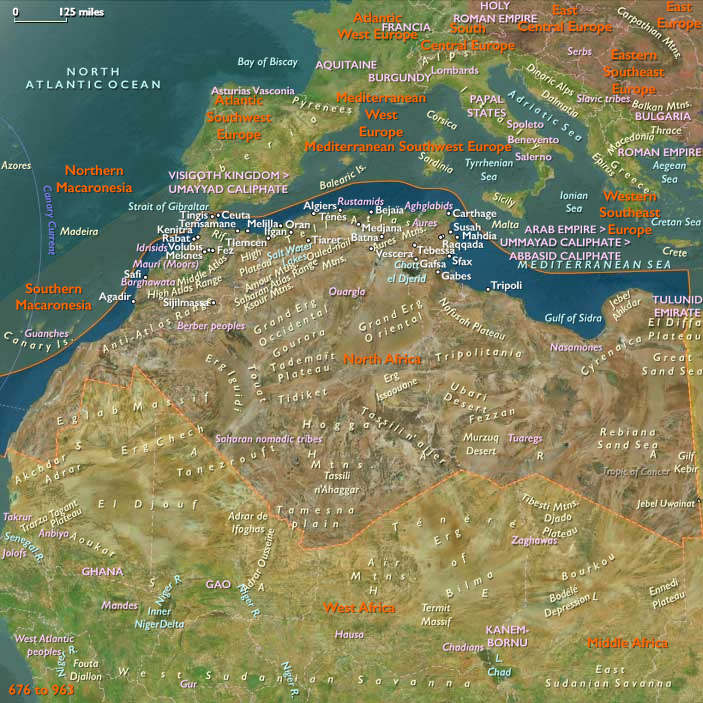
Abd al-Rahman and Bedr reach modern day Morocco near Ceuta.
Their next step will be to cross the sea to al-Andalus, where Abd al-Rahman cannot have been sure whether or not he would be welcomed.
Following the Berber Revolt of the 740s, the province is in a state of confusion, with the Muslim community torn by tribal dissensions among the Arabs and racial tensions between the Arabs and Berbers.
At this moment, the nominal ruler of al-Andalus, emir Yusuf ibn 'Abd al-Rahman al-Fihri (another member of the Fihrid family, and a favorite of the old Arab settlers (baladiyun), mostly of south Arabian or 'Yemenite' tribal stock) is locked in a contest with his vizier (and son-in-law) al-Sumayl ibn Hatim al-Qilabi, the head of the new settlers (shamiyum, the Syrian junds or military regiments, mostly of north Arabian Qaysid tribes, which had arrived only in 742).
Among the Syrian junds are contingents of old Umayyad clients, numbering perhaps five hundred, and Abd al-Rahman believes he might tug on old loyalties and get them to receive him.
Bedr is dispatched across the straits to make contact.
Bedr manages to line up three Syrian commanders—Obeid Allah ibn Uthman and Abd Allah ibn Khalid, both originally of Damascus, and Yusuf ibn Bukht of Qinnasrin.
The trio approach the Syrian arch-commander al-Sumayl (at this time in Zaragoza) to get his consent, but al-Sumayl refuses, fearing Abd al-Rahman will try to make himself emir.
As a result, Bedr and the Umayyad clients send out feelers to their rivals, the Yemenite commanders.
Although the Yemenites are not natural allies (the Umayyads are a Qaysid tribe), their interest is piqued.
The emir Yusuf al-Fihri has proven himself unable to keep the powerful al-Sumayl in check and several Yemenite chieftains feel their future prospects are poor, whether in a Fihrid or Syrian-dominated Spain, that they have a better chance of advancement if they hitch themselves to the glitter of the Umayyad name.
Although the Umayyads do not have a historical presence in the region (no member of the Umayyad family is known to have ever set foot in al-Andalus before) and there are grave concerns about young Abd al-Rahman's inexperience, several of the lower-ranking Yemenite commanders feel they had little to lose and much to gain, and agree to support the prince.
Bedr returns to Africa to tell Abd al-Rahman of the invitation of the Umayyad clients in al-Andulus.
Shortly thereafter, they set off with a small group of followers for Europe.
When some local Berber tribesmen learn of Abd al-Rahman's intent to set sail for al-Andalus, they quickly ride to catch up with him on the coast.
The tribesmen might have figured that they could hold Abd al-Rahman as hostage, and force him to buy his way out of Africa.
He does indeed hand over some amount of dinars to the suddenly hostile local Berbers.
Just as Abd al-Rahman launches his boat, another group of Berbers arrives.
They also try to obtain a fee from him for leaving.
One of the Berbers holds on to Abd al-Rahman's vessel as it makes for al-Andalus, and allegedly has his hand cut off by one of the boat's crew.
Locations
People
Groups
- Arab people
- Berber people (also called Amazigh people or Imazighen, "free men", singular Amazigh)
- Qais (Arabian tribe)
- Muslims, Sunni
- Muslims, Shi'a
- Syrian people
- al-Andalus (Andalusia), Muslim-ruled
- Ifriqiya, Fihrid Emirate of
- Abbasid Caliphate (Kufa)
Topics
Commodoties
Subjects
Regions
Subregions

Related Events
Showing 10 events out of 12 total
Years: 755 - 755
Locations
People
Groups
- Arab people
- Berber people (also called Amazigh people or Imazighen, "free men", singular Amazigh)
- Qais (Arabian tribe)
- Muslims, Sunni
- Muslims, Shi'a
- Syrian people
- al-Andalus (Andalusia), Muslim-ruled
- Ifriqiya, Fihrid Emirate of
- Abbasid Caliphate (Kufa)
Topics
Commodoties
Subjects
Regions
Subregions