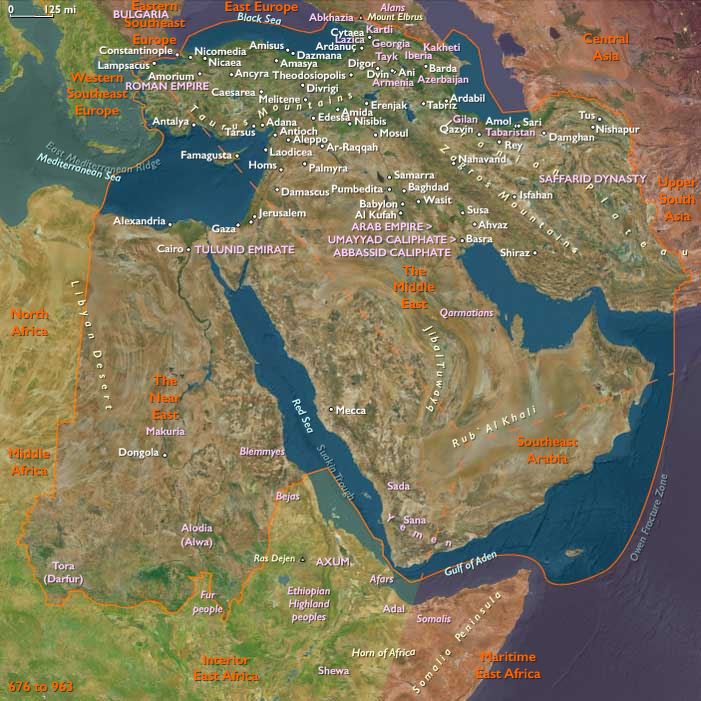
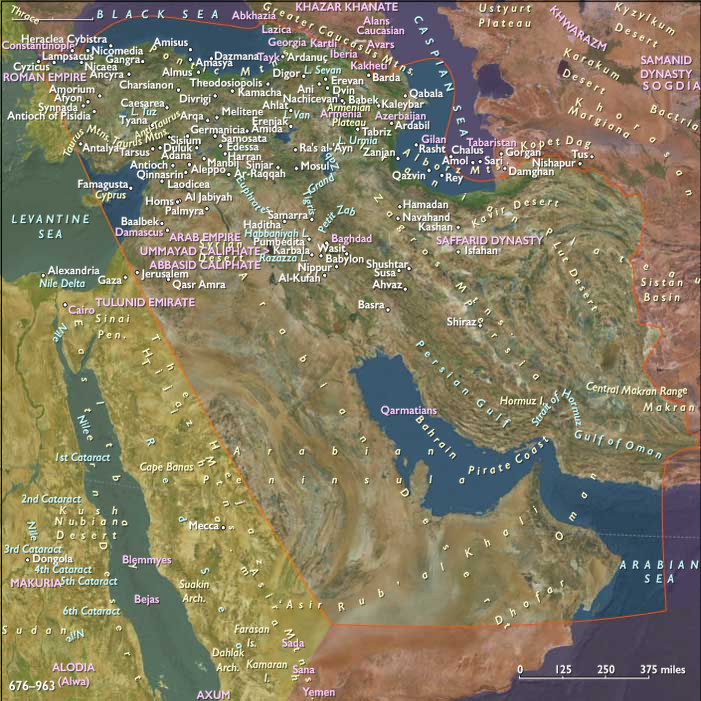
'Abd al-Malik, restricting himself to securing his …
Years: 687 - 687
'Abd al-Malik, restricting himself to securing his own position, has made no further attempt to interfere in Iraq but has bided his time for three years as the various groups in Iraq exhaust themselves in internecine warfare.
Locations
People
Groups
Topics
Commodoties
Subjects
Regions
Subregions
Related Events
Filter results
Showing 10 events out of 55985 total
Justinian II, at the beginning of his reign, had made a treaty with the Arabs whereby they pay increased tribute and …
…in 687, as part of Justinian’s agreements with the Caliphate, he removes from their native Lebanon twelve thousand Christian Maronites, who have continually resisted the Muslims.
Justinian takes advantage of the peace in the East to regain possession of the Balkans, which have until now been almost totally under the heel of Slavic tribes.
In 687, Justinian transfers cavalry troops from Anatolia to Thrace.
The retreat of the Umayyad army had left Ibn al-Zubayr in undisputed control of Mecca.
With the collapse of Umayyad authority, he is soon acknowledged as the rightful Caliph across most of the Muslim world, including northern Syria.
The Umayyads, however, under the leadership of Marwan ibn al-Hakam, had managed to consolidate their position in Syria in the Battle of Marj Rahit, and even reclaim Egypt.
Ibn al-Zubayr's brother Mus'ab defeats al-Mukhtar and gains control of all of Iraq in 687.
The Sixth Ecumenical Council, the major event of Agathos’ pontificate, ends the Monothelite heresy that had been tolerated by previous popes, Honorius among them.
The council had begun when Emperor Constantine IV, desiring to heal the schism, had written to Pope Donus suggesting a conference on the matter, but Donus was dead by the time the letter arrived.
However, Agatho had been quick to seize the opportunity for reconciliation, ordering councils held throughout the West so that legates can present the universal tradition of the Western Church, then sends a large delegation to meet the Easterners at Constantinople.
Leo II, a Sicilian by birth, who had been elected to succeed Pope Agatho a few days after his death on January 10, 681, had not been consecrated as Pope until after the lapse of a year and seven months.
Known as an eloquent preacher who was interested in music, Leo had been noted for his charity to the poor.
Benedict II, a member of the Roman Savelli family, had been chosen in 683 to succeed Leo II but had not been ordained until 684, because the permission of Emperor Constantine IV had not been obtained until some months after the election.
According to Liber Diurnus Romanorum Pontificum, he had obtained from the Emperor a decree which had either abolished imperial confirmations altogether or made them obtainable from the Exarch of Ravenna.
This has given the power of confirmations of papal nominations directly to the Church and the people of Rome.
His successor, Pope John V, a Syrian by birth, had in 680 been named papal legate to the Sixth Ecumenical Council at Constantinople because of his knowledge of Greek; he had passes his pontificate of little more than a year chiefly in bed.
Conon, his successor in 686, dies in 687.
Sergius succeeds him, but Theodore II opposes him as anitipope.
The reign of antipope Paschal follows Theodore’s brief tenure as self-consecrated Bishop of Rome.

Pepin of Heristal and the Triumph at Tertry
From 680, Pepin of Heristal, the son of Pepin of Landen, serves as mayor of the palace of Austrasia, successfully maintaining the kingdom’s autonomy against Neustrian expansionist ambitions. Unlike many of his predecessors, Pepin secures his position through both diplomatic skill and military strength, ensuring peaceful governance in the east while preparing for inevitable conflict with the western Frankish factions.
A turning point comes in 687, when the mayor of the palace of Neustria, seeking to exploit the weakness of an infant Merovingian king in Austrasia, rallies the nobles of Neustria and Burgundy in an effort to reassert control. Pepin, however, proves the stronger force, decisively defeating his foes at the Battle of Tertry, near Péronne in modern France.
This victory secures Pepin’s dominance over the Frankish realms, effectively placing both Neustria and Burgundy under Austrasian control. While the Merovingian kings continue to reign in name, real power now firmly rests with the Arnulfing mayors of the palace, paving the way for the eventual rise of the Carolingian dynasty.
Pepin of Heristal: Architect of Frankish Unity
Following his victory at the Battle of Tertry (687), Pepin of Heristal consolidates his rule over the Frankish realms, uniting Austrasia, Neustria, and Burgundy under his sole mayorship. Though a Merovingian infant king nominally reigns over all the Franks, Pepin wields actual power, effectively governing as the de facto ruler of the entire Frankish kingdom.
By centralizing authority, Pepin ensures the continued dominance of the Arnulfing lineage, establishing a lasting political structure that strengthens the position of the mayors of the palace. His rule not only stabilizes the Frankish realm but also lays the groundwork for the eventual transition from Merovingian figureheads to the full ascendance of the Carolingians, shaping the political landscape of medieval Europe.
Monkwearmouth-Jarrow is a twin-foundation English monastery, located on the River Wear, at Monkwearmouth, and the River Tyne, at Jarrow, respectively, in the Kingdom of Northumbria (now in the metropolitan county of Tyne and Wear).
The monastery had been founded in 674 by Benedict Biscop, first with the establishment of the monastery of St. Peter's, Monkwearmouth on land given by Egfrid, King of Northumbria.
His idea had been to build a model monastery for England, sharing his knowledge of the experience of the Roman traditions in an area previously more influenced by Celtic Christianity stemming from missionaries of Melrose and Iona.
A papal letter in 678 had exempted the monastery from external control, and in 682 the king had been so delighted at the success of St. Peter's, he had given Benedict more land in Jarrow and urged him to build a second monastery.
Benedict had erected a sister foundation (St Paul) at Jarrow, appointing Ceolfrith as its superior, who had left Monkwearmouth with twenty monks (including his protégé the young Bede) to start the foundation in Jarrow.
Benedict had brought workmen from Francia to build these churches, the first ecclesiastical structures in Britain built of stone, and furnished it with glass windows, pictures, service books and the library he had collected on his travels.
Window glass being unusual in England at this time, Benedict had imported glassmakers from Francia, who had established a workshop at the Monkwearmouth site, which stands on a nearby site on the river Wear.
The library Benedict had created on his travels to Rome and then given to the monastery makes it the cradle not only of English art but of English literature—Jarrow is where the Venerable Bede receives his early education under Ceolfrith's patronage and will live, write and die as a monk.
Cuthbert, an Anglo-Saxon monk in the Kingdom of Northumbria—which at this time includes, in modern terms, north east England and south east Scotland as far as the Firth of Forth—had engaged in extensive missionary activities.
Traveling the breadth of the country from Berwick to Galloway, he has reportedly worked so many healing miracles that people have begun to call him “the wonderworker of Britain.”
While living as a hermit on the Farne Islands, he had instituted special laws to protect the Eider ducks and other seabirds nesting on the islands; these may have been the first bird protection laws anywhere in the world.
Consequently, eider ducks are often called cuddy ducks (Cuthbert's ducks) in modern Northumbrian dialects.
Cuthbert had reluctantly given up his solitude in the island of Farne to be consecrated bishop of Lindisfarne in 685.
Dying two years later, Cuthbert will become one of the most important medieval saints of England, with widespread recognition in the places he had been in Scotland; he is today regarded as the patron saint of Northumbria.
Li Sixun, later seen as the chief exponent of a decoratively colored landscape style of the Tang dynasty, is the founder of the so-called Northern school of professional painters.
Related to the Tang imperial family, Li Sixun leads an active political life including exile and restoration, and has been given the honorary rank of general.
His son, Li Zhaodao, is also a famous painter, and thus the father is sometimes called Big General Li and the son Little General Li.
While no genuine works survive, both Li Sixun and Li Zhaodao are known to have painted in a highly decorative and meticulous fashion, employing the precise line technique derived from earlier artists such as Gu Kaizhi and Zhan Ziqian, especially adding the decorative mineral colors blue and green (qinglu), often together with white and gold.
Chinese theoretician Dong Qichang spoke of a stylistic division between the decorative tradition among Northern painters begun by Li Sixun and the scholarly tradition among Southern school painters begun by Wang Wei.
Today, the blue-green shan shui, a Chinese painting style of landscape, or "Shan shui", tends to refer a "ancient style" rather than modern ones.
The main color of the paintings are blues and greens, and in the early period it is painted by mineral dyes.
It is said this style was first formulated by Li Sixun.
Many historic records show that Li Sixun and his son, Li Zhaodao, largely developed the painting techniques and formulated the style.