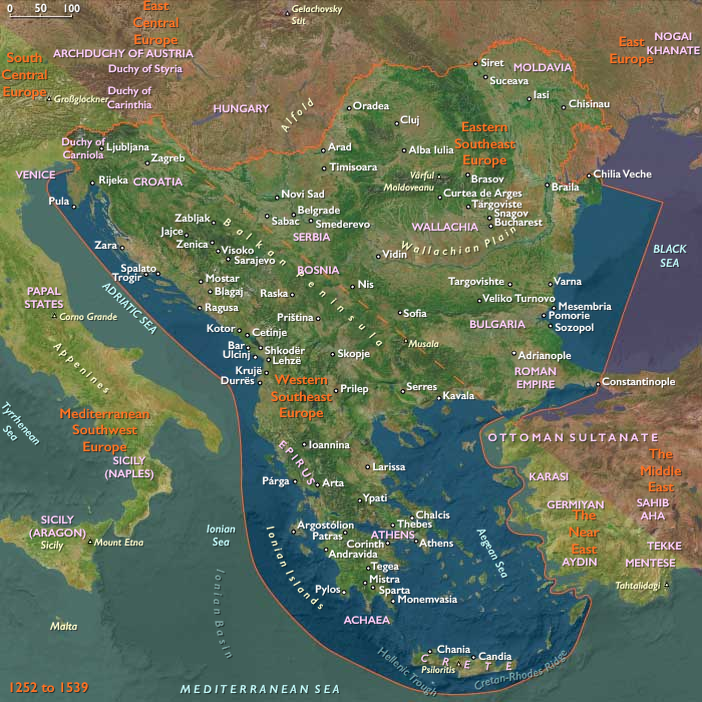
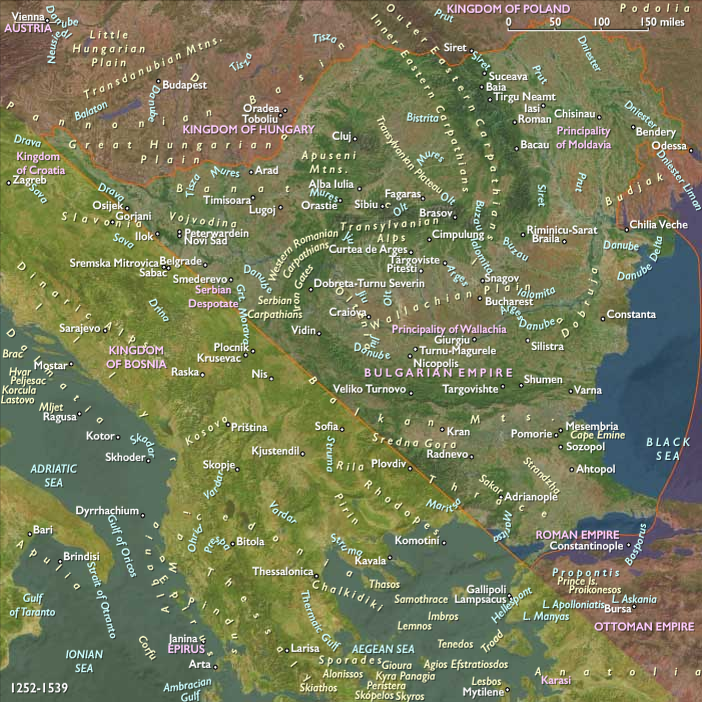
…a turning point comes when Shumen, in …
Years: 1388 - 1388
…a turning point comes when Shumen, in Bulgaria's east, falls in 1388, and …
Locations
People
Groups
- Bulgarian Empire (Second), or Empire of Vlachs and Bulgars
- Serbia, Kingdom of
- Ottoman Empire
- Bosnia, Kingdom of
Topics
Commodoties
Subjects
Regions
Subregions
Related Events
Filter results
Showing 10 events out of 43525 total
Prince Phrohm, effecting a reconciliation with King Saenmuengma, joins the royal retinue and bestows on his nephew, as a token of friendship, a Buddha statue he had stolen from the ruler of Kamphaeng Phet, an Ayutthayan possession since 1378.
Ayutthaya’s King Borommarachathirat, responding to his vassal’s protest at the theft and the occupation of the city by Phrohm’s forces, leads an expedition north in support of Kamphaeng Phet.
He captures the city, but dies in 1388 on the way home.
Korean General Yi Seong-gye had gained power and respect during the late 1370s and early 1380s by pushing Mongol remnants off the peninsula and also by repelling well-organized Japanese pirates in a series of successful engagements.
He is also credited with routing the Red Turbans when they made their move into the Korean Peninsula as part of their rebellion against the Yuan Dynasty.
Following in the wake of the rise of the Ming Dynasty under the Zhu Yuanzhang, the royal court in Goryeo has split into two competing factions: the group led by General Yi (supporting the native Chinese Ming Dynasty) and the camp led by his rival General Choe (supporting the Mongol Yuan Dynasty).
When a Ming messenger comes to Goryeo in 1388 (the fourteenth year of King U) to demand the return of a significant portion of Goryeo’s northern territory, General Choe seizes the opportunity and plays upon the prevailing anti-Ming atmosphere to argue for the invasion of the Liaodong Peninsula (Goryeo claims to be the successor of the ancient kingdom of Goguryeo; as such, restoring Manchuria as part of Korean territory will be a tenet of its foreign policy throughout its history).
A staunchly opposed Yi is chosen to lead the invasion; however, at Wihwa Island on the Amrok River, he makes a momentous decision, commonly called "Turning back the army from Wihwa Island", that will alter the course of Korean history.
Knowing of the support he enjoys both from high-ranking government official and the general populace, and the great deterrent of the Ming Empire under the Hongwu Emperor, he decides to revolt and sweeps back to the capital, Gaesong, to secure control of the government.

Olaf had died suddenly at the age of seventeen in 1387, and his mother Margaret, who had ruled both kingdoms in his name, is chosen Regent of Norway and Denmark in the following year.
She has already proven her keen statesmanship by recovering possession of Schleswig from the Holstein-Rendsburg Counts.
Thus free from fear of domestic sedition by the Jutish nobles, she can now give her undivided attention to Sweden, where mutinous nobles are already in arms against their unpopular King Albert.
Several of the powerful nobles have written to Margaret that if she will help rid Sweden of Albert, she will become their regent.
She quickly gathers an army and invades Sweden.
At a conference held at Dalaborg Castle in March 1388, the Swedes are compelled to accept all of Margaret's conditions, elect her "Sovereign Lady and Ruler", and commit themselves to accept any king she chooses to appoint.
A combined force of Serbs, Bosnians, and Bulgarians inflicts a heavy defeat on the Ottoman army at Plocnik in 1387 or 1388, but …
…the Bulgarian tsar Ivan Shishman breaks with the alliance of Slavic powers and accepts Ottoman suzerainty.
No longer threatened from the east, Murad's armies are able to concentrate their weight against Serb resistance.
Turkish armies, having begun raiding Serbia in the 1380s, cross into Bosnian-ruled Hum (Herzegovina) in 1388; Tvrtko's Bosnian forces halt an Ottoman Turkish invasion at Bileca.
The way is open central Greece in 1388, with Catalan power weakened by the Navarrese Company, for the Florentine Acciajuoli, lords of Corinth, to …
…take Athens.
The stunning Swiss victory over the Austrians at the Battle of Sempach in 1386 had lifted the morale of the Confederation, which goes on to win victory in all the subsequent actions of the Austro-Swiss War, including the Battle of Näfels in 1388, in which the forces of Glarus lie in ambush, scatter the Austrian troops with an avalanche of boulders, then rout both cavalry and infantry.
The Monastery of Santa Maria da Vitória at Batalha (1388): A Masterpiece of Late Gothic and Manueline Architecture
The Monastery of Santa Maria da Vitória, commonly known as Batalha Monastery, is one of Portugal’s greatest architectural achievements. Built to commemorate the decisive Portuguese victory at the Battle of Aljubarrota (1385), its construction began in 1388 under King John I of Portugal.
A Symbol of National Triumph
- John I vowed to build the monastery in gratitude for the victory against Castile, which secured Portugal’s independence.
- The site chosen for construction was Batalha (meaning “battle”), near the Aljubarrota battlefield, reinforcing its significance as a symbol of Portuguese resilience.
- The monastery would also serve as the royal burial church for the House of Aviz, Portugal’s ruling dynasty in the 15th century.
Architectural Style: A Blend of Late Gothic and Manueline Influences
- The monastery’s design was inspired largely by the English Perpendicular Gothic style, reflecting Portugal’s strong alliance with England.
- Over time, Manueline elements—a uniquely Portuguese late Gothic style characterized by ornamental maritime and natural motifs—were integrated into the structure.
- The intricate stonework, ribbed vaulting, elaborate pinnacles, and magnificent stained glass windows make Batalha one of the finest Gothic masterpieces in Portugal.
A Lasting Legacy: The Aviz Dynasty's Royal Pantheon
- John I of Portugal and Philippa of Lancaster, along with their renowned sons—including Prince Henry the Navigator—are buried in the Founder’s Chapel (Capela do Fundador).
- The monastery became a center of royal patronage, hosting some of Portugal’s finest artisans and architects over the next two centuries.
- Its unfinished chapels (Capelas Imperfeitas), begun under King Duarte, remain an extraordinary example of Portugal’s evolving architectural styles.
A UNESCO World Heritage Site
- Today, Batalha Monastery is a UNESCO World Heritage Site, recognized for its historical, artistic, and symbolic significance.
- It stands as a monument to Portugal’s independence, the House of Aviz, and the age of exploration and maritime expansion that would follow in the 15th and 16th centuries.
The Monastery of Batalha remains one of the greatest expressions of Portuguese Gothic architecture, a lasting testament to the national pride and artistic innovation of medieval Portugal.
Years: 1388 - 1388
Locations
People
Groups
- Bulgarian Empire (Second), or Empire of Vlachs and Bulgars
- Serbia, Kingdom of
- Ottoman Empire
- Bosnia, Kingdom of