
A struggle for power had commenced between …
Years: 1087 - 1087
A struggle for power had commenced between King Solomon and his cousins (sons of the late Béla I) during the 1070s.
The King's forces had been decisively defeated by his cousins and their allies, the Dukes of Poland and Bohemia at the Battle of Mogyoród on March 14, 1074.
Solomon’s wife, Judith of Swabia, had fled to Germany while Solomon continues his fight for the Hungarian throne; in 1077, he had accepted the rule of his cousin King László I, who gave him in exchange extensive landholdings after his formal abdication in 1081.
Despite this, Solomon had never given up his pretensions and began to plot against King László I; however, his plans had been discovered and he was imprisoned by the King in the Tower of Visegrád until August 15, 1083, when on the occasion of the canonization of István I, the first King of Hungary, Solomon had been released.
Judith had meanwhile remained in Germany and settled in her residence in Regensburg (with short breaks) from May or July 1074.
After his release, Solomon had gone to Germany and tried to reunite with his wife, but she had refused to receive him.
After a long wandering, Solomon had made an alliance with Kuteshk, the leader of a Pecheneg tribe settled in the later principality of Moldavia.
Between 1084-1085, he married Kuteshk’s daughter, committing bigamy with this act.
Solomon has promised to hand over parts of the kingdom of Hungary in exchange for his new father-in-law's military assistance.
Solomon had led the Pecheneg troops against Hungary in 1085, but King László I had defeated them.
Two years later, Solomon takes part in the Pechenegs' campaign against Constantinople and is killed in a battle near Hadrianopolis in 1087.
Locations
People
Groups
- Greeks, Medieval (Byzantines)
- Pechenegs, or Patzinaks
- German, or Ottonian (Roman) Empire
- Hungary, Kingdom of
- Poland of the first Piasts, Kingdom of
- Roman Empire, Eastern: Komnenos dynasty, restored
- Bohemia, Kingdom of
Commodoties
Subjects
Regions
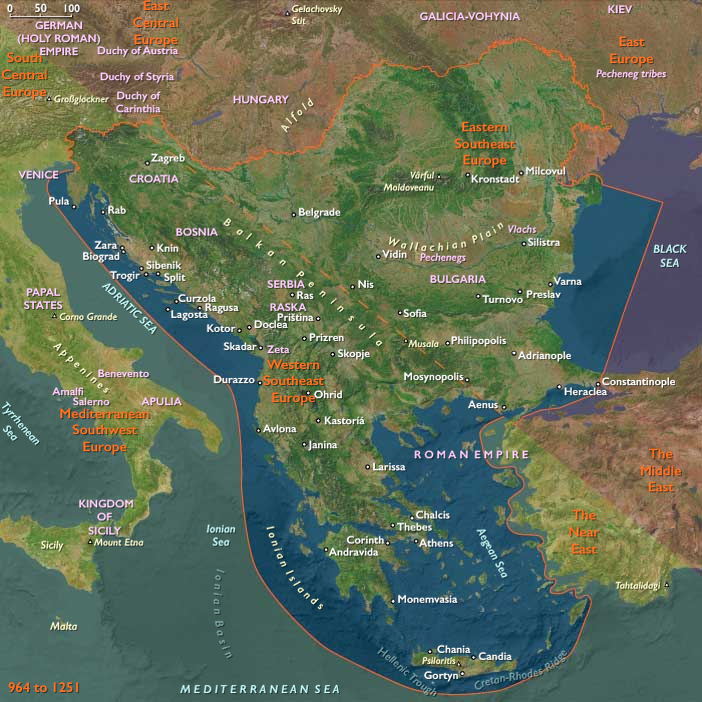
Subregions
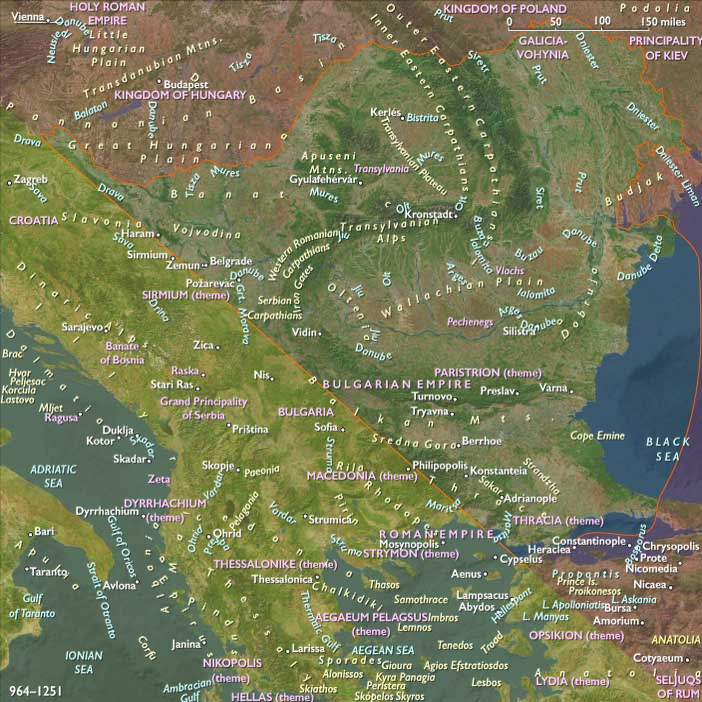
Years: 1087 - 1087
Locations
People
Groups
- Greeks, Medieval (Byzantines)
- Pechenegs, or Patzinaks
- German, or Ottonian (Roman) Empire
- Hungary, Kingdom of
- Poland of the first Piasts, Kingdom of
- Roman Empire, Eastern: Komnenos dynasty, restored
- Bohemia, Kingdom of
Commodoties
Subjects
Regions
Subregions