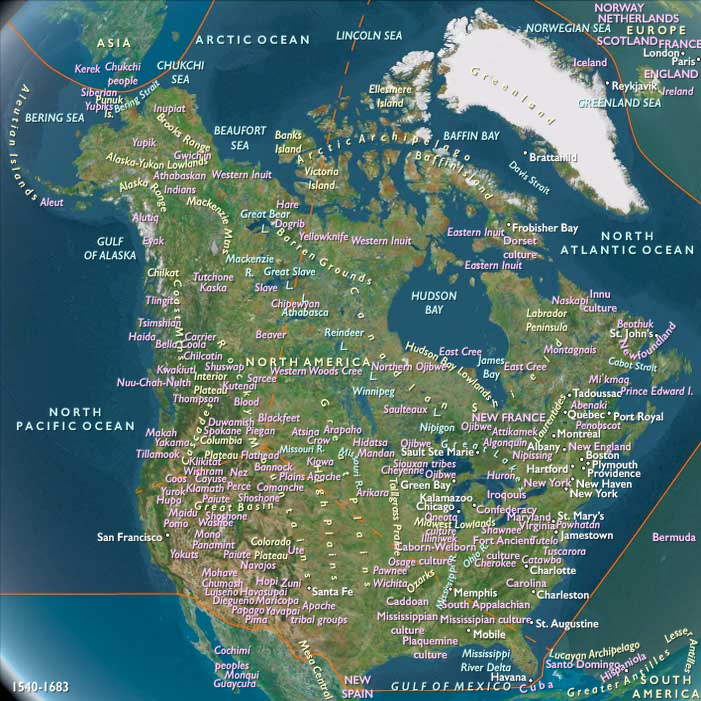
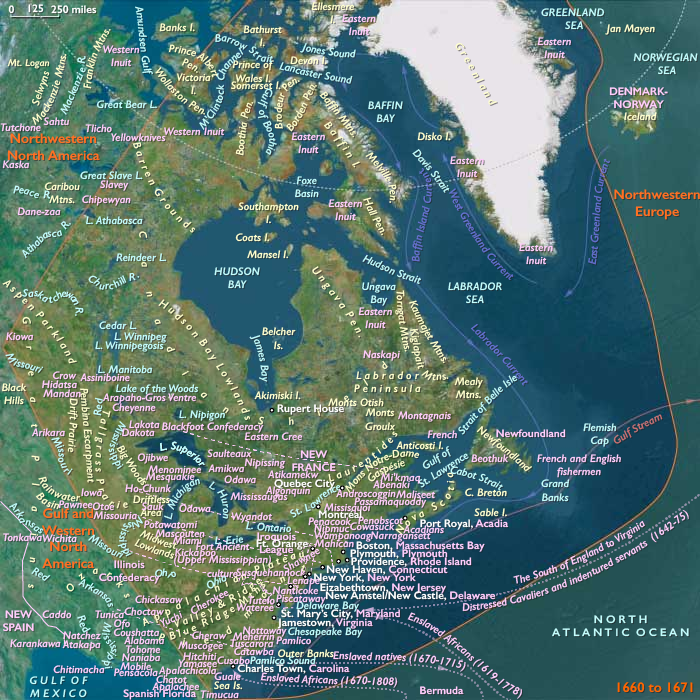
Servants in Virginia are restrained from "unlawful" …
Years: 1662 - 1662
Locations
Groups
- London Company, The (also called the Virginia Company of London)
- Virginia (English Crown Colony)
- England, (Stewart, Restored) Kingdom of
Topics
Commodoties
Subjects
Regions
Subregions
Related Events
Filter results
Showing 10 events out of 31131 total
Narai's reign, under the auspices of French Jesuits who are given permission to settle in Ayutthaya in 1662, will see the first concerted attempt to convert the monarch to Catholicism, although Catholic missions have been present in Ayutthaya as early as 1567 under Portuguese Dominicans. (The conversion attempt will ultimately fail and arguably backfire but Catholics are to remain in Siam up to the present day.)
Ferenc Rákóczi, unable to come by his father's legacy, had therefore withdrawn to his estates in Royal Hungary.
Notably, the Rákóczi family is Calvinist, and they are staunch supporters of the Calvinist cause.
However, Francis' mother, Zsófia Báthori, had come from a Catholic family, and had converted to Calvinism merely for the sake of her marriage, only to leave Calvinism, re-convert to Catholicism (disregarding her husband’s last wishes) and become a bulwark of Hungarian Counter-Reformation after her husband's death.
Ferenc also becomes a Catholic in 1662, thus acquiring favor with the Catholic Habsburg Court.
Negotiations had been started in 1661 to solve the issues concerning the education and future prospects of William III of Orange, which end in the treaty of 1662, in which the Dutch concede on most points.
Robert Boyle, a natural philosopher, chemist, physicist, inventor, and gentleman scientist, had read in 1657 of Otto von Guericke's air-pump.
Setting himself up with the assistance of Robert Hooke to devise improvements in its construction, and with the result, the "machina Boyleana" or "Pneumatical Engine", finished in 1659, he began a series of experiments on the properties of air.
An account of Boyle's work with the air pump had been published in 1660 under the title New Experiments Physico-Mechanicall, Touching the Spring of the Air, and its Effects....
Among the critics of the views put forward in this book is a Jesuit, Franciscus Linus (1595–1675), and it was while answering his objections that Boyle made his first mention of the law that the volume of a gas varies inversely to the pressure of the gas, which among English-speaking people is usually called after his name.
However, the person that originally formulated the hypothesis was Henry Power in 1661.
Boyle included a reference to a paper written by Power, but mistakenly attributed it to Richard Townley.
Although his research and personal philosophy clearly has its roots in the alchemical tradition, he is largely regarded today as the first modern chemist, and therefore one of the founders of modern chemistry.
Among his works, The Sceptical Chymist, published in London in 1661 in the form of a dialogue, is seen as a cornerstone book in the field of chemistry.
The Sceptical Chymist presents Boyle's hypothesis that matter consists of atoms and clusters of atoms in motion and that every phenomenon is the result of collisions of particles in motion.
He appeals to chemists to experiment and asserts that experiments deny the limiting of chemical elements to only the classic four: earth, fire, air, and water.
He also pleads that chemistry should cease to be subservient to medicine or to alchemy, and rise to the status of a science.
Importantly, he advocates a rigorous approach to scientific experiment: he believes all theories must be proved experimentally before being regarded as true.

Milton, established in 1662 as an independent town and named n honor of Milton Abbey, Dorset, England, had been settled in 1640 as "[T]hat part of the Town of Dorchester which is situated on the south side of the Neponsett River commonly called 'Unquatiquisset'."
The Iroquois make several raids in 1661 and 1662 against the Abenakis, who are traditional allies of the French. (One of them, Chief Assacumbuit, is declared a noble under the reign of Louis XIV.)
During the European colonization of North America, the land occupied by the Abenaki is in the area between the English colony of Massachusetts and the French colony of Quebec.
There is no agreement as to the boundaries for any of the parties.
The French Crown, seeing such danger in the heart of New France, orders a change to the governance of Canada, assembling a small military force made up of Frenchmen, Huron, and Algonquin to counter the Iroquois raids.
Venturing into the countryside, they are attacked by the Iroquois.
Only twenty-nine of the French survive and escape; five are captured and tortured to death by the Iroquois in retaliation for the attack.
The Iroquois, despite their victory, also suffer a significant number of casualties.
Their leaders begin to consider negotiating for peace with the French.
General-at-Sea William Penn and General Robert Venables had seized Jamaica in 1655 without orders in the name of Britain's Lord Protector Oliver Cromwell, seeking to make up for the disastrous failure of the mission Cromwell had assigned them: to seize Hispaniola.
Spanish resistance has continued for some years, in some cases with the help of the maroons, but Spain will ever succeed in retaking the island.
Under English rule Jamaica has become a haven of privateers, buccaneers, and occasionally outright pirates: Christopher Myngs, Edward Mansvelt, and most famously, Henry Morgan.
Myngs had earned a reputation for unnecessary cruelty during his actions as a commerce raider during the Anglo-Spanish War of 1654, sacking and massacring entire towns in command of whole fleets of buccaneers.
The Spanish government considers Myngs a common pirate and mass murderer, protesting to no avail to the Cromwell government about his conduct.
Because he had shared half of the bounty of his 1659 raid on Venezuela, about a quarter of a million pounds, with the buccaneers against the explicit orders of Edward D'Oyley, the English Commander of Jamaica, he had been arrested for embezzlement and sent back to England on the Marston Moor in 1660.
The later governor described him in an accompanying letter as "unhinged and out of tune".
The Restoration government has retained Myngs in his command however, and in August 1662 he is sent to Jamaica commanding the Centurion in order to resume his activities, despite the fact the war with Spain had ended.
This is part of a covert English policy to undermine the Spanish dominion of the area, by destroying as much as possible of the infrastructure.
Myngs decides that the best way to accomplish this is to employ the full potential of the buccaneers by promising them the opportunity for unbridled plunder and rapine.
He has the complete support of the new governor, Lord Windsor, who fires a large contingent of soldiers to fill Myngs's ranks with disgruntled men.
This year, ...
...Myngs attacks Santiago de Cuba and takes and sacks the town despite its strong defenses.
Kemény, with only ten thousand troops and weakened by the retirement of Austrian forces in the face of four Turkish armies ravaging Transylvania, dies on January 23, 1662, in the battle of Nagyszőllős.
The western part of the Hungarian Kingdom (Partium) is annexed and placed under direct Ottoman control, marking the greatest territorial extent of Ottoman rule in the former Hungarian Kingdom.
Years: 1662 - 1662
Locations
Groups
- London Company, The (also called the Virginia Company of London)
- Virginia (English Crown Colony)
- England, (Stewart, Restored) Kingdom of