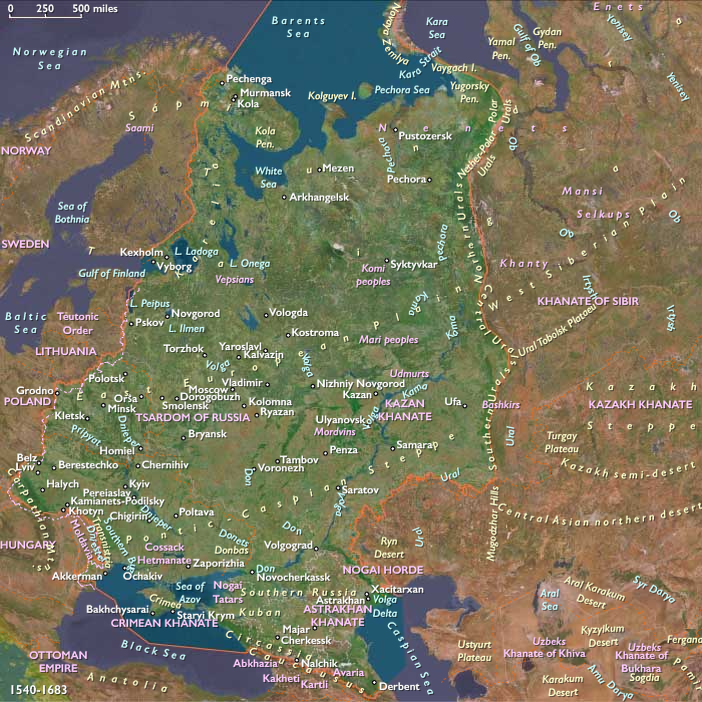
...a second Polish army (allied with the …
Years: 1655 - 1655
January
...a second Polish army (allied with the Tatars) crushes a Russian-Ukrainian contingent at Zhashkov.
Locations
People
Groups
- Crimean Khanate
- Cossacks, Zaporozhian
- Sweden, (second) Kingdom of
- Denmark-Norway, Kingdom of
- Russia, Tsardom of
- Polish-Lithuanian Commonwealth (Commonwealth of the Two Nations)
- Cossack Hetmanate of the Zaporozhian Host
Topics
Commodoties
Subjects
Regions
Subregions
Related Events
Filter results
Showing 10 events out of 31579 total
Charles Emmanuel II, Duke of Savoy, born in Turin to Victor Amadeus I, Duke of Savoy and Christine Marie of France, had succeeded to the duchy of Savoy at the age of four.
His mother had governed in his place, and even after reaching adulthood, Charles Emmanuel continues a life of pleasure, far away from the affairs of state.
The Waldensians, Waldenses or Vaudois, had arrived in the valley of Torre Pelice in the early thirteenth century.
The twenty-year-old Duke Charles Emmanuel commands the Vaudois in 1655 to attend Mass or remove to the upper valleys, giving them twenty days in which to sell their lands.
In a most severe winter, these targets of persecution, old men, women, little children and the sick "waded through the icy waters, climbed the frozen peaks, and at length reached the homes of their impoverished brethren of the upper Valleys, where they were warmly received."
Here they find refuge and rest.
The Duke, deceived by false reports of Vaudois resistance, sends an army.
On April 24, 1655, at 4 a.m., the signal is given for a general massacre, the horrors of which can be detailed only in small part.
The massacre is so brutal it arouses indignation throughout Europe.
Lord Protector Oliver Cromwell, ruling in England, begins petitioning on behalf of the Vaudois, writing letters, raising contributions, calling a general fast in England and threatening to send military forces to the rescue.
Sir Samuel Morland, commissioned with this task, will later write The History of the Evangelical Churches of the Valleys of Piemont (1658).
The massacre prompts John Milton's famous poem on the Waldenses, "On the Late Massacre in Piedmont".
Christ in the House of Martha and Mary, a painting finished in 1655 by the Dutch painter Johannes Reijniersz Vermeer, is today housed in the National Gallery of Scotland in Edinburgh.
Relatively little is known about Vermeer's life.
He seems to have been exclusively devoted to his art, living out his life in the city of Delft.
The only sources of information are some registers, a few official documents and comments by other artists; it was for this reason that Thoré Bürger named him "The Sphinx of Delft".
Johannes had been baptized on October 31, 1632, in the Reformed Church.
His father, Reijnier Janszoon, was a middle-class worker of silk or caffa (a mixture of silk and cotton or wool).
As an apprentice in Amsterdam, Reijnier had lived on fashionable Sint Antoniesbreestraat, then a street with many resident painters.
He had married Digna Baltus in 1615.
The couple had moved to Delft and had a daughter, Gertruy, who had been baptized in 1620.
Reijnier in 1625 had been involved in a fight with a soldier named Willem van Bylandt, who died from his wounds five months later; Reijnier began dealing in paintings around this time.
He had in 1631 leased an inn called "The Flying Fox" and in 1641 bought a larger inn on the market square, named after the Belgian town "Mechelen".
The acquisition of the inn constitutes a considerable financial burden.
When Vermeer's father died in October of 1652, Vermeer had assumed operation of the family's art business.
Johannes in April 1653 had married a Catholic girl named Catharina Bolenes (Bolnes); the blessing took place in a nearby and quiet village Schipluiden.
For the groom it is a good match: his mother-in-law, Maria Thins, is significantly wealthier than he, and it is probably she who had insisted Vermeer convert to Catholicism before the marriage on April 5.
It is unclear where and with whom Vermeer had apprenticed as a painter.
Speculation that Carel Fabritius may have been his teacher is based upon a controversial interpretation of a text written in 1668 by the printer Arnold Bon.
Art historians have found no hard evidence to support this.
Some scholars think Vermeer was trained under the Catholic painter Abraham Bloemaert.
Vermeer's style is similar to that of some of the Utrecht Carravagists, whose works are depicted as paintings-within-paintings in the backgrounds of several of his compositions.
In Delft Vermeer probably competes with Pieter de Hoogh and Nicolaes Maes who produce genre works in a similar style.
Vermeer had on December 29, 1653, become a member of the Guild of Saint Luke, a trade association for painters.
The guild's records make clear Vermeer did not pay the usual admission fee.
It was a year of plague, war and economic crisis; not only Vermeer's financial circumstances were difficult.
The city of Delft had in 1654, suffered the terrible explosion known as the Delft Thunderclap that destroyed a large section of the city, along with the home, studio, paintings and life of Fabritius.

The Polish Rider is a 1655 painting of a man traveling on horseback through a murky landscape, now in the Frick Collection in New York.
When the painting was bought by Henry Frick in 1910, there was consensus that the work was by seventeenth-century Dutch painter Rembrandt.
However, this attribution has since been contested.
There has also been debate over whether the painting was intended as a portrait of a particular person, living or historical, and if so of whom, or if not, what it was intended to represent.
The quality of the painting is generally agreed as is its slight air of mystery.
Parts of the background are very sketchily painted or unfinished.
Josua Bruyn, a member of the Rembrandt Research Project (RRP) in 1984, suggested that characteristics of the work of Willem Drost, a student of Rembrandt, could be observed in the painting.
The Polish Rider is unlike Rembrandt's other work in several ways.
In particular, Rembrandt rarely worked on equestrian paintings, the only other known portrait of a horseback rider in Rembrandt's work being that of Frederick Rihel.
A 1998 study published by the RRP concluded that another artist's hand, besides that of Rembrandt, was involved in the work.
Rembrandt started the painting in 1655; however, he left it unfinished and it was probably completed by someone else.
Vermeer's mother-in-law, Maria Thins, owns Dirck van Baburen's 1622 oil-on-canvas Procuress (or a copy of it), which appears in the background of two of Vermeer's paintings.
The same subject is also painted by Vermeer.
In his The Procuress, painted around 1655, the figure on the left has been called Vermeer's self portrait.
Fine hundred Iroquois die suddenly from an epidemic of smallpox, a European infectious disease to which they have no immunity, in 1655.
The Iroquois had invited the French to establish a trading and missionary settlement at Onondaga (present-day New York state) in 1654.
The Mohawk in the following year attack and expel the French from this trading post, possibly because of the smallpox deaths.
The Iroquois launch a similar attack against the Erie in 1654 but with less success.
The Erie, or Nation of the Cat, an Iroquoian group of Native Americans, live from western New York to northern Ohio on the south shore of Lake Erie.
In the competition in the fur trade, the Erie have alienated the surrounding tribes by encroaching on their territories.
They have also angered their eastern neighbors, the League of the Iroquois, by accepting refugees from Huron villages that had been destroyed by the Iroquois.
Though rumored to use poison-tipped arrows (Jesuit Relations 41:43, 1655-58 chap. XI), the Erie are disadvantaged in armed conflict by having few firearms (if the Erie tribe did use poison on their arrows, it would make them the only tribe in North America to do so.)
The Erie territory in 1650 is estimated to have twelve thousand members.
A series of grants had been made in late 1654 for tracts "achter de Kol" or Achter Col at Pamrapo and Minkakwa.
The colony grows and the situation remains relatively peaceful until 1655, when Pavonia is attacked by a united band of about five hundred Lenape.
One hundred settlers are killed.
One hundred and fifty are taken hostage and held at Paulus Hook until their release can be negotiated.
This incident is known as the Peach Tree War, and is said to have been precipitated by the killing of a young woman who had stolen a peach from settler's orchard on Manhattan, but may have been a retaliation for the Dutch attack on the Lenapes' trading partners on the Delaware Bay in New Sweden.
Common sources of friction between Dutch settlers and the Esopus include settlers' livestock trampling native cornfields, disputes over trade, and the adverse effects of Dutch brandy on the Native Americans.
Prior to the Europeans' arrival, they had no experience with liquor.
Sheremetev and Khmelnitsky rout the Poles at Akhmatov in January 1655, while ...
Pascal, his belief and religious commitment revitalized, in January 1655 visits the older of two convents at Port-Royal for a two-week retreat.
He will regularly travel for the next four years between Port-Royal and Paris.
It is at this point, immediately after his conversion, that he begins writing his first major literary work on religion, the Provincial Letters, set in the conflict between Jansenists and Jesuits.
In this year, he also writes an important treatise on the arithmetic of triangles.
Years: 1655 - 1655
January
Locations
People
Groups
- Crimean Khanate
- Cossacks, Zaporozhian
- Sweden, (second) Kingdom of
- Denmark-Norway, Kingdom of
- Russia, Tsardom of
- Polish-Lithuanian Commonwealth (Commonwealth of the Two Nations)
- Cossack Hetmanate of the Zaporozhian Host