
A quarter century after its development, Australian …
Years: 1936 - 1947
A quarter century after its development, Australian medical authorities finally accept nurse Elizabeth Kenny’s muscle retraining program for paralyzed polio victims.
Related Events
Filter results
Showing 10 events out of 6145 total
Corporatist governments arise in Greece, under Prime Minister Metaxas, who models his regime on the fascist governments of Germany’s Adolf Hitler and Italy’s Benito Mussolini, and in Romania, where King Carol, am admirer of Mussolini, proclaims a corporatist dictatorship to counter the growing political menace of the principal national Fascist group, the Iron Guard.
Carol eventually proclaims a royal dictatorship, similar to those already in place in Albania, Bulgaria, and Yugoslavia.
The Second World War, having as its dress rehearsal the Spanish Civil War, begins in earnest with the Russo-Soviet dismemberment of Poland and quickly engulfs the Balkans.
Resistance organizations soon appear in the Balkan countries, as elsewhere, but the resistance is by no means a unified movement.
Rival organizations form, and in several countries deep divisions exist between communist and noncommunist groups.
Initially, the communists take a pacifist line, but, after Germany's invasion of the Soviet Union in June 1941, they join the underground and in some areas become dominant in it.
In Yugoslavia, the Serbian nationalist Chetniks under Dragoljub Mihailovic and the communist Partisans under Josip Broz Tito fight each other as well as the Germans, and the two major Greek resistance organizations, one nationalist and one communist, are unable to cooperate militarily against the Germans.
The Allies expect in 1945 that a benign Soviet Union will continue the wartime alliance through the period of postwar East European realignment.
Continued fighting in Greece among rival resistance organizations after the end of the German occupation morphs into the Greek Civil War.
North Polynesia (1936–1947 CE)
Economic Recovery and Wartime Transformation
From 1936 to 1947, North Polynesia, primarily the Territory of Hawaii, experienced significant economic recovery and transformation, largely driven by the demands of World War II. The previously struggling sugar and pineapple industries rebounded strongly as wartime conditions boosted demand for these essential foodstuffs. Additionally, increased military spending brought significant economic opportunities to the islands, supporting broader employment and industry growth.
Impact of World War II and Military Significance
The strategic importance of North Polynesia, particularly Pearl Harbor, reached a historic peak with the onset of World War II. On December 7, 1941, the surprise attack by Japan on Pearl Harbor dramatically altered the islands' role in global affairs, thrusting them into the center of American wartime strategy. The attack led to significant loss of life and considerable destruction of naval and military assets, prompting the United States' entry into the war.
Mobilization and Military Infrastructure Development
The immediate aftermath of the Pearl Harbor attack saw rapid militarization and massive expansion of military infrastructure. New airfields, naval bases, barracks, hospitals, and fortifications were constructed throughout the islands. The military population surged, significantly reshaping local demographics, economy, and daily life as thousands of troops and defense workers arrived.
Civil Liberties and Wartime Restrictions
Wartime conditions led to substantial restrictions on civil liberties, particularly affecting Hawaii's large Japanese-American population. While internment was less widespread in Hawaii than on the U.S. mainland, many Japanese Americans experienced curfews, surveillance, and restrictions on travel and employment. Despite this, many Japanese Americans demonstrated loyalty and patriotism by enlisting in large numbers, notably serving with distinction in the highly decorated 442nd Regimental Combat Team.
Social and Labor Shifts
The wartime economy prompted significant labor shifts, as military demand led to expanded employment opportunities for women and minorities, marking a substantial social transformation. Filipino, Japanese, Portuguese, and Hawaiian laborers continued to seek improved working conditions, and wartime conditions accelerated labor organization and unionization efforts.
Cultural Preservation Amidst Change
Cultural preservation remained important, even amidst wartime disruptions. Efforts continued to sustain traditional Hawaiian cultural practices, though resources and attention were often diverted by wartime priorities. Nonetheless, the era witnessed increased recognition of Hawaiian identity, partly as a response to the intense American military presence and cultural assimilation pressures.
Postwar Adjustments and Economic Diversification
The immediate postwar period, from 1945 to 1947, brought substantial adjustments to the islands' economy and society. The decline in military spending required a transition toward economic diversification, emphasizing tourism, construction, and a reinvigoration of agricultural industries beyond sugar and pineapple. Federal programs and investment played crucial roles in facilitating this economic shift.
Educational and Social Reforms
Educational initiatives increasingly emphasized a balanced approach, integrating both American education standards and local Hawaiian cultural heritage. Public health services continued to improve significantly, notably driven by wartime advances in medicine, sanitation, and hospital infrastructure, resulting in better overall health outcomes.
Political Developments and Calls for Statehood
The wartime experience accelerated the political maturation of North Polynesia, heightening awareness of its geopolitical importance and intensifying demands for greater political representation and autonomy. This period laid the critical groundwork for Hawaii's future statehood campaign, setting the stage for intensified political activism and negotiations with the U.S. federal government.
Conclusion of the Era
Between 1936 and 1947, North Polynesia underwent transformative changes spurred by wartime exigencies and postwar adjustments. The experiences and adaptations during this period significantly influenced the region’s economic, social, and political trajectory, preparing it for its pivotal role in subsequent decades, notably its eventual admission as a state of the United States.
Almost all of the Japanese-held island groups become United States Trust Territories after the war.
The US establishes the Trust Territory of the Pacific Islands, which covers some three million square miles of Micronesia, in 1947.
Its four constituent jurisdictions will eventually become the Republic of Palau, the Republic of the Marshall Islands, the Commonwealth of the Northern Marianas and the Federated States of Micronesia.
Japan’s attack on the American fleet at Pearl Harbor brings the formerly isolationist United States into the war on the side of the Allies.
Japan conquers most of the islands of the western Pacific.
The US Navy halts Japan’s advance at the battles of Midway and the Coral Sea; US troops fight the Japanese at New Guinea and Guadalcanal.
Menzies, now out of office, integrates free enterprise ideology into the philosophy of the Australian Liberal party (ALP).
Australian novelist Christina Stead, writing of family situations as they affect women, follows 1940s “The Man Who Loved Children” with her 1944 publication of “For Love Alone.”
Australian artist Sidney Nolan establishes his reputation in 1946 - 47 with a series of folkloric paintings based on the life of outlaw Ned Kelly.
Of the tens of thousands of Australian soldiers sent to serve overseas in the Second World War, more than half are killed or wounded in action.
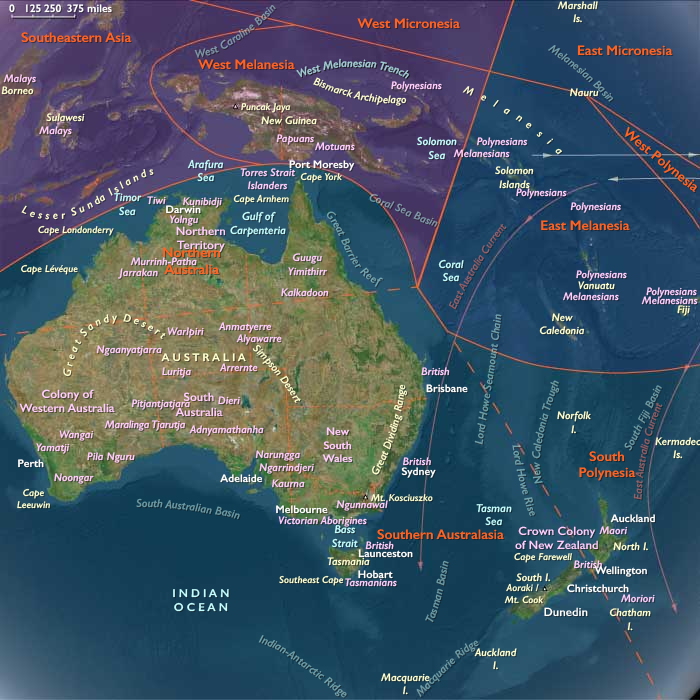
The Japanese army bombs Darwin, Broome and several other northern Australian towns.