A quarrel seems to have arisen in …
Years: 722 - 722
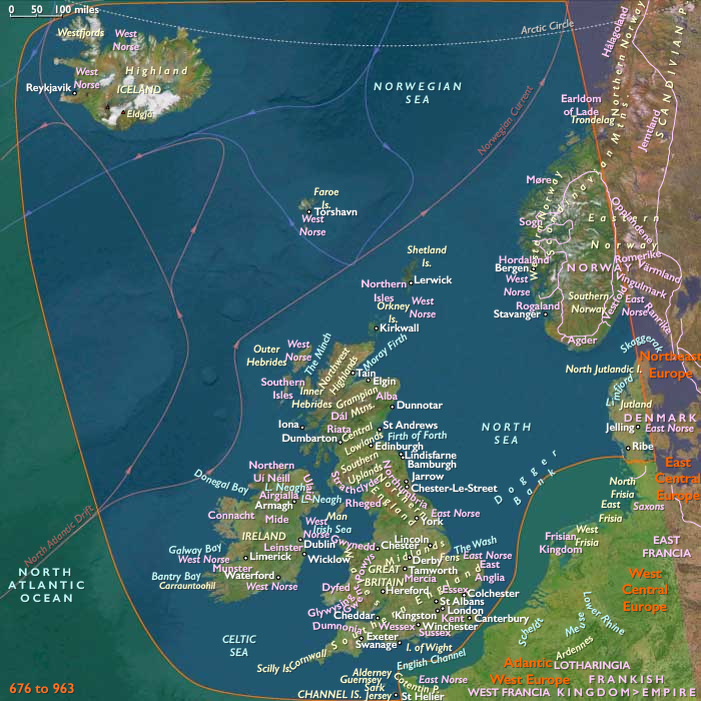
A quarrel seems to have arisen in the royal family of Wessex.
Ine had slain one Cynewulf in 721 and in 722 his queen Æthelburg destroys Taunton, which her husband had built earlier in his reign.
The South Saxons, previously subject to Ine, rise against him under the exile Aldbryht, who may have been a member of the West Saxon royal house.
Locations
People
Groups
- Saxons
- Anglo-Saxons
- Sussex, Kingdom of
- Wessex, English Kingdom of
- Mercia, Kingdom of
- Britain, Medieval
Topics
Subjects
Regions
Subregions
Related Events
Filter results
Showing 10 events out of 55603 total
King Seongdeok had ordered the construction of a great wall across Silla‘s northern border in 721, remnants of which can still be seen in what is today South Hamgyǒng province, North Korea.
Plagued as well by the raids of Japanese pirates along the southern coast, the following year (and quite likely with the same laborers) Seongdeok also has a large fortress erected near the capital of Gyeongju that extends ten kilometers in circumference.
According to the Samguk Yusa, a thirteenth century Korean record of history and fable that deals with the period in question, the fortress (known as Mobeol prefectural fortress) required the labor of nearly 40,000 men, a massive mustering of manpower that is testimony of the increasing power of the centralized monarchy.
The reign of Seongdeok also bears evidence of continued attempts at reforming the land system of Silla.
The dispersal of “able–bodied land” is first mentioned as taking place in the twenty–first year of King Seongdeok (722).
The exact nature of able–bodied land is disputed since almost no corroborating evidence remains.
However, based on the title, it would seem to be land distributed to able bodied commoners, though whether to work or own outright is unclear.
In any case, whatever its precise nature, it would appear to be an attempt to buttress royal authority by nurturing relations with the peasantry at the expense of the landholding aristocracy.
The most important new development in Xuanzong's reign is the growth in the power of the military commanders.
During Gaozong's reign the old militia system had proved inadequate for frontier defense and had been supplemented by the institution of permanent armies and garrison forces quartered in strategic areas on the frontiers.
These armies were made up of long-service veterans, many of them non-Chinese cavalry troops, settled permanently in military colonies.
Although these armies were adequate for small-scale operations, for a large-scale campaign an expeditionary army and a headquarters staff had to be specially organized and reinforcements sent in by the central government.
This cumbersome system was totally unsuitable for dealing with the highly mobile nomadic horsemen on the northern frontiers.
At the beginning of Xuanzong's reign the Turks had threatened to become again a major power, rivaling China in Central Asia and along the borders.
Mo-ch'o, the Turkish khan who had had invaded Hopeh in the aftermath of the Khitan invasion in the time of Wu-hou and had attacked the Chinese northwest at the end of her reign, had turned his attention northward.
By 711 he had controlled the steppe from the Chinese frontier to Transoxiana and appeared likely to develop a new unified Turkish empire but his flimsy empire had collapsed with his murder in 716.
His successor, Bilge, had assumed leadership of the T'u-chüeh, a tribe of Turks in control of southern Central Asia, when his brother instigated a palace coup against the old ruler.
Bilge had tried to make peace with the Chinese in 718, but Xuanzong had preferred to try to destroy his power by an alliance with the southwestern Basmil Turks and with the Khitan in Manchuria.
Bilge, however, had crushed the Basmil and attacked Kansu in 720, forcing the Chinese to sue for peace, which is established in 721–722.
(Bilge is even better known, however, for advising his successors that the power of the Turks comes from their nomadic life and that to settle in agricultural communities on the Chinese border would weaken them.)
Leo’s military achievements, which have earned him great popularity with his soldiers and the people, may give him the confidence to pursue his religious policies forcefully.
He not only holds firm religious opinions but he also has a profound belief in his duty as emperor to implement them as he understands them.
Having only narrowly defeated the Arab army at the gates of his capital, he ascribes the weakness of his empire to its heterogeneous population and in 722, he orders the forcible baptism of Jews and Montanists (a Christian heretical group), as well as those known as the “New Christians”.
Most of them convert outwardly while secretly adhering to their original faith.
Leo personally investigates but does not prosecute adherents of the Paulician heresy.
The Battle of Covadonga (722 CE) and the Birth of Christian Resistance
In 722 CE, the Umayyads send a military force under the command of Al Qama and Munuza, accompanied by Bishop Oppas of Seville, the brother of former Visigothic King Witiza, to suppress the Asturian resistance.
As Al Qama advances through Asturias, Oppas attempts to negotiate the surrender of his fellow Christians but fails. Meanwhile, Pelagius (Pelayo) and his small force retreat into the Asturian mountains, choosing a narrow valley flanked by steep cliffs as their defensive position, where a broad-fronted attack would be impossible.
Pelagius' army may have been as small as 300 men, yet they held a tactical advantage in the mountainous terrain.
The Battle of Covadonga
Upon reaching Covadonga, Al Qama sends an envoy demanding Pelagius' surrender, but Pelagius refuses. In response, Al Qama orders his elite troops into the valley to crush the resistance.
However, the Asturians, hidden in the mountain slopes, ambush the Umayyad forces, raining projectiles down from above. At the critical moment, Pelagius and a concealed unit—hiding in a cave—surge forward into the valley, catching the Umayyad forces by surprise.
According to Christian sources, the Muslims suffer heavy casualties, and Al Qama himself is killed. The remaining soldiers flee, only to be pursued and slaughtered by armed villagers emerging from nearby settlements.
Munuza’s Last Stand and the Aftermath
After learning of Al Qama's defeat, Munuza regroups with surviving forces and organizes another attack. However, at a later battle, near modern-day Proaza, he is once again defeated by Pelagius. Munuza may have been killed in the fighting, marking the final failure of Umayyad efforts to suppress Asturian resistance.
While Umayyad sources dismiss the battle as a minor skirmish, referring to Pelagius' men as “thirty infidels left, what can they do?”, Muslim forces never again seriously challenge the independence of the Kingdom of Asturias.
The victory at Covadonga is later commemorated at the shrine of Our Lady of Covadonga, and it is regarded as the first Christian victory over Muslim forces in Iberia, symbolizing the beginning of the Reconquista—the long process of Christian reclamation of Spain.

The Dux et Princeps Francorum: Military Commanders in Charles Martel’s Francia
Under the reorganization of Francia by Charles Martel, the title dux et princeps Francorum signifies not only an administrative role as Mayor of the Palace but also the supreme command of the Frankish armies. This position effectively consolidates military and governmental power, ensuring that Francia remains under the firm control of its ruling warlords rather than the nominal Merovingian monarchy.
One of Charles’s most significant military reforms is the creation of a standing guard, a force he begins maintaining year-round after his victory at Toulouse in 721. This development marks a critical shift in Frankish military organization, as the Franks traditionally relied on seasonal levies for warfare. By instituting a permanent, professionalized military force, Charles strengthens Frankish defenses, ensuring rapid response to both external threats and internal revolts.
The role of dux et princeps Francorum thus evolves into one of absolute military authority, with its holders acting as both strategists and administrators, leading the armies of the kingdom while overseeing the governance of the realm. This structure not only enhances the effectiveness of the Frankish war machine but also paves the way for the militarized rule that will define the Carolingian era.
In 722 also, the Cornish defeat the advancing West Saxons at a river identified as the Hehil.
Maya building projects and expansion reach a peak in this era, as revealed by archaeological evidence, with constant enlargement and building, the majority of the burden of construction being placed on peasant workers in the cities.
The Maya city-state of Palenque had been sacked in 711 by the realm of Toniná, and the old king K'inich K'an Joy Chitam II had been taken prisoner.
It is not known what the final destination of the king was, and it is presumed that he was executed in Toniná.
For the past ten years there has been no king in Palenque until K'inich Ahkal Mo' Naab III finally takes the throne on January 3, 722.
Although the new king belonga to the royalty, there is no certainty that he is a direct descendant of K'inich K'an Joy Chitam II.
It is believed, therefore, that this coronation is a break in the dynastic line; and probably K'inich Ahkal Nab' has arrived to power after years of maneuvering and forging political alliances.
Tang dynasty astronomer, mathematician, and Buddhist monk Yi-xing and government official Liang Ling-zan combine Zhang Heng's water-powered celestial globe with an escapement device in 723.
The result is allegedly the world's first water powered mechanical clock.
Yi-xing has also calculated the number of possible positions on a go board, though without a sign for zero he has difficulties expressing the number.
Usa, a city in modern Oita ken (prefecture), northern Kyushu, Japan, begins to develop around the site of the first and most famous of shrines dedicated to the Shinto god Hachiman, Usa Hachiman Shrine, which dates to about 717–724.
The taxation system that had been introduced in Japan by Empress Jitō in the late seventh century has begun to malfunction.
To motivate new cultivation and compensate for decrease of tax revenue, an initiative passed in 723 by Prince Nagaya allows people to possess the fields newly placed under cultivation for a maximum of three generations.
In the fourth generation, the right of possession is to transfer to the national government.
Years: 722 - 722
Locations
People
Groups
- Saxons
- Anglo-Saxons
- Sussex, Kingdom of
- Wessex, English Kingdom of
- Mercia, Kingdom of
- Britain, Medieval