
Filters:
Frederick William II's attitude towards the army …
Years: 1791 - 1791
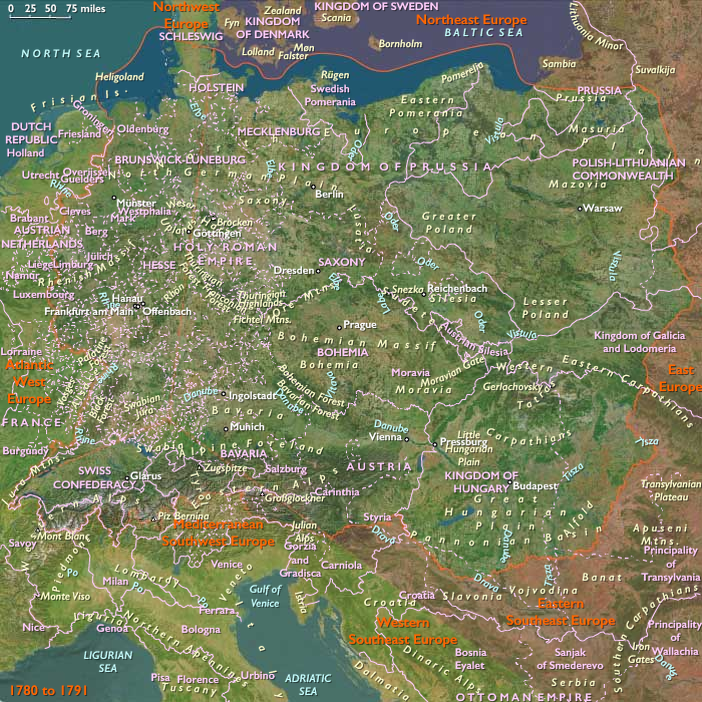
Frederick William II's attitude towards the army and foreign policy is far more fateful for Prussia.
The army is the very foundation of the Prussian state, a truth that both Frederick William I and Frederick the Great had fully realized; the army had been their first care, and its efficiency had been maintained by their constant personal supervision.
The king, who has no taste for military matters, had put his authority as "Warlord" (Kriegsherr) into commission under a supreme college of war (Oberkriegs-Collegium) under the Duke of Brunswick and General Wichard Joachim Heinrich von Möllendorf.
It is the beginning of the process that will end in 1806 at the disastrous Battle of Jena.
Although the Prussian army will reach its highest peacetime level of manpower under Frederick William (one hundred and eighty-nine thousand infantry and forty-eight thousand cavalry), under his reign the Prussian state treasury incurs a substantial debt and the quality of the troops' training deteriorates.
Under the circumstances, Frederick William′s interventions in European affairs are of little benefit to Prussia.
The Dutch campaign of 1787, entered into for purely family reasons, had indeed been successful, but Prussia had received not even the cost of her intervention.
An attempt to intervene in the war of Russia and Austria against the Ottoman Empire fails to achieve its objective; Prussia does not succeed in obtaining any concessions of territory, and the dismissal of minister Hertzberg (July 5, 1791) marks the final abandonment of the anti-Austrian tradition of Frederick the Great.
Meanwhile, the French Revolution alarms the ruling monarchs of Europe, and in August 1791 Frederick William, at the meeting at Pillnitz Castle, agrees with Emperor Leopold II to join in supporting the cause of King Louis XVI of France.
However, the king's character and the confusion of the Prussian finances cannot sustain effective action in this regard.
The army is the very foundation of the Prussian state, a truth that both Frederick William I and Frederick the Great had fully realized; the army had been their first care, and its efficiency had been maintained by their constant personal supervision.
The king, who has no taste for military matters, had put his authority as "Warlord" (Kriegsherr) into commission under a supreme college of war (Oberkriegs-Collegium) under the Duke of Brunswick and General Wichard Joachim Heinrich von Möllendorf.
It is the beginning of the process that will end in 1806 at the disastrous Battle of Jena.
Although the Prussian army will reach its highest peacetime level of manpower under Frederick William (one hundred and eighty-nine thousand infantry and forty-eight thousand cavalry), under his reign the Prussian state treasury incurs a substantial debt and the quality of the troops' training deteriorates.
Under the circumstances, Frederick William′s interventions in European affairs are of little benefit to Prussia.
The Dutch campaign of 1787, entered into for purely family reasons, had indeed been successful, but Prussia had received not even the cost of her intervention.
An attempt to intervene in the war of Russia and Austria against the Ottoman Empire fails to achieve its objective; Prussia does not succeed in obtaining any concessions of territory, and the dismissal of minister Hertzberg (July 5, 1791) marks the final abandonment of the anti-Austrian tradition of Frederick the Great.
Meanwhile, the French Revolution alarms the ruling monarchs of Europe, and in August 1791 Frederick William, at the meeting at Pillnitz Castle, agrees with Emperor Leopold II to join in supporting the cause of King Louis XVI of France.
However, the king's character and the confusion of the Prussian finances cannot sustain effective action in this regard.
Locations
People
Groups
- Jews
- Christians, Roman Catholic
- Unity of the Brethren (Moravians)
- Lutheranism
- Calvinists
- Mennonites
- Prussia, Kingdom of
Subjects
Regions
Subregions
Years: 1791 - 1791
Locations
People
Groups
- Jews
- Christians, Roman Catholic
- Unity of the Brethren (Moravians)
- Lutheranism
- Calvinists
- Mennonites
- Prussia, Kingdom of
Subjects
Regions
Subregions