A pair of inscriptions in Ge'ez have …
Years: 325 - 325
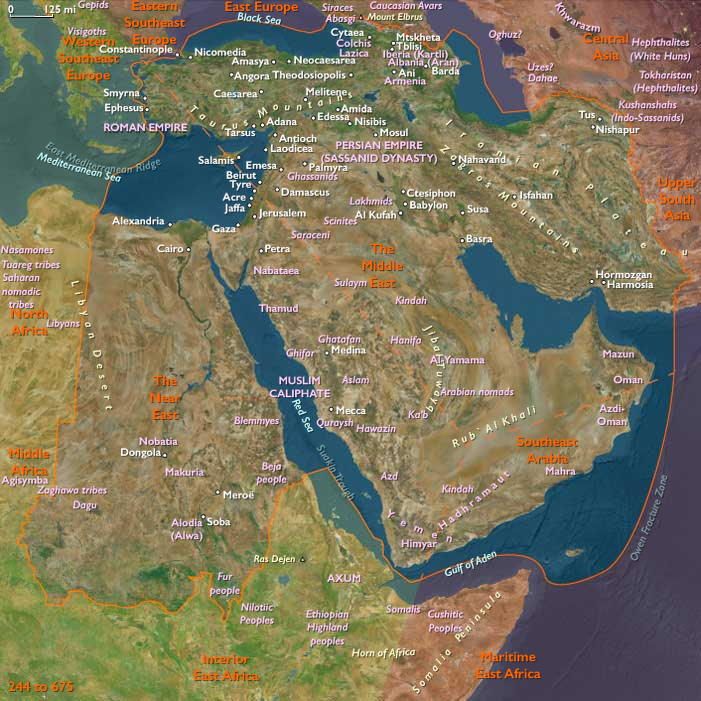
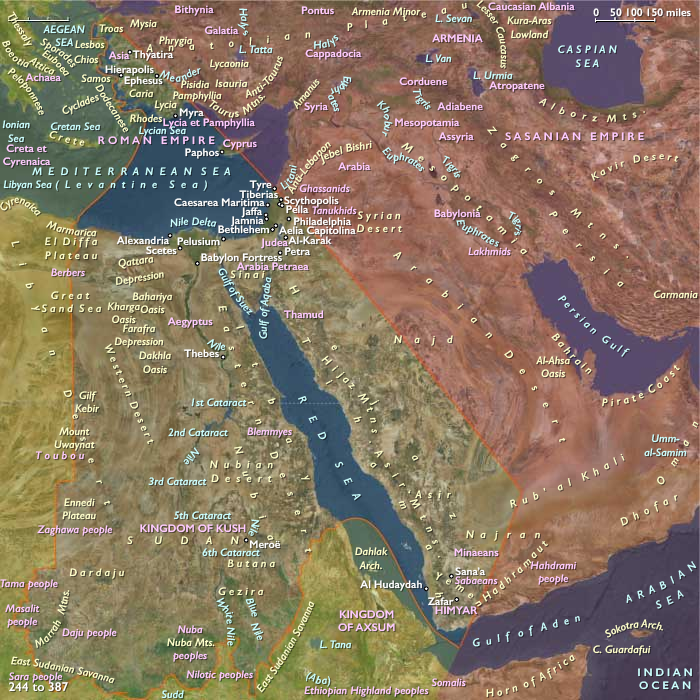
A pair of inscriptions in Ge'ez have been found at Meroe, which is understood as evidence of a campaign in the fourth century, either during 'Ezana's reign, or by a predecessor like Ousanas.
While some authorities interpret these inscriptions as proof that the Axumites destroyed the Kingdom of Kush, others note that archaeological evidence points to an economic and political decline in Meroe around 300.
Locations
Groups
Topics
Commodoties
Subjects
Regions
Subregions
Related Events
Filter results
Showing 10 events out of 59920 total
Constantine, now sole emperor of East and West, had in 324 made Byzantium the official capital of Roman Empire.
(There is no evidence that the city’s title of Nova Roma, or New Rome, was actually used for official purposes in Constantine's own time).
By this time, Constantine, who has on several occasions granted special privileges to individual churches and bishops, now openly embraces Christianity.
The Lakhmid Kingdom had been founded by the Lakhum tribe that emigrated from Yemen in the seconnd century and ruled by the Banu Lakhm, hence the name given it.
The founder of the dynasty was 'Amr, whose son Imra' ul-Qays (not to be confused with the famous poet Imru' al-Qais who lived in the sixth century) is claimed to have converted to Christianity according to Western authors.
Imra' ul-Qays dreams of a unified and independent Arab kingdom and, following that dream, had seized many cities in Arabia.
He had then formed a large army and developed the Kingdom as a naval power, which consists of a fleet of ships operating along the Bahraini coast.
From this position he has attacked the coastal cities of Persia—which at that time was in civil war due to a dispute as to the succession—even raiding the birthplace of the Sassanid kings, the province of Pars (Fars).
The Persians, led by Shapur II, had initiated a campaign against the Arab kingdom in 325.
When Imra' ul-Qays realizes that a mighty Persian army composed of sixty thousand warriors is approaching his kingdom, he asks for the assistance of the Roman Empire, but no help comes from that quarter.
The Persians advance toward al-Hirah and a series of vicious battles takes place over al-Hirah and the surrounding cities.
Shapur crushes the Lakhmid army and captures al-Hirah, then orders the extermination of its population in retaliation for their raids on Pars.
In this, the young Shapur acts much more violently than is customary at this time in order to demonstrate to the Arab Kingdoms and the Persian nobility his power and authority.
Shapur's title in Arabic is Zol 'Aktaf, meaning the one who pierces shoulders, as he did this with some of his captives.
He installs Aus ibn Qallam and gives the city autonomy, thus making the kingdom a buffer zone between the Persian Empire and the territory of other Arabs in the Peninsula.
Imra' ul-Qays escapes to Bahrain, taking his dream of a unified Arab nation with him.
Constantine, after his victory over Licinius in 324, writes that he has come from the farthest shores of Britain as God's chosen instrument for the suppression of impiety, and in a letter to the Persian king Shapur II he proclaims that, aided by the divine power of God, he has come to bring peace and prosperity to all lands.
The Arian heresy, with its intricate explorations of the precise nature of the Trinity that are couched in difficult Greek, is as remote from Constantine's educational background as it is from his impatient, urgent temperament.
In a letter to the chief protagonist, Arius of Alexandria, Constantine states his opinion that the dispute had been fostered only by excessive leisure and academic contention, that the point at issue is trivial and can be resolved without difficulty.
Egris, known to the ancient Greeks and Romans as Lazica and to Persians as Lazistan, is an early western Georgian kingdom in the South Caucasus, which flourishes between the sixth century BCE and the seventh century CE.
It covers the territory of the former kingdom Kolkha (Colchis) and the territory of modern day Abkhazia.
Throughout its existence it has been primarily a strategic vassal kingdom of the Eastern Roman Empire, occasionally coming under the Sassanid Persian rule.
At some point in the early fourth century CE, the Christian Eparchy or bishopric of Pitiunt (Bichvinta in Georgian) is established in this kingdom.
In 325, among the participants of the First Council of Nicaea is the Bishop of Pitiunt, Stratophilus.
Hosius convokes another synod, one of Syrian bishops, at Antioch.
Both this synod and the one held simultaneously at Alexandria condemn Arius and his followers.
Iamblichus, born at Chalcis (modern Quinnesrin) in Syria, is the chief representative of Assyrian Neoplatonism, though his influence has spread over much of the known world.
Having founded his own school at Apameia (near Antioch) in about 304, he has interpreted Plotinus' and Porphyry's systems of emanations in a mystic and religious sense, rather than an aesthetic or logical sense.
Breaking from Plotinus in his espousal of a level of "ideal numbers" between The One and Mind, Iamblichus has added many levels of Being, arranged triadically, with two extremes and a connecting mean, each level inhabited by gods or demons who mediate between higher and lower orders.
Differing also from Porphyry, Iamblichus maintains that proper religious observance (theurgy) is a virtue higher than that of the intellect and one that can sway the benevolent gods and repel the evil demons.
Called "the divine" by Neoplatonists, Iamblichus dies in 325, leaving several works including Life of Pythagoras; a treatise, On the Egyptian Mysteries; and an essay, The Community of the Mathematical Sciences, as well as (lost) commentaries on Plato and Aristotle.
Arianism by the 320s has become so widespread in the Christian church and spurred such disunity that Constantine, prompted by Hosius, convokes the Council of Nicaea in May 325, the first ecumenical council held by the church, meant to settle the relationship between the persons of the Trinity. (This is not Constantine's first attempt to reconcile orthodox and heretical factions in Christianity, but it is his first use of the imperial office to impose a settlement.)
A lengthy and heated debate ensues among the attendees, nearly all of whom come from the eastern Mediterranean region.
Athanasius may have accompanied Alexander to Nicaea, who, called as a theological expert, leads the council in defending the unity of Christ as both God and man, promoting his “homoousios” ("of one substance") doctrine to establish the full divinity and equality of Christ with the Father, as against the Arian position of “homoiousios” ("of like substance").
Eusebius of Caesarea, having become embroiled in the controversy raised by Arianism over the nature of the Trinity, seeks to reconcile the opposing parties.
Not naturally a spiritual leader or theologian, but as a very learned man and a famous author who enjoys the special favor of the emperor, he comes to the fore among the three hundred members of the council and is prominent in its transactions.
The confession that he proposes becomes the basis of the formula approved at Nicaea, which Eusebius, although disinclined to fully support the “homoousios” doctrine propounded by Alexander and Athanasius, eventually signs, largely in deference to Constantine.
The council issues a decision, formalized in the Nicene Creed, declaring that God the Father and God the Son, or Christ, are of one identical and eternal substance.
The Arian belief in a Christ created by and thus inferior to the Father is thus deemed heretical, and Arius himself is excommunicated and banished.
The Nicaean Creed simultaneously rejects Monarchianism (the belief that God the creator is supreme but shared his power with Christ, the logos or Word) and Sabellianism, or Modalism (the belief that the three persons of the Trinity are modes or aspects of the same God).
The council also makes disciplinary decisions concerning the status and jurisdiction of the clergy in the early church and establishes the date on which Easter is to be celebrated.
Hosius is influential in securing the inclusion in the Nicene Creed of the key word homoousios, to affirm that God the Son and God the Father are of the same substance.
The Council, which represents the first stage in the rigidification of Christianity, officially changes the date of Easter from Passover and forbids Jews from owning Christian slaves or converting pagans to Judaism.
In this year also, Constantine outlaws gladiatorial combat in the Roman Empire.
Those who were condemned to become gladiators for their crimes are to work from now on in the mines.

Axum's growth during the second and third centuries as a trading empire had increasingly impinged on the power of the Kushite Kingdom of Meroë, the fall of which is brought about in the fourth century by an Axumite invasion, probably under Ella-Amida, whose reign ends with his death between about 320 and 325.
Tradition states that 'Ezana succeeded his father Ella Amida (Ousanas) while still a child and his mother, Sofya served as regent.
Eusebius had been in Caesarea Maritima when Agapius was bishop and become friendly with Pamphilus of Caesarea, with whom he seems to have studied the text of the Bible, with the aid of Origen's Hexapla and commentaries collected by Pamphilus, in an attempt to prepare a correct version.
Pamphilus had been imprisoned in 307 but Eusebius continued their project.
The resulting defense of Origen, in which they had collaborated, had been finished by Eusebius after the death of Pamphilus in 309 and sent to the martyrs in the mines of Phaeno in Egypt.
Eusebius then seems to have gone to Tyre and later to Egypt, where he first suffered persecution.
Next heard of as bishop of Caesarea Maritima, he had succeeded Agapius, whose time of office is not known, but Eusebius must have become bishop soon after 313.
Nothing is known about the early years of his tenure.
Eusebius recounts early Christian history in his Chronicle, which, as preserved extends to the year 325.
Describing the development of the church in his Ecclesiastical History, which he begins around this time, he takes a historical approach in his attempt to explain the association of Christianity with the Roman Empire.
Alexander had subsequently excommunicated Arius, who had begun to elicit the support of many bishops who agreed with his position.
Support for Arius from powerful bishops like Eusebius of Caesarea and Eusebius of Nicomedia further illustrate the extent to which other Christians in the Empire share Arius' subordinationist Christology.
Arianism affirms that Christ is not truly divine but a created being.
Arius' basic premise is the uniqueness of God, who is alone self-existent and immutable; the Son, who is not self-existent, cannot be God.
The Godhead, because it is unique,cannot be shared or communicated, so the Son cannot be God.
Because the Godhead is immutable, the Son, who is mutable, being represented in the Gospels as subject to growth and change, cannot be God.
The Son must, therefore, be deemed a creature who has been called into existence out of nothing and has had a beginning.
Moreover, the Son can have no direct knowledge of the Father since the Son is finite and of a different order of existence.
Arius' teaching according to its opponents, reduces the Son to a demigod, reintroduces polytheism (since worship of the Son is not abandoned), and undermines the Christian concept of redemption since only he who was truly God could be deemed to have reconciled man to the Godhead.
Hosius, sent in 324 by Constantine as imperial emissary to the East to settle the Arian dispute, convokes a synod at Alexandria of Egyptian bishops.