
A monarch of central Java’s wealthy and …
Years: 796 - 807
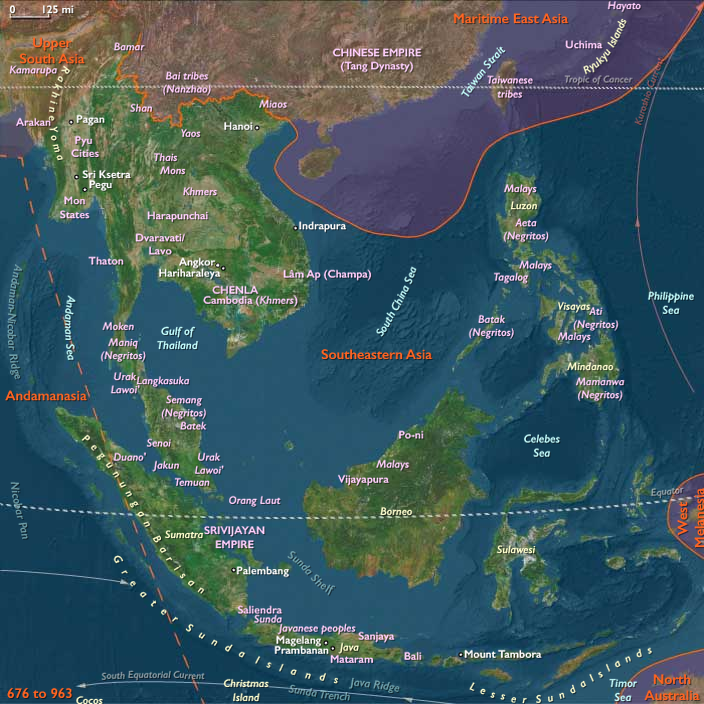
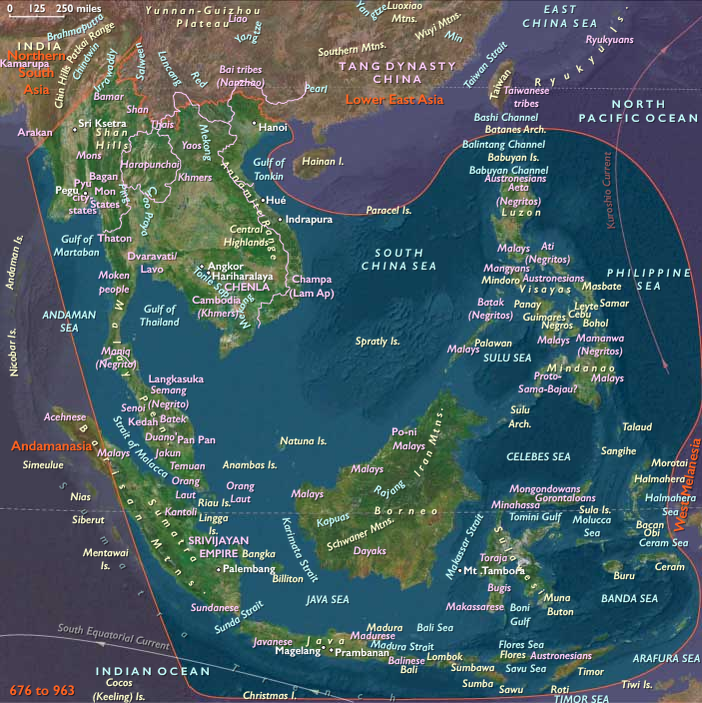
A monarch of central Java’s wealthy and powerful Saliendra dynasty establishes, in about 800, a major Buddhist monument at Borobudur, located about twenty-five miles (forty kilometers) from Jogjakarta.
The great shrine, built of dark gray volcanic stone with no interior spaces, crowns a small hill, and consists of a square base four hundred feet (one hundred and twenty-one meters) on each side.
Above the base are eight diminishing tiers of terraces—the lower five square, and bounded by a roofless corridor; the upper three unwalled and circular—connected by stairways.
From the uppermost terrace, a colossal stupa, or bell-shaped dome, rises another one hundred feet (thirty meters).
The walls of the lower five terraces of the great shrine feature intricately carved bands of narrative relief profusely illustrating the progress of the Bodhisattva in his striving for all-encompassing compassion.
The gently rounded contours of the ornate relief sculpture on each terrace depict a stage of the Bodhisattva’s development: the more mundane lower scenes contain moral lessons; the higher scenes, executed in a more severe and static in style, are more spiritual.
The upper three terraces carry seventy-two stupas containing large, stone-cut Buddha images, enclosed in stone latticework, which encircle the huge central stupa.
The complex in its entirety is an architectural mandala—the world’s largest—with the central stupa representing the world axis.
The walls of the lower five terraces of the great shrine feature intricately carved bands of narrative relief profusely illustrating the progress of the Bodhisattva in his striving for all-encompassing compassion.
The gently rounded contours of the ornate relief sculpture on each terrace depict a stage of the Bodhisattva’s development: the more mundane lower scenes contain moral lessons; the higher scenes, executed in a more severe and static in style, are more spiritual.
Locations
Groups
Topics
Subjects
Regions
Subregions
Years: 796 - 807
Locations
Groups
Topics
Subjects
Regions
Subregions