
A meeting takes place in Merseburg between …
Years: 1032 - 1032
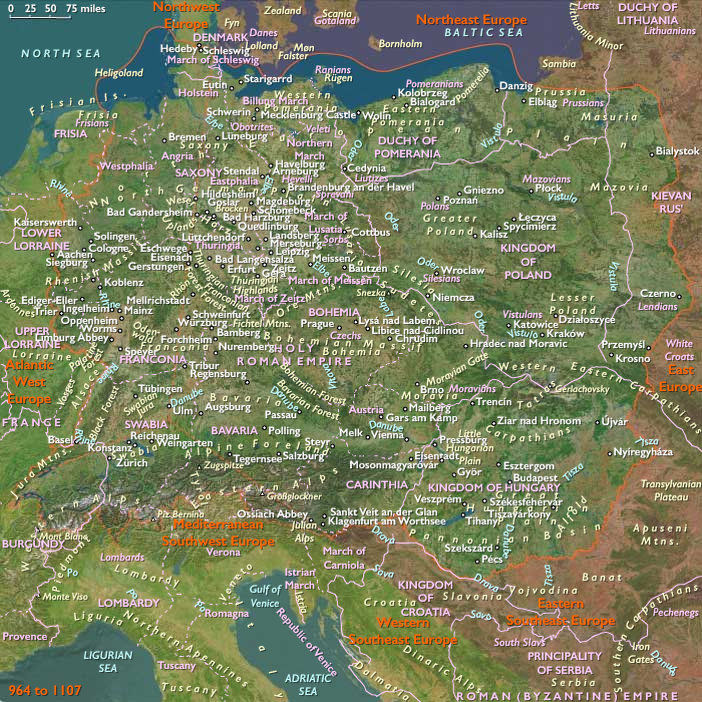
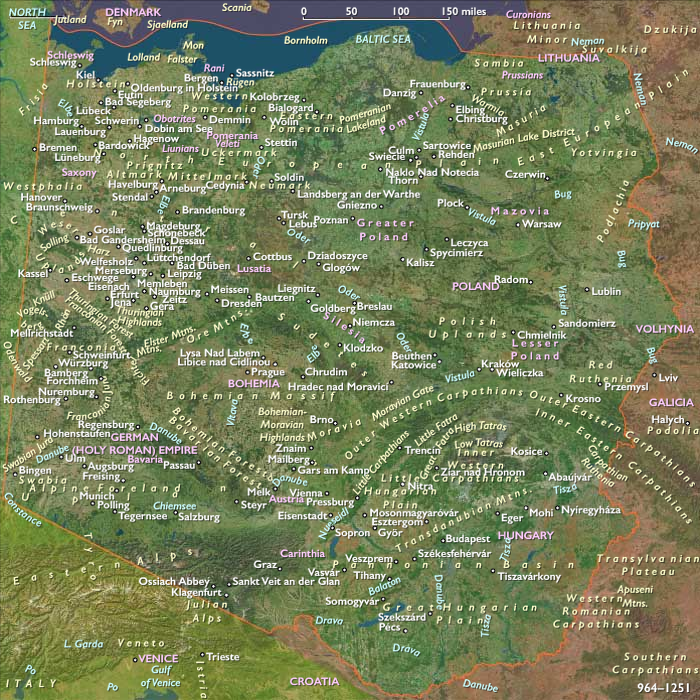
A meeting takes place in Merseburg between Conrad II and the surviving heirs of the Piast dynasty on July 7, 1032.
Mieszko II, lacking alternatives, is forced to surrender the royal title and agree to the division of Poland between him and the other two competitors: his brother Otto and a certain Dytryk, a cousin, grandson of Duke Mieszko I and his third wife Oda.
Mieszko II probably receives Lesser Poland and Masovia, Otto obtain Silesia, and Dytryk takes Greater Poland.
Another proposal speculates that Mieszko II received Greater Poland, and other neighborhoods were given to Otto and Dytryk.
Locations
People
Groups
- Polytheism (“paganism”)
- Christianity, Chalcedonian
- Bohemia, Duchy of
- Kievan Rus', or Kiev, Great Principality of
- German, or Ottonian (Roman) Empire
- Poland of the first Piasts, Kingdom of
Topics
Commodoties
Subjects
Regions
Subregions
Related Events
Filter results
Showing 10 events out of 51522 total
It is possible that the new rule of Duke Bezprym is attractive to the Polish population.
However, there probably remains a large group of supporters of the former ruler.
It is believed that Bezprym began his bloody persecution against them shortly after he began his government.
Many representatives of the Polish social elite are forced to flee as a result.
According to sources, some of them took refuge in Masovia.
Perhaps among the victims of the repression, there were two bishops, whose date of death is recorded in 1032 in the Chronicles of the Chapter of Kraków: Roman and Lambert.
The brutal fight with the opposition could have led to the above-mentioned Pagan Reaction, however it was probably instigated by discontent against the power of the Church and with the state apparatus.
Contemporary historiography places the riots in 1031–1032, during the reign of Bezprym.
The reaction isn't only of a religious background, but social.
It is primarily a reflection of the economic state caused by the aggressive policy of Boleslaw I the Brave and less successful rule of Mieszko II.
The defeat in battle in the west during that period has cut off the basic source of livelihood of the Polish troops, who are forced to loot the western lands.
As a result, the cost of maintaining the existence of an extensive army is probably too much for the population.
In addition, the devastating incursions of foreign troops is another cause of dissatisfaction among the citizenry.
The rule of Bezprym is extremely cruel and short.
According to the Chronicles of Hildesheim, he was murdered by his own men no later than spring of 1032.
Probably the instigators of his death were his half-brothers, although the main conspirator was Otto, who remains free in Germany.
The place of his burial is unknown.
As a result of Bezprym's rule, the Polish state has been substantially weakened, and the Polish throne remains vacant.
Mieszko II is still imprisoned in Bohemia and Otto probably in Germany.
German sources report that the Empero organized an expedition in order to invade Poland.
It is unknown what happened after this, but certainly Mieszko II was released by Duke Oldrich and he could return to the country.
After his recent opponent regains the power, the Emperor immediately reacts and begins the preparations for the expedition against Poland.
Mieszko II isn't prepared for the confrontation, so he uses his influence in the German court in order to resolve the conflict.
The queen dowager Mariam had paid a visit in 1030 to the new emperor Romanos III, negotiated a peace treaty, and returned with the high imperial title of curopalates for her son in 1032.
Mariam also brings him an imperial princess, Helena, as wife.
Helena is a daughter of Basil Argyros, brother of the emperor Romanos, and the marriage is a diplomatic effort to establish a strategic association.
However, Helena's death shortly afterwards at Kutaisi presents the Georgian court with the opportunity to pursue yet another diplomatic initiative through Bagrat's marriage with Borena, daughter of the king of Alania, a Christian country in the North Caucasus.
Ragusa (centered upon modern Dubrovnik), victimized by Dalmatian Muslim pirates, had joined Constantinople in 1030 in a series of naval wars against the raiders.
After their combined fleet crushes the pirates in the Adriatic in 1032, the imperial warships, manned chiefly by Scandinavian mercenaries, patrol the Mediterranean, winning several encounters over Muslim pirates and ravaging parts of North Africa's Muslim-controlled coast.
The revived German Empire annexes the kingdom of Burgundy, France’s junior partner, upon the death of Burgundy’s King Rudolph III in 1032.
Umberto, or Humbert, is the son of Amadeus (who was perhaps count of Maurienne).
His brother is Bishop Otto of Belley.
Umberto is the progenitor of the dynasty known as the House of Savoy.
The origins of this dynasty are unknown, but Humbert's ancestors are variously said to have come from Saxony, Burgundy or Provence.
Given Humbert's close connections with Rudolf III of Burgundy, it is likely that his family is Burgundian, and is descended either from the dukes of Vienne, or from or a Burgundian aristocratic family (such as the Guigonids, ancestors of the counts of Albon).
Umberto initially held lands around Belley and in the county of Sermorens, before gaining lands in Aosta and Valais.
He is also called Umberto the White-Handed, reportedly to signify his generosity.
However, this posthumously applied title may derive from a misreading of a late medieval record (in Latin) which actually refers to the walls of his castle (blancis moenibus), not his hands (blancis manibus), as white.
After Rudolf III’s death in 1032, Umberto I swears fealty to Emperor Conrad II.
He supports the emperor in his campaigns against Odo II, Count of Blois and Archbishop Aribert of Milan.
In return, Conrad appoints Umberto count of Savoy and grants him Maurienne, Chablais and perhaps Tarentaise.
Pietro Barbalano has struggled to bring Venice back together for the six years of his reign as Doge, but he cannot.
Because the Orseoli had created so many links between their family and the hereditary ruling dynasties of Europe, various actions have been taken against Venice as a retaliation for deposing Otto Orseolo.
Barbalano has tried to obtain from the Holy Roman Emperor, Conrad II, a renewal of the Venetian commercial privileges that had been granted to them by Otto III, but he has been unable to do so.
In the meantime, King Stephen of Hungary, whose sister Grimelda of Hungary is the wife of Otto Orseolo, has attacked Dalmatia and annexed a number of cities that had been captured by Pietro II.
The Republic appears to be collapsing and many people go back to supporting Otto Orseolo, though not the Orseolo family as hereditary rulers.
In 1032, Pietro Barbolano abdicates under heavy pressure and Otto Orseolo is called back to rule from his exile in Constantinople.
However, when the messengers arrive, Otto is approaching his death, causing Domenico Orseolo, his relative in Venice, to attempt to seize power.
This bold action is extremely ill-received in Venice as the populous displays its animosity for the notion that an Orseolo is somehow entitled to the Dogeship.
To counter the notion of instituting a royal family in Venice, Barbolano's successor, chosen in 1032, is the wealthy merchant Domenico Flabanico, who has few noble ties.
Under Flabanico, new laws are instilled to limit the powers of the Doge against creating a hereditary monarchy and many new acts are passed.
Alberic III, Count of Tusculum, obtains the Papal chair for his son Theophylact III (or IV), who is a nephew of Pope Benedict VIII and Pope John XIX, at the death of the latter in October 1032.
He reportedly leads an extremely dissolute life and allegedly had few qualifications for the papacy other than connections with a socially powerful family.
Alberic uses the title of consul, dux et patricius Romanorum: "consul, duke, and patrician of the Romans."
This signifies his secular authority in Rome.
He also bears the titular comes sacri palatii Lateranensis ("Count of the Sacred Lateran Palace"), which signifies his ecclesiastical function in the papal curia.
During the pontificate of his brother John XIX, he had been made a senator, but he had had to abandon this title for the aforementioned consular dignity in order to avoid tensions with the Emperor Henry II.
Alberic does not appear in sources after 1033, when he leaves the comital powers to his son, the newly elected pope.
Various revolts erupt in North Africa under Ali az-Zahir, the seventh Fatimid Khalif.
When Abul Kamal Tumin, rebelling against Fatimid rule, conquers Fes in 1032, killing six thousand Jews in the process, the Moroccan city’s Jewish community is decimated.
The Death of Constance of Arles and the Settlement of the Capetian Succession (1032)
On July 28, 1032, Queen Constance of Arles passed away, bringing an end to her tumultuous and politically charged reign. She was buried beside her husband, King Robert II, at the Basilica of Saint-Denis, the traditional resting place of French royalty. Her death marked the final resolution of the Capetian succession crisis, allowing Henry I to consolidate his rule.
Henry I’s Reconciliation with Robert of Burgundy
- Following Constance’s death, Henry I sought to ensure stability by placating his younger brother, Robert, who had been his mother’s favored candidate for the throne.
- To avoid further conflict, Henry granted Robert the Duchy of Burgundy, fulfilling a promise originally made by their father, Robert II, in 1016.
- This settlement secured Robert’s loyalty, preventing another dynastic rebellion and strengthening Capetian control over both the royal domain and the powerful Duchy of Burgundy.
Legacy and Impact
- Constance’s death removed the last major obstacle to Henry I’s uncontested reign, allowing him to focus on securing Capetian authority.
- The granting of Burgundy to Robert ensured that the duchy remained within the Capetian family, though it would later become a powerful and semi-independent rival to the French crown.
- With the Capetian succession crisis resolved, Henry I could finally shift his focus away from internal struggles and toward external threats, particularly the growing power of the Holy Roman Empire and Normandy.
Constance’s fierce political maneuvering had shaped the early Capetian monarchy, but in the end, Henry I emerged victorious, securing his throne through military force, political strategy, and family compromise.
Sancho VI of Gascony: His Reign and the Integration of Gascony into Navarre (c. 1009–1032)
Sancho VI of Gascony, son of William II Sánchez and Urraca of Navarre, played a key role in the complex feudal dynamics of southwestern France and northern Iberia. His reign saw close ties with Navarre, participation in the Reconquista, and significant political maneuvering that eventually led to Gascony falling under Navarrese influence after his death in 1032.
Ties to the Kingdom of Navarre
- Sancho VI spent part of his life at the court of Sancho III of Navarre in Pamplona, forging strong familial and political ties with the most powerful Iberian monarch of the time.
- He participated in the Reconquista, a clear sign of his alignment with Navarre’s military and religious objectives in the region.
- Some historians suggest that Sancho VI may have even submitted Gascony to the suzerainty of Navarre, though this remains speculative.
Relations with France and Aquitaine
- Unlike many of his contemporaries in France, Sancho never paid homage to the Capetian king, maintaining Gascony’s independence from direct French royal authority.
- In 1010, he appeared alongside Sancho III of Navarre, Robert II of France, and William V of Aquitaine at Saint-Jean d'Angély, demonstrating his diplomatic importance in the region.
- In 1027, he met William V at Blaye, where the two jointly selected Geoffrey, a Frank, as Archbishop of Bordeaux—a clear indication of Gascony’s political alignment with Aquitaine at the time.
- During his reign, Bordeaux became the de facto capital of Gascony, reflecting its growing importance as an ecclesiastical and administrative center.
Marriage Alliance with Aquitaine and Succession Crisis
- Sancho gave his sister, Brisca, in marriage to Duke William V of Aquitaine, forming a dynastic bondbetween the two regions.
- When Sancho VI died without direct heirs in October 1032, his Aquitanian nephews (William’s children by Brisca) inherited Gascony, shifting its control to the House of Poitiers-Aquitaine.
The Expansion of Navarrese Authority into Gascony
- After Sancho VI’s death, Sancho III of Navarre extended his influence into Gascony, effectively taking control of the duchy.
- Documents from Sancho III’s chancery begin mentioning his authority extending as far as the Garonne, marking the formal integration of Gascony into Navarre’s sphere of influence.
Legacy
- Sancho VI’s rule marked a turning point in the history of Gascony, leading to its gradual incorporation into the political structure of both Aquitaine and Navarre.
- His strong alliances with Navarre and Aquitaine helped shape the future power struggles in southwestern France and northern Spain.
- His death triggered a succession shift, reinforcing the House of Poitiers-Aquitaine’s claims while allowing Navarre to extend its dominion into Gascony.
Sancho VI’s reign highlights the fluid and often overlapping influences of medieval feudalism, where marriages, military alliances, and dynastic claims shaped territorial politics, setting the stage for centuries of shifting control between France and Iberian rulers.
Years: 1032 - 1032
Locations
People
Groups
- Polytheism (“paganism”)
- Christianity, Chalcedonian
- Bohemia, Duchy of
- Kievan Rus', or Kiev, Great Principality of
- German, or Ottonian (Roman) Empire
- Poland of the first Piasts, Kingdom of
