The Battle of …
Years: 911 - 911
July
The Battle of Chartres (911): A Decisive Defeat for Rollo and the Normans
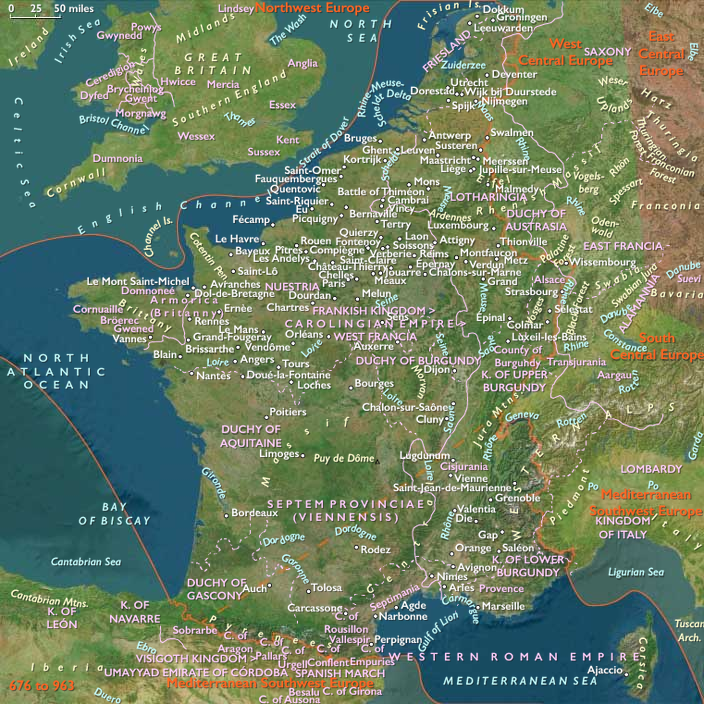
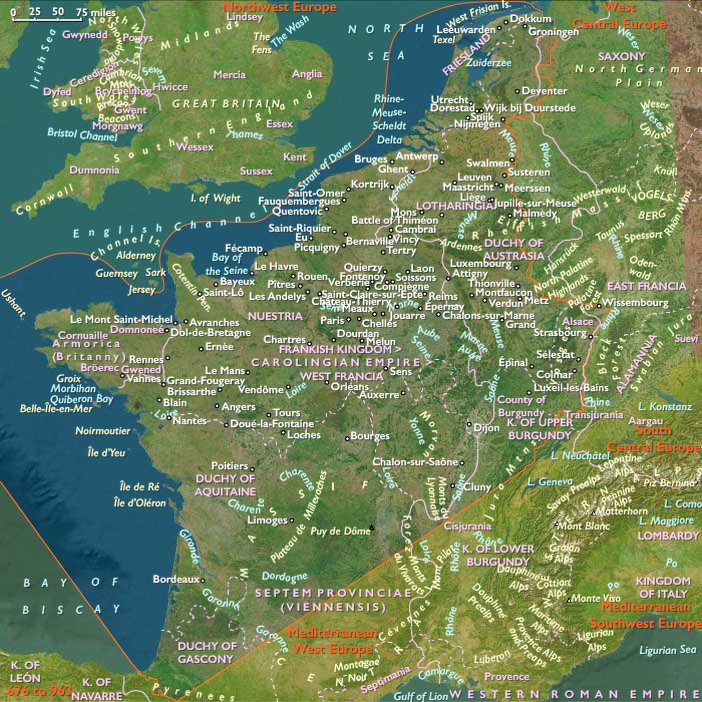
In 911, a Norman Viking force led by Rollo launches one of its final major raids into West Francia, attacking Paris before laying siege to Chartres. However, the Frankish resistance, led by Robert, Marquis of Neustria; Richard, Duke of Burgundy; and Manasses, Count of Dijon, successfully defeats the Normans at the Battle of Chartres on July 20, 911.
The Siege of Chartres and Bishop Joseaume’s Appeal
- Rollo’s Viking forces, having already attacked Paris, march south to lay siege to Chartres, a key Frankish stronghold.
- Bishop Joseaume of Chartres sends urgent appeals for military aid, fearing the city will fall to Norman plundering.
- His calls are answered by:
- Robert, Marquis of Neustria (later Robert I of France), one of the most powerful nobles in West Francia.
- Richard, Duke of Burgundy, a key defender of the southern Frankish frontier.
- Manasses, Count of Dijon, bringing additional Burgundian forces.
The Battle of Chartres (July 20, 911)
- Despite the absence of King Charles the Simple and many Frankish barons, the assembled Frankish force confronts Rollo’s army in open battle.
- The Normans are decisively defeated, suffering heavy losses.
- Rollo, seeing his forces weakened and unable to continue large-scale raiding, is forced to reconsider his position in West Francia.
Consequences of the Battle of Chartres
-
End of Large-Scale Viking Raids in Northern France
- The defeat weakens Rollo’s ability to conduct further raids, demonstrating that the Frankish nobles can effectively defend their lands.
-
Sets the Stage for the Treaty of Saint-Clair-sur-Epte (911)
- After his defeat at Chartres, Rollo negotiates peace with Charles the Simple, leading to the formal cession of Normandy to the Normans in exchange for military service and baptism.
-
Rise of the Robertians
- Robert, Marquis of Neustria, gains prestige and influence, laying the groundwork for his eventual rise to the French throne in 922 as Robert I.
Conclusion: A Turning Point for France and Normandy
The Battle of Chartres (911) is a decisive moment in Viking-Frankish relations, marking the last major Norse defeat before the foundation of Normandy. It forces Rollo to seek peace and paves the way for the Viking integration into Frankish society, shaping the future Duchy of Normandy and its role in medieval Europe.
Locations
People
Groups
Topics
Commodoties
Subjects
Regions
Subregions
Related Events
Filter results
Showing 10 events out of 53428 total
The infant Constantine, as Leo's only male offspring, must be accepted and, in 911, is proclaimed coemperor, as Constantine VII.
His surname, Porphyrogenitus (that is, born in the Purple Chamber of the Imperial Palace in Constantinople, as befits legitimate children of reigning emperors), pointedly answers the doubts expressed about the legitimacy of his birth in 905, which has slowed down his career and contributed to his shyness.
Sancho has involved himself in the squabbles among the Muslim lords to the south with repeated success.
In 907, he had turned on his former ally Lubb ibn Muhammad, killing him in battle.
Four years later, another former ally, Galindo Aznar, joins with his brother-in-law Muhammad al-Tawil and Abd Allah ibn Lubb ibn Qasi to attack Sancho, but they are defeated and neutralized as a threat.
Al-Tawil flees and is killed shortly afterward, and the power of the Banu Qasi is severely crippled, while Galindo is forced into vassalage to Sancho, leading to the incorporation of the County of Aragon into the Pamplona kingdom.
Tiaret begins to be fought over by a number of tribes, being first captured by Massala ibn Habbus of the Miknasas in the year 911, in alliance with the Fatimid Caliphate.
Æthelflaed, known as the Lady of the Mercians, rules Mercia on her own during the illness that precedes her husband’s death in 911 and thereafter on her own.
She builds fortresses and helps her brother Edward of Wessex recover areas held by the Danes.
The Treaty of Saint-Clair-sur-Epte (August 26, 911): The Foundation of Normandy
Following the Frankish victory at the Battle of Chartres in July 911, King Charles the Simple decides to negotiate with Rollo, the leader of the Norse settlers in northern France. The result is the Treaty of Saint-Clair-sur-Epte, concluded on August 26, 911, marking the official establishment of Norman rule in Francia.
Terms of the Treaty
The negotiations, led by Hervé, Archbishop of Reims, establish several key terms:
-
Territorial Grant to Rollo
- Rollo and his warriors are granted all land between the River Epte and the sea, which corresponds to the northern part of modern Upper Normandy down to the Seine.
- This land is granted "in freehold and good money", meaning Rollo holds it with full hereditary rights.
-
Grant of Brittany for "Livelihood"
- The treaty also grants Brittany to Rollo, despite the fact that Brittany is an independent territory that Francia has failed to conquer.
- However, at this time, Brittany is leaderless, as Alan I, King of Brittany, has died, and another group of Vikings occupies Brittany.
- In practice, this grant allows Rollo to raid or subjugate Brittany without interference from Charles.
-
Rollo’s Oath of Loyalty and Military Service
- In return for these lands, Rollo swears fealty to Charles, making him a vassal of the Frankish king.
- He agrees to provide military assistance to defend Francia, particularly against other Viking incursions.
-
Rollo’s Baptism and Marriage
- As a symbol of his commitment to the treaty, Rollo agrees to be baptized as a Christian.
- He also marries Gisela, a presumed illegitimate daughter of Charles the Simple, further integrating him into the Frankish aristocracy.
The Birth of Normandy
- The new territory granted to Rollo becomes the basis of the future Duchy of Normandy, which takes its name from the Norsemen (Normans) who rule it.
- Though initially a fief, likely a county, Normandy will later be elevated to a duchy as its rulers consolidate power.
- The lack of surviving written records of its exact creation suggests that its status as a duchy evolves gradually over time.
Consequences of the Treaty
-
The End of Major Viking Raids in Northern Francia
- Rollo and his men transition from raiders to rulers, effectively securing northern Francia from further Norse invasions.
- With Viking forces now serving as defenders of the Seine, they block other Norse warbands from raiding further inland.
-
The Integration of the Norse into Frankish Society
- Rollo’s baptism and marriage mark the beginning of Norman assimilation into Frankish culture, language, and governance.
- The Norse settlers intermarry with the local Gallo-Roman and Frankish populations, creating a unique Norman identity that blends Viking warrior traditions with Frankish feudal customs.
-
Brittany’s Continued Turmoil
- Though nominally granted to Rollo, Brittany remains contested and continues to be a region of instability.
- The Bretons will eventually reclaim independence, resisting Frankish and Norman control.
-
Normandy as a Future Powerhouse
- The Duchy of Normandy will grow into one of the most powerful feudal states in medieval France.
- In 1066, Duke William II of Normandy (William the Conqueror) will invade England and establish Norman rule over England, reshaping European history.
Conclusion: A Turning Point in European History
The Treaty of Saint-Clair-sur-Epte (911) represents a strategic shift in Viking-Frankish relations, as the Norse stop raiding and start ruling. Rollo’s new Norman state ensures that northern Francia remains secure, while the Normans themselves emerge as one of the most dynamic forces in medieval Europe, influencing France, England, and beyond.
Louis, only seventeen or eighteen years old, dies in a state of despair at Frankfurt am Main on September 20 or 24, 911.
He is buried in the monastery of Saint Emmeram in Regensburg, where his father Arnulf of Carinthia lies.
His death brings an end to the eastern (German) branch of the Carolingian dynasty.
The vacuum left in the Carolingian East will eventually be filled by the family of Henry the Fowler, a cousin, and heralds the beginning of the Ottonian dynasty.
Firstly, however, the dukes of East Francia assemble to elect Conrad of Franconia king, as opposed to the reigning king of West Francia, Charles the Simple.
The magnates of Lotharingia elect Charles.

Lotharingia Shifts Allegiance to West Francia After Louis the Child’s Death (911)
With the death of Louis the Child, the last Carolingian ruler of East Francia, in 911, the kingdom is left without a direct Carolingian heir. As a result, Lotharingia (Lorraine) becomes the only East Frankish duchy to break away, transferring its allegiance to Charles the Simple, King of West Francia.
Why Does Lotharingia Join West Francia?
-
Weakness of East Francia After Louis the Child
- With Louis the Child’s death, East Francia is without a Carolingian ruler, and the throne passes to Conrad I of Franconia, a non-Carolingian noble elected by the East Frankish nobility.
- Lotharingian nobles, however, are reluctant to accept Conrad, preferring the legitimacy of the Carolingian dynasty.
-
Charles the Simple’s Carolingian Lineage
- Charles the Simple, King of West Francia, is a direct Carolingian, making him a more legitimate ruler in the eyes of the Lotharingian aristocracy.
- Seeking a stronger royal protector, the Lotharingians swear allegiance to Charles rather than to the East Frankish king, Conrad I.
-
Lotharingian Nobles Seeking Greater Autonomy
- Lotharingia had long been a contested border region between East and West Francia.
- By siding with Charles, the Lotharingian nobility likely hoped to increase their independence and retain control over their own affairs.
The Political Impact of Lotharingia’s Shift
- Conrad I of East Francia views Lotharingia’s defection as a direct challenge to his authority, leading to decades of conflict over the region.
- Charles the Simple strengthens his position in West Francia, but his hold over Lotharingia will remain fragile, as tensions between East and West Francia persist over the region.
- The Lotharingian identity as a borderland between France and Germany continues to define its political and cultural history for centuries.
The Beginning of the Lotharingian Conflict Between France and Germany
Lotharingia’s shift to West Francia in 911 is a crucial moment in Frankish history, as it sets the stage for centuries of Franco-German rivalry over the region. Eventually, in 925, Lotharingia will be reabsorbed into the East Frankish realm, marking the continued struggle between France and the Holy Roman Empire for control over the territory.
Igor, supposedly the son of legendary Varangian adventurer Rurik of Novgorod (who died around 879), rules Kiev (according the Russian Primary Chronicle) at the death of Rurik’s successor, Oleg.
Constantine Zuckerman, drastically revising the chronology of the Primary Chronicle, argues that Igor actually reigned for three years, between summer 941 and his death in early 945.
He explains the epic thirty-three-year span of his reign in the chronicle by its author's faulty interpretation of Byzantine sources.
Indeed, the chronicle records none of Igor's activities prior to 941.
Arnulf, besieged by frequent raids by the Hungarians and desperate to raise funds to finance a defense, strengthens his power through confiscation of church lands and property, which earns him the nickname "the Bad".
He reestablishes the stem duchy of Bavaria and eventually negotiates a truce with the Hungarians, who hereafter largely pass through Bavaria on their raids into other German territories.
Alexander, the brother of Leo VI, crowned co-emperor by his father Basil I in about the year 879, succeeds his brother on May 11, 912, as senior emperor alongside Leo's young son Constantine VII.
He is the first of Constantinople’s emperors to use the term "autocrator" on coinage to celebrate the ending of his thirty-three years as co-emperor.
Alexander promptly dismisses most of Leo's advisers and appointees, including the admiral Himerios, the patriarch Euthymios, and the Empress Zoe Karbonopsina, the mother of Constantine VII whom he locks up in a nunnery.
The patriarchate is again conferred on Nicholas Mystikos, who had been removed from this position because he had opposed Leo's fourth marriage.